Felis catus
Exotic Longhair
 Featured photoexotic-longhair.jpg
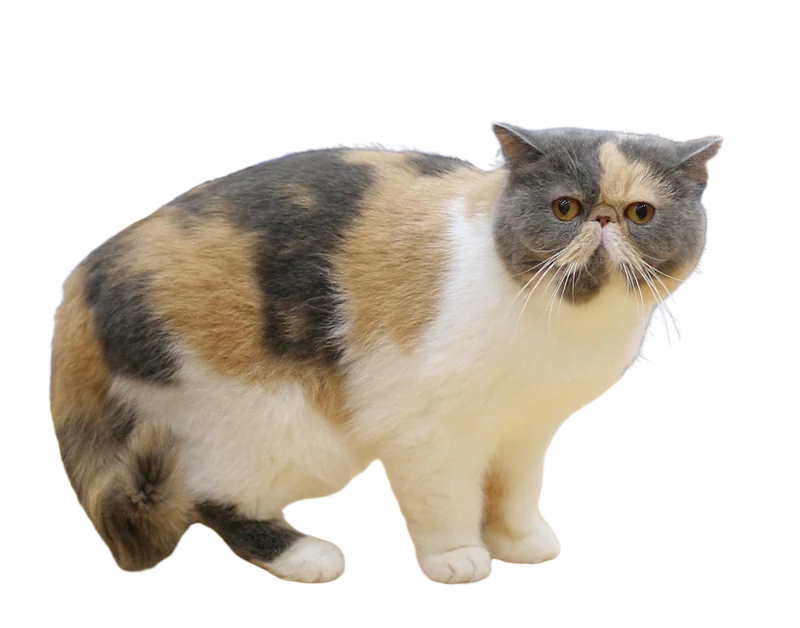
The Exotic Longhair is the longhaired counterpart of the Exotic Shorthair, arising when the recessive longhair gene (l) is present in both parents. FIFe classifies it as a separate Category 1 breed distinct from the Persian; GCCF and WCF likewise register it independently. In CFA and TICA, longhaired Exotics compete in the Persian class rather than as a distinct breed. The standard describes the same type as the Exotic Shorthair — cobby body, flat face, large round eyes — but with a longer, denser coat requiring more grooming than the plush shorthair version.
Quick facts
- Origin country
- United States (developed from Exotic Shorthair programme)
- Origin period
- 1960s Exotic Shorthair programme; FIFe separate recognition established
- Coat type
- Long
- Coat colors
- All Persian/Exotic colour classes recognized
- Size category
- Medium
- Average lifespan
- 10-15 years
- Recognition
- —
Origin
The Exotic Longhair arises as a natural genetic consequence of the Exotic Shorthair breeding programme. When two Exotics carrying the recessive longhair allele (l) are mated, approximately one-quarter of the offspring are longhaired. CFA classifies these kittens as Persians; FIFe, GCCF, and WCF register them as the distinct Exotic Longhair breed, reflecting their Exotic-programme origin rather than the traditional Persian lineage.
Recognition
FIFe classifies the Exotic Longhair as a separate Category 1 breed, separate from both Exotic (Shorthair) and Persian. GCCF and WCF maintain the same distinction. The Cat Fanciers' Association and The International Cat Association do not separately recognize the Exotic Longhair, registering longhaired Exotic offspring in the Persian breed instead.
Standard
The FIFe standard for the Exotic Longhair describes the same extreme Persian type as the Exotic Shorthair — a compact, cobby body, short thick neck, broad round head with small ears, large round eyes, and a flat (peke) face — but with a long, dense coat that stands away from the body. The coat is thinner than a traditional Persian's but requires similar grooming. All color and pattern classes recognized in the Persian and Exotic programs apply to the Exotic Longhair.
Sources & further reading (2)
- encyclopedia — accessed 2026-05-27
- registry-breed-profile — accessed 2026-05-27
Frequently asked questions
How is the Exotic Longhair different from a Persian?
The Exotic Longhair has the same flat-face cobby type as the Persian but originates from the Exotic Shorthair breeding programme rather than the traditional Persian lineage. FIFe, GCCF, and WCF register them as separate breeds. In CFA and TICA, longhaired Exotics are classified as Persians and compete in Persian championships.
Which registries recognize the Exotic Longhair as a distinct breed?
The Fédération Internationale Féline (FIFe), the Governing Council of the Cat Fancy (GCCF), and the World Cat Federation (WCF) all register the Exotic Longhair as a breed separate from both the Exotic Shorthair and the Persian. The Cat Fanciers' Association and TICA do not maintain this distinction, classifying longhaired Exotics within the Persian breed.
Do Exotic Longhairs shed more than Exotic Shorthairs?
Yes. The Exotic Longhair's full Persian-length coat sheds more heavily than the Exotic Shorthair's short, plush coat, particularly during seasonal transitions. Owners typically brush the coat two to three times per week to manage shedding and prevent matting. In this respect, the Exotic Longhair's maintenance needs are equivalent to those of the Persian.