Hero
Orpheus
Divine musician of Greek mythology who descended to the underworld for love.
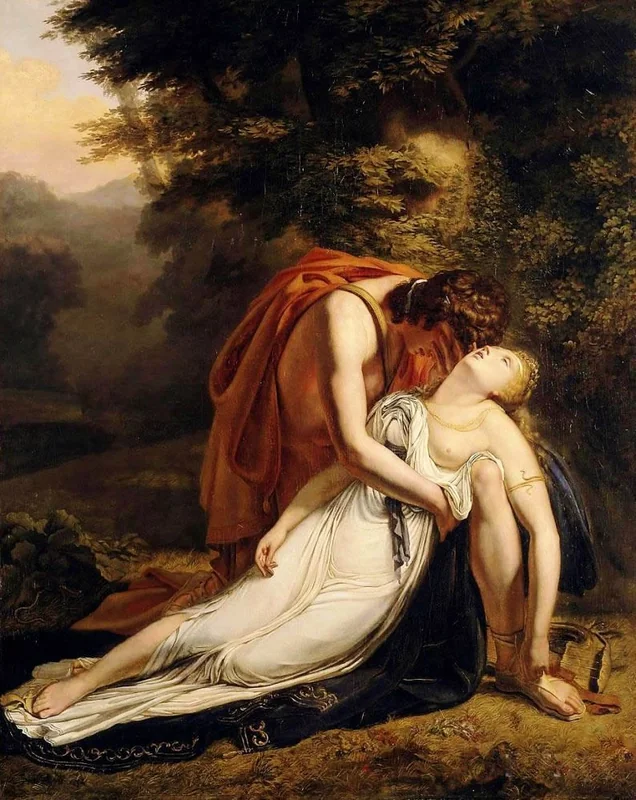
Orpheus is the supreme musician and poet of Greek mythology, son of the Thracian river god Oeagrus and the Muse Calliope. His lyre-playing could charm stones, trees, animals, and rivers. When his wife Eurydice died from a snake-bite, Orpheus descended to the underworld and charmed Persephone and Hades with his music, winning Eurydice's return — on condition that he not look back. He failed to keep this condition. Later torn apart by Bacchic women (Maenads), his head and lyre continued to make music after death. He sailed as an Argonaut and founded the Orphic mystery religion.
Quick facts
- Pantheon
- Greek
- Figure type
- Hero
- Period
- Legendary figure; placed in the generation before the Trojan War in ancient tradition
- Primary sources
- Apollodorus Bibliotheca 1.3.2; Apollodorus Bibliotheca 1.9.16 (Argonauts); Virgil Georgics 4.453–527 (in Latin, but transmitting earlier Greek tradition); Ovid Metamorphoses 10.1–77
- Related figures
- eurydice, hades, persephone, jason
- Constellation link
- Lyra Constellation (Lyra)
Orpheus and Eurydice
The myth of Orpheus's descent to Hades to retrieve his dead wife Eurydice is one of the most celebrated in Greek mythology. Apollodorus (Bibliotheca 1.3.2) and Virgil's Georgics (4.453–527) narrate the core story. Orpheus played his lyre so movingly that the wheels of Ixion's torment stopped turning, Tantalus forgot his thirst, Sisyphus sat on his rock, and Persephone and Hades wept. The rulers of the underworld agreed to let Eurydice return, on one condition: Orpheus must not look back at her until they reached the upper world. On the very threshold of Hades, Orpheus turned to look. Eurydice was immediately taken back.
Death and the Lyre
After losing Eurydice a second time, Orpheus either swore never to love another woman or spurned the Thracian women's advances. Offended, the Maenads (Bacchic women) tore him apart during a Dionysiac festival (Apollodorus 1.3.2). His severed head floated down the River Hebrus to the sea, still singing; it came ashore on the island of Lesbos, which became famous for lyric poetry. The lyre was set among the stars as the constellation Lyra (Eratosthenes Catasterismi 24). The Orphic mystery religion, which promised initiates special knowledge of the afterlife, attributed its sacred texts to Orpheus.
Sources & further reading (2)
- primary-source — accessed 2026-05-06
- encyclopedia — accessed 2026-05-06
Frequently asked questions
What is the constellation Lyra named after?
The constellation Lyra, containing the bright star Vega (the fifth-brightest star in the night sky), represents the lyre of Orpheus. Ancient sources including Eratosthenes (Catasterismi 24) and Hyginus (Astronomica 2.7) record that Hermes invented the lyre and gave it to Apollo, who passed it to Orpheus. After Orpheus's death, his lyre was placed among the stars. The constellation Lyra is one of Ptolemy's original 48 constellations (Almagest, c. 150 CE).
What are the Orphic mysteries?
The Orphic mysteries were a set of ancient Greek religious texts and practices attributed to Orpheus. They taught a distinctive cosmogony (Orphic Theogonies), an account of the soul's fate after death, and ritual instructions for achieving a better afterlife. Orphic gold tablets, found in burials from the 5th century BCE onward across the Greek world, record instructions for the soul's journey in the underworld. The tradition drew on earlier Hesiodic and Homeric themes but diverged significantly in cosmogony and eschatology.