Hero
Achilles
Greatest Greek warrior of the Trojan War, hero of Homer's Iliad.
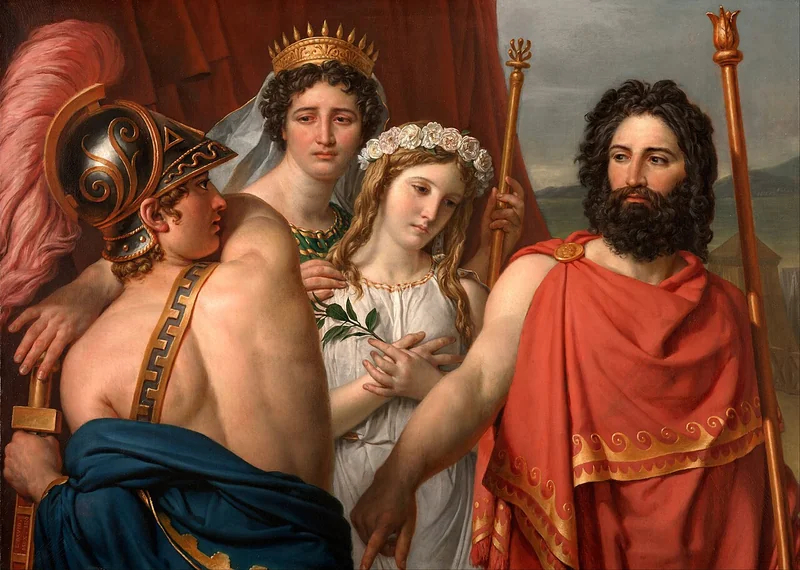
Achilles is the central hero of Homer's Iliad and the greatest warrior in the Greek forces at Troy. Son of the mortal Peleus and the sea-nymph Thetis, he is swift-footed, nearly invulnerable, and possessed of tremendous martial prowess. The Iliad narrates the wrath of Achilles — his quarrel with the Greek commander Agamemnon, his withdrawal from battle, the death of his companion Patroclus at the hands of the Trojan prince Hector, and his return to combat to avenge Patroclus. His death, from an arrow in the heel shot by Paris and guided by Apollo, occurs after the Iliad ends but is alluded to within it.
Quick facts
- Pantheon
- Greek
- Figure type
- Hero
- Period
- Mythological hero; tradition places him in the Trojan War, c. 1200 BCE in ancient reckoning
- Primary sources
- Homer Iliad 1.1–7 (proem: 'the wrath of Achilles'); Homer Iliad 18.1–147 (death of Patroclus); Homer Iliad 24.1–804 (Achilles and Priam); Apollodorus Bibliotheca 3.13.6
- Related figures
- hector, patroclus, odysseus, ajax, hephaestus, thetis
The wrath of Achilles
Homer's Iliad begins with its famous first line: 'Sing, goddess, of the wrath of Achilles son of Peleus, the destructive wrath that brought ten thousand griefs upon the Achaeans' (Iliad 1.1–2). The quarrel between Achilles and the commander Agamemnon arises when Agamemnon takes from Achilles the captive woman Briseis. Achilles withdraws from battle, asking his mother Thetis to persuade Zeus to let the Trojans prevail, to demonstrate his own worth to the Greeks. The Greek army suffers greatly in his absence. The narrative returns to Achilles only when his closest companion Patroclus is killed by Hector (Iliad 16).
Death and legacy
Achilles's own death is not narrated in the Iliad, which ends before it occurs, but the text alludes to it multiple times. The Iliad predicts that Achilles must choose between a long inglorious life and a short glorious one, and he has chosen the latter (Iliad 9.410–416). Later sources (Apollodorus Epitome 5.3) record that Paris shot Achilles with an arrow guided by Apollo. The arrow struck the heel — the one vulnerable point on Achilles's body. In the tradition recorded by Statius (Achilleid, 1st century CE), Thetis had dipped the infant Achilles in the River Styx to make him invulnerable, holding him by the heel; that spot remained mortal.
Sources & further reading (2)
- primary-source — accessed 2026-05-06
- encyclopedia — accessed 2026-05-06
Frequently asked questions
What is the Achilles heel?
The 'Achilles heel' refers to the myth that Achilles was invulnerable everywhere except his heel — the spot by which his mother Thetis held him when she dipped him in the River Styx to make him immortal. The motif of the single vulnerable spot appears in Statius's Achilleid (late 1st century CE), a later elaboration of the Homeric tradition. In Homer's Iliad itself there is no mention of this vulnerability; Achilles is simply a mortal with extraordinary prowess. The phrase 'Achilles heel' has become a common idiom for any critical vulnerability.
Who is Patroclus in relation to Achilles?
Patroclus is the closest companion of Achilles throughout the Iliad. When Achilles withdraws from battle after his quarrel with Agamemnon, Patroclus eventually persuades him to allow the use of his armour and leads the Myrmidons into battle. Patroclus is killed by the Trojan hero Hector (Iliad 16.818–863). Achilles's grief at Patroclus's death drives him to return to battle and slay Hector, the climax of the Iliad. The close bond between Achilles and Patroclus is among the most prominent relationships in ancient Greek literature.