Lyr · Lyrae
Lyra Constellation
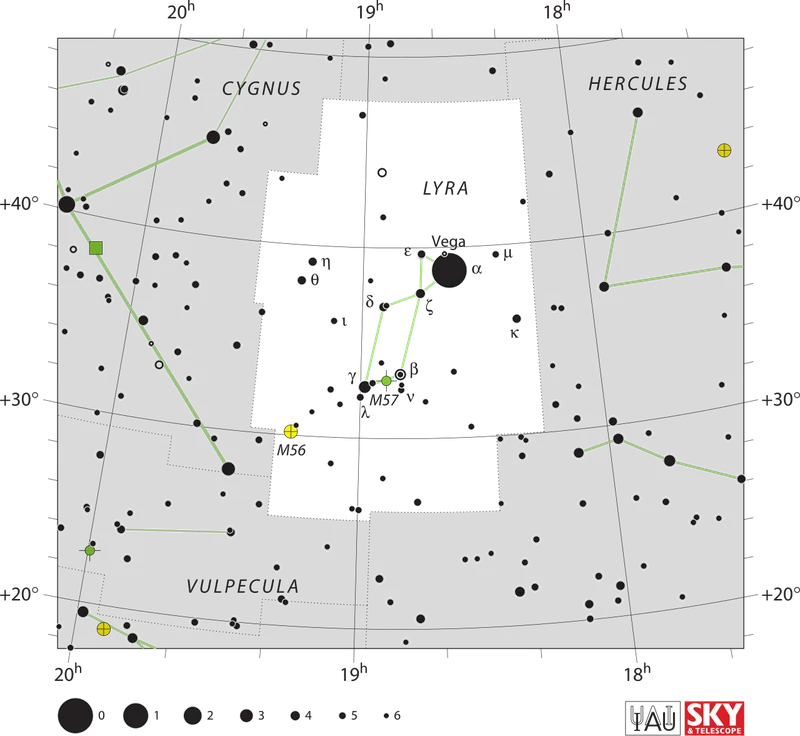 IAU constellation mapLyr
Lyra (Lyr) is one of the 88 constellations recognised by the International Astronomical Union. It covers 286 square degrees of the northern sky in quadrant NQ4. Its brightest star is Vega. The Latin genitive of the name is Lyrae, used to form star names within the constellation. In Greek mythology, Lyra is associated with greek tradition. The IAU standardised all constellation boundaries in 1930.
Quick facts
- IAU name
- Lyra
- Abbreviation
- Lyr
- Latin genitive
- Lyrae
- Hemisphere
- northern
- Area
- 286 sq deg
- Brightest star
- Vega
- Quadrant
- NQ4
- Family
- Hercules
- Mythology origin
- Greek
- Discovery era
- Ptolemy's 48 (Almagest, c. 150 CE)
Mythology
Lyra, the Lyre, represents the instrument of Orpheus, the legendary musician whose playing was so beautiful that it could charm wild animals, halt rivers in their courses, and even move rocks and trees. When Orpheus's wife Eurydice died from a snakebite, he descended into the underworld and played so movingly before Hades and Persephone that they agreed to release her, on the condition that Orpheus not look back at her as they ascended. He could not resist, looked back at the last moment, and lost her forever. After his death (he was torn apart by Maenads, the ecstatic followers of Dionysus, enraged either by his rejection of women after losing Eurydice or by his devotion to Apollo), the Muses gathered his remains and placed the Lyre in the sky in his memory. Vega (Alpha Lyrae), the constellation's brilliant blue-white star at magnitude 0.03, is the fifth brightest star in the night sky and only 25 light-years from Earth. It served as the northern pole star around 12,000 BCE and will do so again in about 13,800 CE due to the precession of the equinoxes. The Ring Nebula (Messier 57) in Lyra is one of the most photographed planetary nebulae.
Sources: Ovid Metamorphoses 10.1-77; Hyginus Astronomica 2.7; Aratus Phaenomena 268-274.
Overview
Lyra is one of the 88 constellations formally recognised by the International Astronomical Union (IAU). It occupies 286 square degrees of sky in the northern hemisphere sky, best visible at latitudes between +90 and -60 degrees in September. The constellation belongs to the Hercules family of constellations. Its Latin genitive is Lyrae, the form used when naming stars within the constellation — for example, the brightest star Vega may appear in catalogues as Alpha Lyrae or similar. The IAU standardised the boundaries of all 88 constellations in 1930 under the direction of Eugène Delporte, using straight lines of right ascension and declination to eliminate the ambiguities of earlier variable-boundary systems.
Notable stars
The brightest star in Lyra is Vega. Individual stars within Lyra are conventionally named using Bayer designation — Greek letters followed by the Latin genitive of the constellation name (Lyrae) — introduced by Johann Bayer in his 1603 star atlas Uranometria. Flamsteed numbers (numeric designators followed by Lyra) were added by John Flamsteed in his 1712 catalogue. Variable stars, double stars, and deep-sky objects within the Lyra boundary are catalogued by the IAU with the abbreviation Lyr.
History and mythology
The figure of Lyra appears in the classical astronomical tradition. Ptolemy included this constellation in the Almagest (c. 150 CE), the definitive ancient catalogue of 48 constellations, which formed the foundation for Islamic, medieval European, and Renaissance astronomy. The constellation's figure and mythology were transmitted through works such as Aratus's Phaenomena, Eratosthenes's Catasterismi, and Hyginus's Astronomica. See the Mythology section above for the full narrative.
Sources & further reading (2)
- official-iau — accessed 2026-05-06
- encyclopedia — accessed 2026-05-06
Frequently asked questions
What does the name Lyra mean?
Lyra is the Latin name used by the IAU to designate this constellation. The name comes from classical Latin and Greek astronomical tradition. In star catalogues, stars within Lyra are designated using the genitive form of the name (e.g. Alpha Lyra or similar Latin genitive forms) — a naming convention introduced by Johann Bayer in his 1603 atlas Uranometria and still in use today.
How large is Lyra compared to other constellations?
Lyra covers 286 square degrees of sky. The full sphere of the sky contains 41,253 square degrees, so Lyra occupies about 0.7% of the total sky. For comparison, the largest constellation is Hydra at 1303 square degrees; the smallest is Crux at 68 square degrees.
When and where is Lyra visible?
Lyra is primarily a northern hemisphere constellation, best seen from mid-northern latitudes. Southern hemisphere observers may see it low on the horizon depending on their latitude. The brightest star, Vega, serves as the main visual anchor for locating the constellation. As with all constellations, the best viewing conditions are a dark sky away from artificial light pollution, with the constellation high enough above the horizon to minimise atmospheric absorption.