Hero
Andromeda
Ethiopian princess of Greek mythology rescued from a sea monster by Perseus.
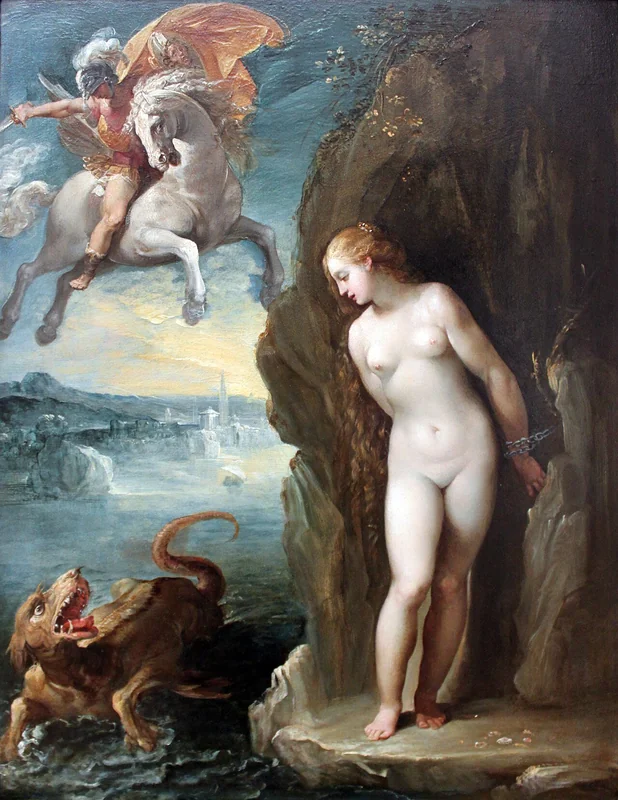
Andromeda is the daughter of King Cepheus and Queen Cassiopeia of Aethiopia (ancient Ethiopia) in Greek mythology. When her mother Cassiopeia boasted that Andromeda was more beautiful than the sea-nymphs (Nereids), Poseidon sent the sea monster Cetus to ravage the kingdom. To appease the monster, Andromeda was chained to a sea-cliff as a sacrifice. The hero Perseus, returning from slaying Medusa, saw her, fell in love, and slew Cetus in exchange for her hand in marriage. After her death she was placed among the stars as the constellation Andromeda. The myth is narrated by Apollodorus (Bibliotheca 2.4.3).
Quick facts
- Pantheon
- Greek
- Figure type
- Hero
- Period
- Mythological tradition; set in the same generation as Perseus
- Primary sources
- Apollodorus Bibliotheca 2.4.3–5; Ovid Metamorphoses 4.663–739; Aratus Phaenomena 197–204
- Related figures
- perseus, cassiopeia, cepheus, poseidon
- Constellation link
- Andromeda Constellation (Andromeda)
Andromeda and Cetus
Apollodorus (Bibliotheca 2.4.3) narrates that Cassiopeia's boast that Andromeda surpassed the Nereids in beauty enraged Poseidon, who sent the sea monster Cetus to devastate the coast of Aethiopia. An oracle told Cepheus that the only remedy was to sacrifice his daughter Andromeda to the monster. She was chained to a rock by the sea. Perseus, flying overhead after beheading Medusa (he was returning on Pegasus in some versions, or on his winged sandals), saw Andromeda and fell in love. He negotiated with Cepheus for her hand and slew Cetus. Andromeda became his wife.
Constellation
After her death, Andromeda was placed among the stars as the constellation Andromeda, described by Aratus (Phaenomena 197–204) and Eratosthenes (Catasterismi 17). The constellation is depicted in ancient star atlases as a woman with arms outstretched, chained. It is one of Ptolemy's 48 constellations (Almagest, c. 150 CE). The Great Andromeda Galaxy (Messier 31), the nearest large galaxy to our own Milky Way at 2.537 million light-years, lies within the constellation boundaries.
Sources & further reading (2)
- primary-source — accessed 2026-05-06
- encyclopedia — accessed 2026-05-06
Frequently asked questions
What constellation is named after Andromeda?
The constellation Andromeda is an IAU-recognised constellation covering 722 square degrees in the northern sky, one of Ptolemy's original 48 (Almagest, c. 150 CE). It represents Andromeda chained to a rock before Perseus's rescue. Its most notable feature is the Andromeda Galaxy (Messier 31), the nearest major galaxy to the Milky Way, visible to the naked eye on dark nights as a faint fuzzy patch. The Andromeda constellation is best seen in autumn in the northern hemisphere.
Who was Cassiopeia, Andromeda's mother?
Cassiopeia was the queen of Aethiopia and wife of King Cepheus, best known in Greek mythology for her vain boast that she (or her daughter Andromeda) was more beautiful than the sea-nymphs (Nereids), which angered Poseidon and led to the chain of events that endangered Andromeda. After her death, Cassiopeia was placed among the stars as the constellation Cassiopeia — depicted seated on a throne, and notably placed in a position where she sometimes appears upside-down, as a continued punishment for her vanity (Aratus Phaenomena 198–200).