God
Aphrodite
Goddess of love, beauty, and desire in Greek mythology.
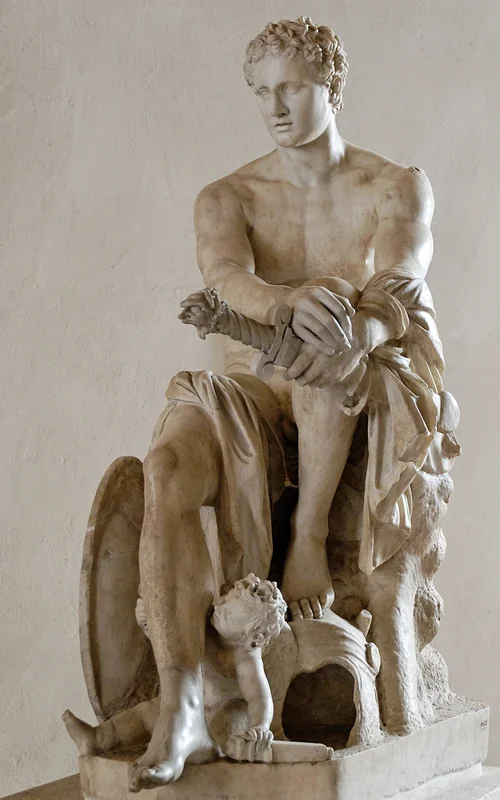
Aphrodite is the Olympian goddess of love, beauty, pleasure, and procreation in Greek mythology. According to Hesiod's Theogony, she arose from the sea foam near Cyprus after the severed genitals of the sky-god Ouranos fell into the sea. In Homer's Iliad, she is the daughter of Zeus and Dione. She is married to Hephaestus but had a famous love affair with Ares. Aphrodite is associated with Cyprus (her cult centres at Paphos and Amathus) and the myrtle, dove, and sparrow. Her Roman counterpart is Venus.
Quick facts
- Pantheon
- Greek
- Figure type
- God
- Period
- Attested from the 8th century BCE; possibly of Near Eastern origin (cf. Ishtar/Astarte)
- Primary sources
- Hesiod Theogony 188–206; Homer Iliad 5.311–430; Homeric Hymn 5 (To Aphrodite); Homer Odyssey 8.266–366
- Related figures
- ares, hephaestus, hermes, adonis, eros
Birth from the sea
Hesiod's Theogony (188–206) records the cosmogonic birth of Aphrodite. When Cronus severed the genitals of his father Ouranos with a sickle and cast them into the sea, white foam (aphros) gathered around them. From this foam Aphrodite arose, first reaching the island of Cythera and then Cyprus. This 'sea-born' origin (Anadyomene, 'rising from the sea') is the scene depicted in later iconic works such as Botticelli's The Birth of Venus (1484–1486). Homer's Iliad gives a different account, listing Aphrodite as the daughter of Zeus and the Titaness Dione (Iliad 5.370–371) — an older genealogy that connects her to the broader Olympian family.
The Judgment of Paris and the Trojan War
The Homeric Hymn to Aphrodite and later sources record that three goddesses — Hera, Athena, and Aphrodite — competed for a golden apple inscribed 'to the fairest' (the apple of Eris). Zeus delegated the judgment to the Trojan prince Paris. Each goddess offered Paris a bribe; Aphrodite offered him the most beautiful woman in the world, Helen of Sparta. Paris chose Aphrodite, whose subsequent help to Paris and the Trojans in obtaining Helen set in motion the Trojan War. This myth, the 'Judgment of Paris,' underlies the entire plot of Homer's Iliad.
Sources & further reading (2)
- primary-source — accessed 2026-05-06
- encyclopedia — accessed 2026-05-06
Frequently asked questions
What are the two accounts of Aphrodite's birth?
There are two main accounts in ancient sources. Hesiod's Theogony (188–206) states that Aphrodite arose from the sea foam (aphros) created when Cronus threw the severed genitals of Ouranos into the sea near Cyprus — this is the 'sea-born' tradition. Homer's Iliad (5.370–371) gives a simpler genealogy: Aphrodite is the daughter of Zeus and the Titaness Dione. Both traditions were current in ancient Greece; they may represent different regional cult traditions.
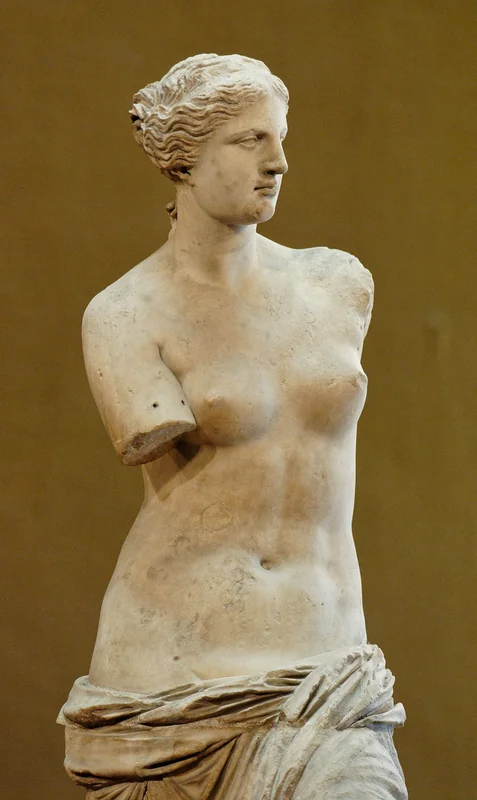
What is the Venus de Milo?
The Venus de Milo is an ancient Greek marble statue found in 1820 on the Aegean island of Milos and now in the Louvre Museum, Paris. Dating to c. 130–100 BCE, it depicts Aphrodite (Venus to the Romans) and is considered one of the greatest masterpieces of ancient sculpture. The statue's missing arms have been the subject of much speculation. Its discovery caused great excitement in 19th-century Europe and it became a defining image of classical beauty.