God
Apollo
God of the sun, music, poetry, prophecy, and healing in Greek mythology.
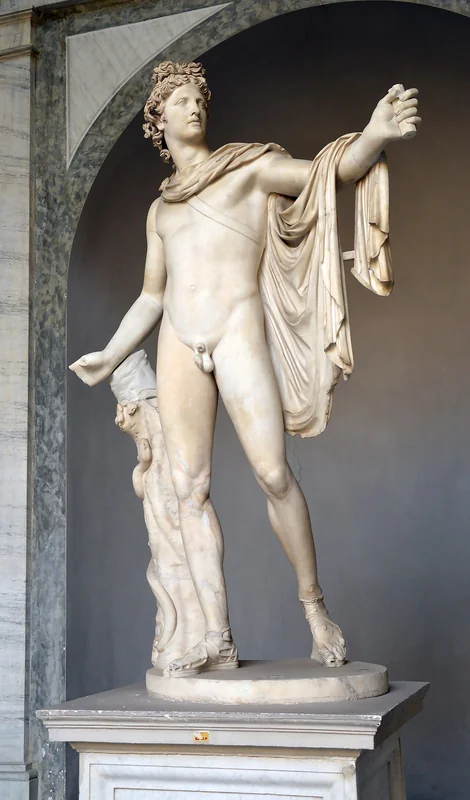
Apollo is one of the twelve Olympian gods and one of the most widely venerated deities in ancient Greece and Rome. Son of Zeus and the Titaness Leto, and twin brother of Artemis, he was born on the island of Delos. Apollo governs the sun, light, music, poetry, art, prophecy, truth, archery, plague, healing, and more. His oracle at Delphi was the most prestigious prophetic site in the ancient world. Homer's Iliad opens with Apollo sending a plague on the Greek camp.
Quick facts
- Pantheon
- Greek
- Figure type
- God
- Period
- Attested from the 8th century BCE; possibly pre-Greek in origin
- Primary sources
- Homer Iliad 1.8–52; Homeric Hymn 3 (To Apollo) 1–546; Apollodorus Bibliotheca 1.4.1–2; Pindar Pythian Odes
- Related figures
- artemis, zeus, leto, hermes, dionysus, orion
Birth and early myths
The Homeric Hymn to Apollo (c. 650 BCE) narrates that Leto wandered the earth seeking a place to give birth, as Hera had forbidden the land from receiving her rival. The island of Delos accepted Leto, and she bore Apollo and Artemis there. As a young god, Apollo slew the Python, a monstrous serpent that guarded the oracle at Delphi, and took possession of the sanctuary. He established the Pythian Games at Delphi in the serpent's honour (Hymn 3.356–374). Apollo also killed the Cyclopes who forged Zeus's thunderbolts, in retaliation for the death of his son Asclepius, and was sentenced by Zeus to serve as a mortal herdsman for one year.
Oracle at Delphi
Apollo's sanctuary at Delphi on the slopes of Mount Parnassus was the most important prophetic site in the ancient Greek world, consulted by city-states, kings, and individuals from at least the 8th century BCE to the 4th century CE. The oracle (Pythia) sat over a chasm and delivered Apollo's pronouncements, which were interpreted by priests. The advice of Delphi shaped major historical decisions including Greek colonisation, the Persian Wars (Herodotus 7.140–142), and the career of Alexander the Great.
Sources & further reading (2)
- primary-source — accessed 2026-05-06
- encyclopedia — accessed 2026-05-06
Frequently asked questions
Where was Apollo born?
According to the Homeric Hymn to Apollo (c. 650 BCE), Apollo was born on the island of Delos in the Aegean Sea. His mother Leto had been unable to find a place to give birth because Hera, jealous of Zeus's affair with Leto, had forbidden all lands to receive her. The floating island of Delos agreed to serve as birthplace in exchange for the honour of housing Apollo's cult. The sacred lake and palm tree at Delos were pointed out as the specific spot of his birth.
What was the Oracle at Delphi?
The Oracle at Delphi was Apollo's primary prophetic sanctuary, located on the slopes of Mount Parnassus in central Greece. A priestess called the Pythia delivered prophetic utterances believed to come from Apollo. Delphi was consulted by individuals, city-states, and rulers throughout the ancient Greek world from at least the 8th century BCE until the 4th century CE. The sanctuary also housed the inscription 'Know thyself' (gnōthi seautón), associated with Greek wisdom traditions.