Vanda coerulea
Vanda coerulea Care Guide
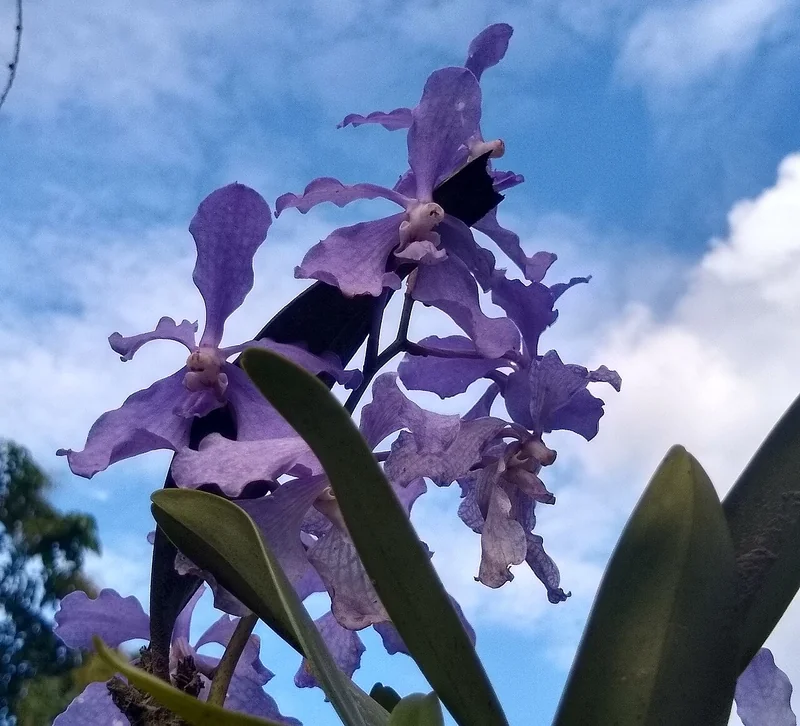 Featured photovanda-coerulea.jpg
Vanda coerulea is one of the most celebrated orchids in the world and one of the very few plants of any kind to produce genuinely blue flowers — large, flat, 8–10 cm blooms in clear sky-blue to violet-blue, produced in long racemes of 6–15 flowers in autumn. Native to the cool, seasonally dry forests of the Himalayan foothills in northeast India, Myanmar, and Thailand, it requires cooler winter temperatures and strong light than most vandas, making it better suited to cool conservatories than tropical indoor environments. It is protected under CITES Appendix I due to historic over-collection.
Care facts at a glance
- Light
- Bright indirect
- Water
- Water daily in summer (the bare roots dry within hours); reduce to every 2 to 3 days in winter.
- Humidity
- 55–80 %
- Temperature
- 8–28 °C
- Soil
- No medium — grow in a wooden slatted basket or on a cork mount with roots fully exposed to the air. Alternatively in very coarse bark chips with maximum airflow.
- Origin
- Cool forests of northeast India (Assam, Manipur), Myanmar, and northern Thailand at 1,000–1,800 m elevation.
- Mature size
- Monopodial stem to 60–90 cm tall; leaves strap-like. Flower spike 30–60 cm with 6–15 flowers.
Overview
Vanda coerulea Griff. ex Lindl. was described in 1847 and has been regarded as one of the world's most desirable orchids ever since. The species name coerulea means 'sky-blue' in Latin. Its blue flower colour is exceptionally rare in the plant kingdom — produced by delphinidin-based anthocyanins, the same pigments responsible for blue in delphiniums and some gentians. The Himalayan origin makes it cold-tolerant among vandas (down to 8 °C), but it requires very bright light and seasonal conditions to bloom reliably. It is listed on CITES Appendix I (highest protection level) — all plants in trade must be from registered nursery propagation, not wild collection.
Care Priorities
- Grow in a wood-slatted basket with completely exposed roots — the roots rot quickly in any enclosed medium.
- Provide maximum available light (bright south-facing window or conservatory); insufficient light is the most common cause of non-flowering.
- A distinct cool, dry winter rest (8–15 °C, less frequent watering) from November to February is essential for flower initiation.
- Daily root-watering in summer is not optional — the exposed roots desiccate rapidly in warm, dry indoor air.
- Only buy from reputable nurseries with CITES documentation; wild-collected plants are illegal and rarely survive long-term.
Common Problems
Failure to bloom despite good growth is the most common frustration — the plant requires both very high light AND a cool winter rest. If grown at constant warmth, it will not initiate flower buds. Bacterial soft rot can develop rapidly in wet crown conditions; ensure water does not pool between the strap leaves at the growing tip. Root tips dying or shrivelling while the plant is otherwise healthy indicates the roots are drying out too quickly — increase watering frequency or maintain higher ambient humidity. Scale insects on the tough strap leaves are common; treat with horticultural oil.
Sources & further reading (2)
- botanical-garden — accessed 2026-05-27
- encyclopedia — accessed 2026-05-27
Frequently asked questions
Is the blue colour real?
Yes — V. coerulea produces genuine blue pigmentation via delphinidin anthocyanins, unlike the dyed blue orchids commonly sold in supermarkets (which are white Phalaenopsis injected with blue dye and revert to white on the next flower spike). The flower colour ranges from pale sky-blue to deep violet-blue depending on the clone; the most saturated blue forms command premium prices.
Why does it need to hang?
Vandas are epiphytic orchids with thick, velamen-coated roots that need to alternate rapidly between wet and completely dry. In any enclosed pot or medium the roots stay moist too long and rot. Hanging baskets allow the roots to dangle freely in the air, mimicking the tree-branch epiphytic habitat where the plant grows naturally.
Can I grow it on a windowsill?
A very bright south-facing windowsill is the minimum light requirement, but the ideal position is a full-sun conservatory or heated greenhouse. The daily root watering requirement (which produces dripping water) makes windowsill culture challenging without a tray system. A greenhouse or conservatory setting with high light is strongly preferred.