Tacca chantrieri
Tacca chantrieri Care Guide
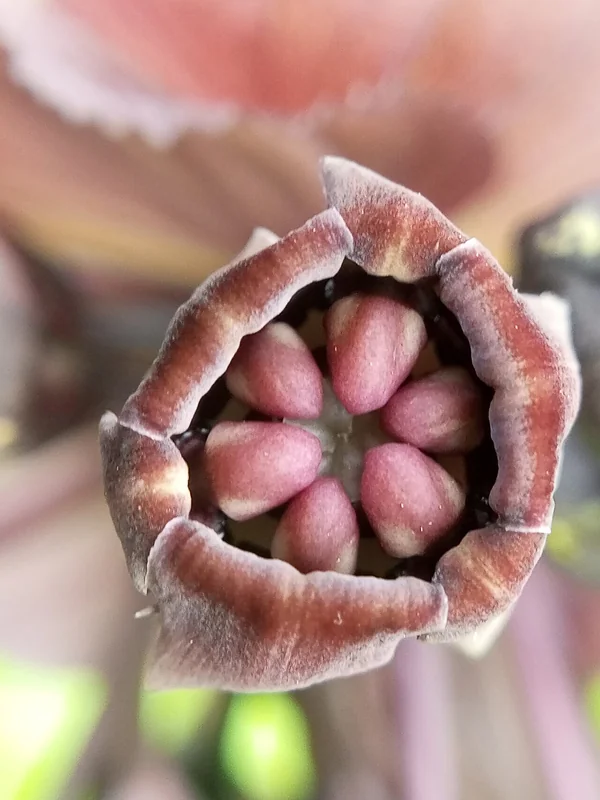 Featured phototacca-chantrieri.jpg
Tacca chantrieri is one of the most dramatically unusual plants in cultivation — the Bat Flower, a Southeast Asian tropical plant producing extraordinary flowers with large, near-black to deep maroon wing-like bracts and drooping 'whiskers' (bracteoles) up to 28 cm long that resemble a bat in flight. The dark, brooding aesthetic and extraordinary structural complexity of the flowers have made it one of the most sought-after houseplants for collectors of unusual plants. It requires consistent warm humidity and filtered light, making it demanding but uniquely rewarding.
Care facts at a glance
- Light
- Low light
- Water
- Keep consistently moist; water every 5 to 7 days. Never allow the medium to fully dry.
- Humidity
- 65–90 %
- Temperature
- 20–32 °C
- Soil
- Rich, moisture-retentive, very well-draining mix: peat-free compost, perlite (20%), and fine orchid bark.
- Origin
- Humid tropical forests of Thailand, Myanmar, Vietnam, Cambodia, and southern China.
- Mature size
- Clump-forming; 50–90 cm tall. Flower stalks to 60 cm with multiple successive blooms.
Overview
Tacca chantrieri André was described in 1901. The genus Tacca belongs to the family Dioscoreaceae (yam family). The bat flower's extraordinary appearance is a result of insect-deception pollination — the dark colour and long filamentous bracteoles mimic a dead or decaying organism to attract carrion flies as pollinators. The wings are technically large bracts (modified leaves), not petals; the actual flowers are small and inconspicuous within the bat structure. A single mature clump can produce successive flower stalks over many months, providing an extended display of the extraordinary blooms.
Care Priorities
- Consistent humidity above 65% is the single most critical requirement; below 60% the large leaves develop brown tips and the flower whiskers abort before full extension.
- A terrarium or enclosed display case provides the best humidity environment in temperate climates.
- Warm temperatures year-round (above 20 °C); this is a true tropical species with no cold tolerance.
- Moderate to low light — bright indirect light is acceptable but avoid direct sun; the large, thin leaves scorch quickly.
- Consistent watering without waterlogging; the rhizome is vulnerable to rot in soggy conditions.
Common Problems
Whisker bracteoles failing to extend fully or aborting early indicates low humidity; increase to 70%+ immediately. Large leaf brown tips from the outside margins inward indicate insufficient humidity or fluoride in water; switch to filtered water and increase humidity. Root rot in waterlogged conditions destroys the rhizome rapidly; ensure drainage is excellent and that water does not pool around the rhizome crown. Spider mites in dry conditions are the primary pest; the large leaf surface is vulnerable to population explosions. Flowers appearing but failing to set fruit even with hand-pollination is normal — fruiting requires specific pollinator conditions.
Sources & further reading (2)
- botanical-garden — accessed 2026-05-27
- encyclopedia — accessed 2026-05-27
Frequently asked questions
What are the long black whiskers?
The 'whiskers' are bracteoles — small modified bracts attached to the individual flower pedicels within the flower structure. In T. chantrieri they are extraordinarily elongated, up to 28 cm, and droop gracefully from the central flower cluster. They are part of the bat-mimicry pollination mechanism, adding to the overall visual impression of a bat in flight.
How long do the flowers last?
Each individual flower structure lasts 1–3 weeks. However, a healthy clump produces successive flower stalks over several months, particularly in warm, humid summer conditions. Stalks emerge from the rhizome and carry multiple sequential blooms; the overall flowering season can last 3–4 months.
Can it be grown in a standard living room?
Challenging — most living rooms in temperate climates have humidity of 30–50%, which is insufficient. In a bathroom with natural light, a kitchen, or an enclosed plant terrarium, the conditions are more achievable. A humidifier set to maintain 65%+ near the plant is the most reliable solution for non-terrarium cultivation.