Goeppertia picturata
Goeppertia picturata Care Guide
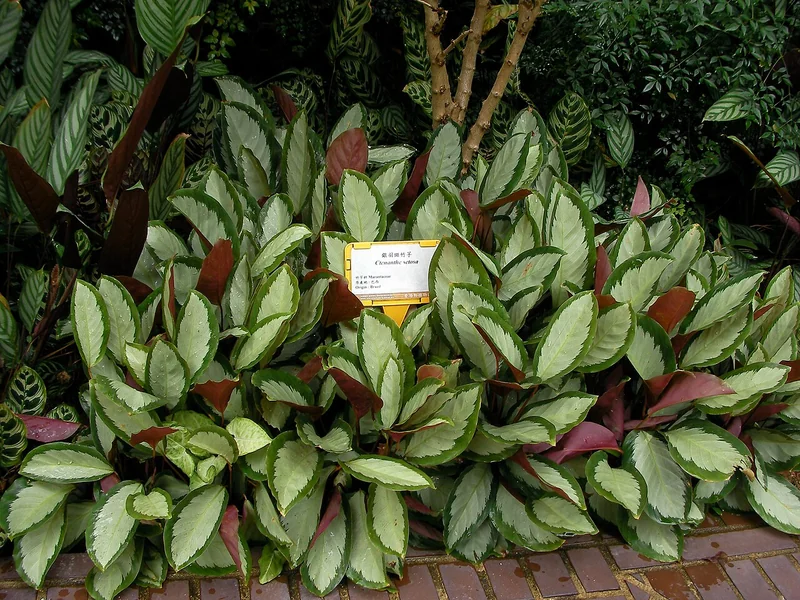 Featured photogoeppertia-picturata.jpg
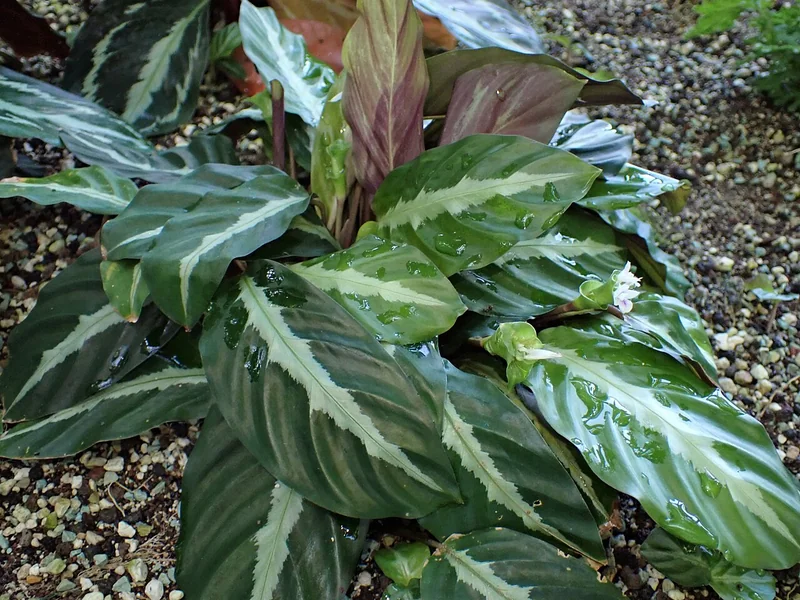
Goeppertia picturata (formerly Calathea picturata) is a striking prayer plant from South America, particularly popular in its cultivar 'Argentea' (syn. 'Silver'), which has an almost entirely silver-white upper leaf surface edged with dark green — one of the most dramatically patterned prayer plants available. The standard species has a broad silver central stripe on dark green. The purple-maroon leaf undersides contrast beautifully with the patterned upper surface. It performs nyctinasty (leaf-folding at night) reliably and is valued for both its foliage pattern and its relatively manageab...
Care facts at a glance
- Light
- Low light
- Water
- Water every 6 to 9 days; keep the medium consistently moist but not waterlogged.
- Humidity
- 55–80 %
- Temperature
- 18–30 °C
- Soil
- Moisture-retentive, well-draining potting mix: peat-free compost with 20% perlite and coconut coir.
- Origin
- Humid lowland forests of Colombia, Venezuela, and Brazil.
- Mature size
- Clump-forming; 40–60 cm tall.
Overview
Goeppertia picturata (K.Koch) Borchs. & S.Suárez was formerly Calathea picturata, described by Karl Koch in 1870. The species name means 'painted' — an apt description of the leaf patterning, which appears hand-applied. The cultivar 'Argentea' is the most widely sold form, with an almost entirely silver upper leaf surface bordered by a dark-green margin; the effect is of leaves made from polished pewter. The species belongs to the neotropical Marantaceae and shares the characteristic pulvinus joint at the base of the petiole that enables nyctinastic leaf movement.
Care Priorities
- Water with filtered or rainwater; the silver-patterned leaves show fluoride damage (brown tips) quickly in hard-water areas.
- Avoid direct sun; the silver 'Argentea' form shows bleaching within days in direct sunlight.
- Consistent warmth (above 18 °C year-round) is important; temperature fluctuations cause leaf rolling and curling.
- High humidity prevents crisp, curling leaf edges; a pebble tray with water, a humidifier, or grouping with other plants all help.
- Division in spring is the only reliable propagation method; the rhizome divisions root easily if each section has several healthy shoots.
Common Problems
Brown leaf tips or edges are the most common problem and indicate either fluoride in tap water, low humidity, or over-fertilisation — switch to rainwater and reduce fertiliser. Spider mites are the primary pest; look for fine webbing on the undersides of leaves in winter heating season. Yellowing leaves at the base of the clump are normal senescence; the plant renews its oldest leaves regularly. Leaves permanently rolled or folded during the day (not just at night) indicate cold temperatures or severe water stress — check conditions immediately.
Sources & further reading (2)
- botanical-garden — accessed 2026-05-27
- encyclopedia — accessed 2026-05-27
Frequently asked questions
What is the difference between the species and 'Argentea' cultivar?
The species type has a broad central silver stripe on a dark-green background with dark-green margins. The cultivar 'Argentea' (also sold as 'Silver') is almost entirely silver-white with only a narrow dark-green border — a much more dramatic and bold appearance. 'Argentea' is the most commonly sold form in horticulture.
Why do the leaves fold up at night?
Nyctinasty is driven by the pulvinus — a swelling at the base of each leaf stalk filled with motor cells that swell and deflate via osmotic pressure changes. At night the cells deflate on one side, causing the leaf to fold upright. At dawn the cycle reverses. It is a genetic, rhythmic movement controlled by the plant's circadian clock, not a response to light level alone.
Is it harder to grow than G. ornata?
G. picturata is considered slightly easier than G. ornata; it tolerates a wider humidity range and is marginally less fussy about water quality. Both are more demanding than G. makoyana. As a group, Goeppertia species benefit from the same attentive approach: soft water, humidity, and warmth.