Sinningia leucotricha
Sinningia leucotricha Care Guide
 Featured photosinningia-leucotricha.jpg
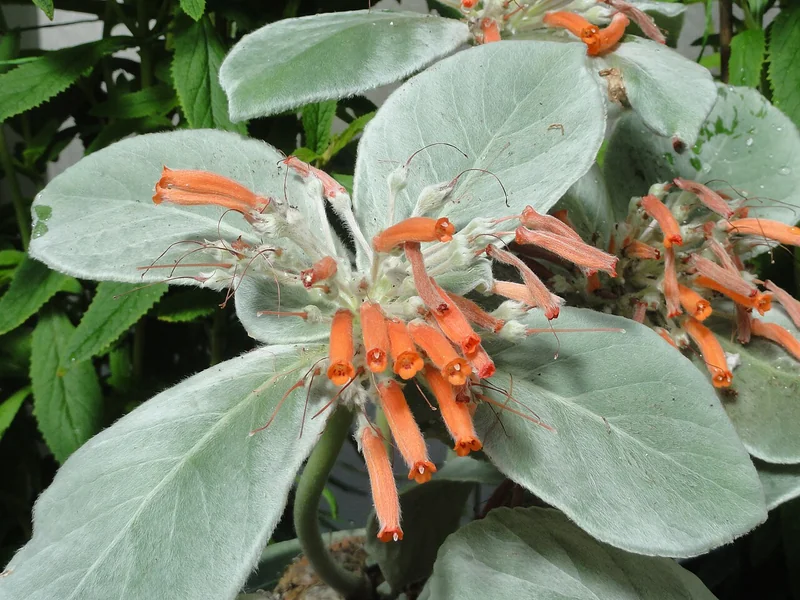
Sinningia leucotricha is an extraordinary Brazilian gesneriad unlike any other houseplant — a caudiciform (caudex-forming) species whose every surface, from the swollen woody base to the leaves and flower tubes, is covered in dense silvery-white hair, giving the entire plant a frosted, felted appearance. The coral-orange tubular flowers emerge from the hairy stems in spring. Growing from a large, above-ground caudex (a swollen water-storing base), it is drought-tolerant and goes fully dormant in winter, dying back completely to the caudex before resprouting in spring.
Care facts at a glance
- Light
- Bright indirect
- Water
- Water every 10 to 14 days in the growing season (spring to autumn). Withhold water completely in winter dormancy.
- Humidity
- 40–65 %
- Temperature
- 10–32 °C
- Soil
- Very well-draining mix: 50% perlite, 50% peat-free potting compost. The caudex must sit at or just above soil level.
- Origin
- Rocky cliff faces and steep slopes in Paraná and São Paulo states, Brazil.
- Mature size
- Compact; 15–25 cm tall in active growth. Caudex to 15 cm diameter on old specimens.
Overview
Sinningia leucotricha (Hoehne) Moore was described in its current combination in 1973. It belongs to the Gesneriaceae family — the same family as African violets (Saintpaulia) and gloxinias. The species grows on near-vertical rock faces in the Brazilian states of Paraná and São Paulo, where it is exposed to intense sun, strong drying winds, and seasonal drought. The dense white hair coating (trichomes) of every plant surface is a multi-function adaptation: reflecting intense UV light, reducing transpiration, and trapping a humid microclimate of still air next to the leaf surface. The caudex (swollen, woody, water-storing base) allows the plant to survive the dry winter season as a fully dormant structure, resprouting vigorously in spring.
Care Priorities
- Never water during winter dormancy — the caudex is the plant; it needs to rest completely dry from the time the stems die back in autumn until new growth appears in spring.
- The hairy surfaces must NOT be misted or wetted during the growing season; moisture trapped in the dense white trichomes causes fungal rot within days.
- Position the caudex at or just above the soil surface; burying it in medium causes caudex rot.
- Direct morning sun is beneficial in summer; the silvery hair reflects most of the energy and the plant thrives in bright, direct light.
- Dormancy breaking (first watering of the season) should only occur when new shoots are clearly visible; do not 'wake' a dormant caudex with water.
Common Problems
Caudex rot during winter is almost always caused by watering a dormant plant; withhold water completely from when stems die back until new shoots appear. Trichome damage from misting or overhead watering causes brown-felted patches that are permanent on that leaf — avoid all leaf contact with water. Thrips damage the silvery hair surface, leaving dark stippled patches; treat with systemic insecticide as a soil drench since foliar spray damages the hair. Leaf curling during active growth in summer indicates very low humidity or extreme heat stress; provide shade from harsh afternoon sun.
Sources & further reading (2)
- botanical-garden — accessed 2026-05-27
- encyclopedia — accessed 2026-05-27
Frequently asked questions
How do I know when to start watering again in spring?
Wait until you can see new pink or coral-coloured shoot tips emerging from the caudex — usually February to April depending on the warmth of your growing environment. Do not water a completely dormant caudex to try to stimulate growth; the plant will sprout when it is ready. The first watering after dormancy should be moderate, not a heavy soak.
Is it related to florist's gloxinia?
Yes — Sinningia is the same genus as the florist's gloxinia (Sinningia speciosa). However, S. leucotricha is very different from the heavily double-flowered florist cultivars; it is a more compact, hairy, drought-tolerant species with a very different growth habit. The family (Gesneriaceae) is also the family of African violets and streptocarpus.
Can I propagate it from a leaf?
Yes — leaf cuttings work reliably. Take a healthy leaf with some petiole and insert into moist perlite, keeping warm and humid. A small caudex forms at the base of the cutting within a few months, and the new plant goes dormant in its first winter at a tiny size. It takes 3–5 years to develop a substantial caudex.