Senecio haworthii
Senecio haworthii (Cocoon Plant) Care Guide
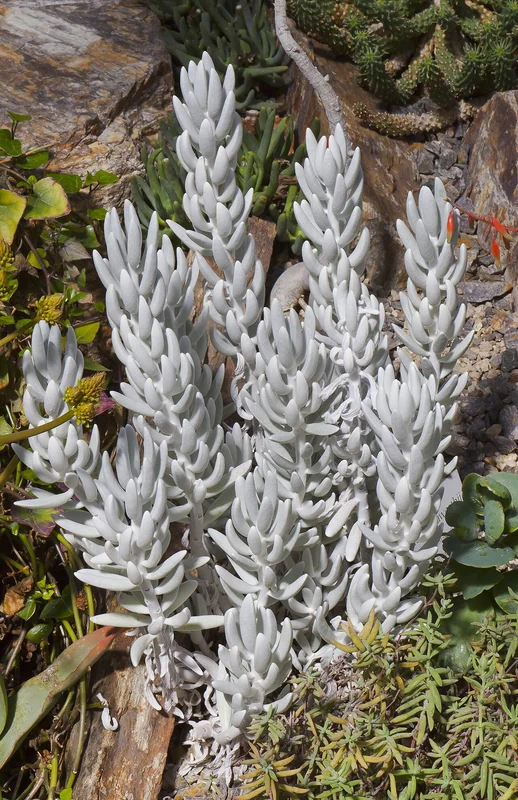 Featured photosenecio-haworthii.jpg
Senecio haworthii, sold as Cocoon Plant, is a member of the *Curio* / *Senecio* / *Othonna* group of succulent Asteraceae from southern Africa. A South African upright succulent with cylindrical pure-white leaves arranged tightly along branching stems, the white surface created by a dense felt of fine hairs. Looks startlingly like cocoons or fluffy white pebbles. Modern taxonomy has separated several former *Senecio* succulents into the genus *Curio*, but plants are still commonly sold under the older Senecio names at retail.
Care facts at a glance
- Light
- Bright indirect
- Water
- Water deeply when the mix is fully dry, typically every 2 to 3 weeks.
- Humidity
- 30–50 %
- Temperature
- 10–27 °C
- Soil
- Free-draining cactus or succulent mix with extra perlite or pumice.
- Origin
- Southern Africa, mostly the Western and Eastern Cape and Namibia.
- Mature size
- Trailing stems to 60 cm or more in mature plants.
Overview
Senecio haworthii sits in the broader Curio/Senecio/Othonna succulent radiation across southern Africa. A South African upright succulent with cylindrical pure-white leaves arranged tightly along branching stems, the white surface created by a dense felt of fine hairs. Looks startlingly like cocoons or fluffy white pebbles. The succulent leaves and trailing stems are an adaptation to the seasonally dry Cape habitats where most species grow. Modern molecular work has split the leafy-succulent species into Curio and the bulb-like ones into Othonna, but retail labels still mix the genus names freely.
Care Priorities
- Bright filtered light or a few hours of direct morning sun.
- Free-draining gritty mix; sustained moisture rots the roots.
- Water deeply, then let the mix dry fully.
- Cool dry winter rest below 15 °C encourages flowering.
Common Problems
Stretched stems are insufficient light. Mushy base is overwatering. Aphids cluster on flower buds and are easy to dislodge with a strong water spray. Many species drop older leaves naturally as part of the seasonal rest cycle.
Sources & further reading (2)
- encyclopedia — accessed 2026-04-29
- botanical-garden — accessed 2026-04-29
Frequently asked questions
Why is the plant pure white?
S. haworthii leaves are coated in a dense felt of fine white hairs (trichomes) that protect against intense Karoo sunlight. The coating is so thick the green tissue beneath is hidden — touching the leaves removes patches of felt that do not regrow on the same leaf.
Are these really Senecio or Curio?
Modern molecular taxonomy has split the succulent species formerly in *Senecio* into a separate genus *Curio*, alongside the unchanged true *Senecio* and the bulb-like *Othonna*. Retail labels often still use the older Senecio names, which is why both names appear on plant tags.
Can I propagate from broken stems?
Yes — stem cuttings root readily. Snap a healthy stem at a node, let the cut callus for a day or two, and lay the cutting on dry succulent mix. Roots typically appear within two to three weeks.