Selaginella martensii
Selaginella martensii Care Guide
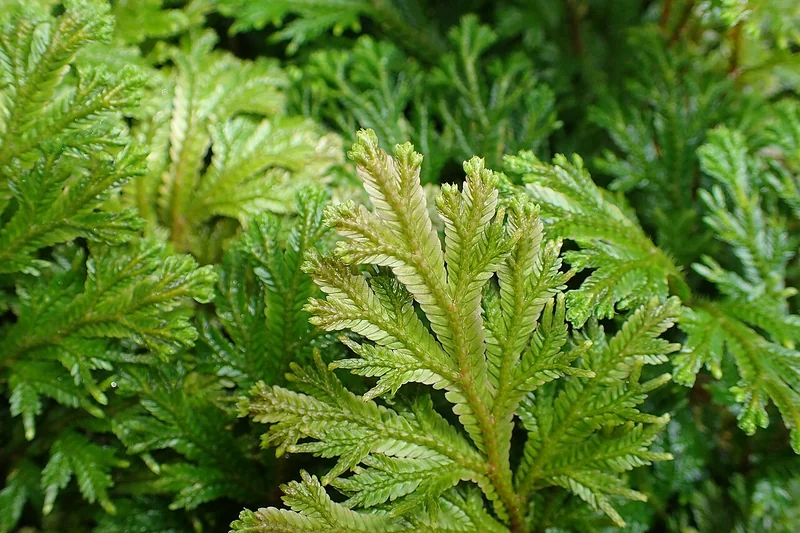 Featured photoselaginella-martensii.jpg
Selaginella martensii is a small, erect club moss from Mexico and Central America, producing densely branched, upright stems covered in tiny, bright-green scale-like leaves that form a lacy, mound-like habit. Unlike the creeping S. uncinata, it grows semi-upright to about 30 cm, making it useful as a textural mid-layer in large terrariums and vivariums. It requires consistently high humidity and indirect light to thrive, and rewards careful cultivation with a remarkably lush, prehistoric appearance.
Care facts at a glance
- Light
- Low light
- Water
- Keep the medium consistently moist; water every 3–5 days in open environments. In terrariums, water only when the medium begins to lighten in colour.
- Humidity
- 70–95 %
- Temperature
- 15–28 °C
- Soil
- Moist, peaty or coco-based mix; slightly acidic pH 5.5–6.5.
- Origin
- Humid forests and shaded slopes of Mexico and Central America.
- Mature size
- 20–30 cm tall; compact, branching upright habit.
Overview
Selaginella martensii Spring was described in 1850, named for the German naturalist Martin Martens. The variegated form 'Variegata' (sometimes sold as 'Frosty') has white-tipped branches that give a frosted appearance, adding to the plant's visual interest. Like all Selaginella, it reproduces by spores and is a vascular plant despite its moss-like appearance. The erect growth habit differentiates it from S. uncinata and S. apoda, making it more useful as an architectural element in terrarium design.
Care Priorities
- Constant high humidity is the single most important factor; the plant will decline within days in dry room air.
- Avoid direct light or full shade — a medium-low, diffuse light position produces the densest, greenest growth.
- The root zone should stay consistently moist; bottom-watering or a self-watering container works well.
- In a terrarium, ensure adequate air circulation to prevent stem rot at the base.
Common Problems
Stem tips turning brown and crispy in dry conditions is the most common issue; the plant requires humidity above 70% at all times. Individual stem dieback radiating from a central point indicates stem rot — caused by poor drainage or direct overwatering onto the stems; improve drainage and trim affected growth. Spider mites can appear on the undersides of the tiny leaves in dry conditions; treat with diluted neem oil spray. Fungus gnat larvae feed on the fine roots; apply beneficial nematodes to the medium.
Sources & further reading (2)
- botanical-garden — accessed 2026-05-27
- encyclopedia — accessed 2026-05-27
Frequently asked questions
How does it differ from S. uncinata?
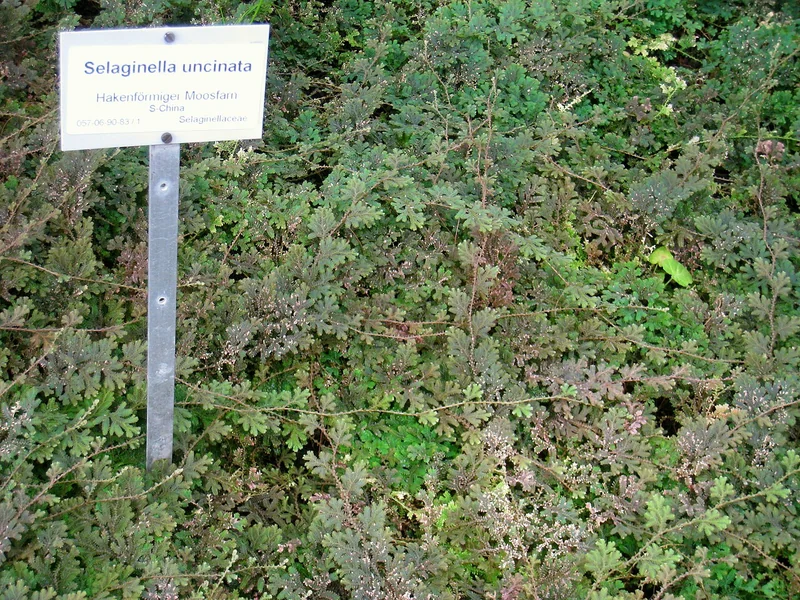
S. uncinata is a flat-creeping, iridescent species with a blue-green structural colour. S. martensii is more upright and branching, with a bright, clear green colour and no iridescence. Both require high humidity and low light; S. martensii is generally easier to maintain outside a closed terrarium.
What is the 'Frosty' or 'Variegata' form?
A cultivar with white-tipped stem branches that create a silvery-frosted appearance in the upper portions of the plant. The white tips are caused by reduced chlorophyll in the cells at the branch tips. Care requirements are identical to the standard green form.
Can I keep it in a regular pot without a terrarium?
Yes, if you maintain high humidity using a humidifier, pebble tray, or by grouping it with other moisture-loving plants. Without supplemental humidity above 70%, the tips will brown and the plant will gradually decline.