Selaginella uncinata
Selaginella uncinata Care Guide
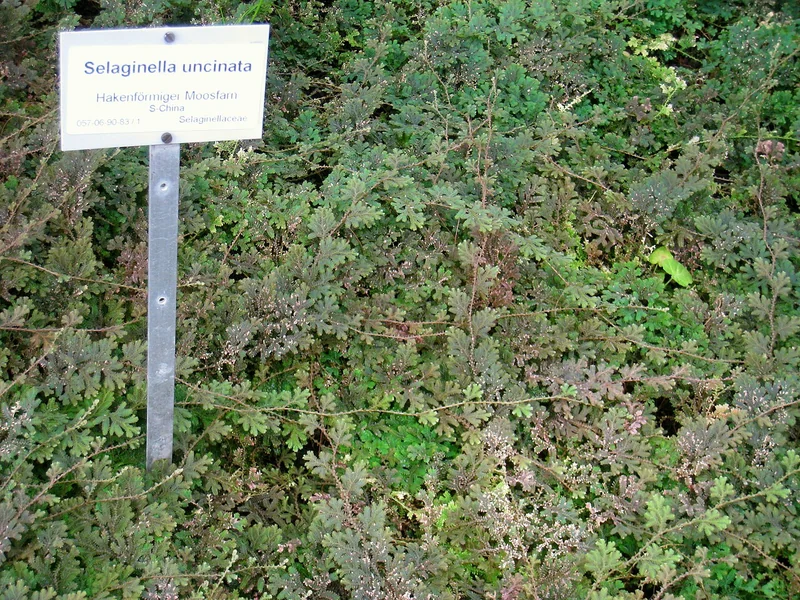 Featured photoselaginella-uncinata.jpg
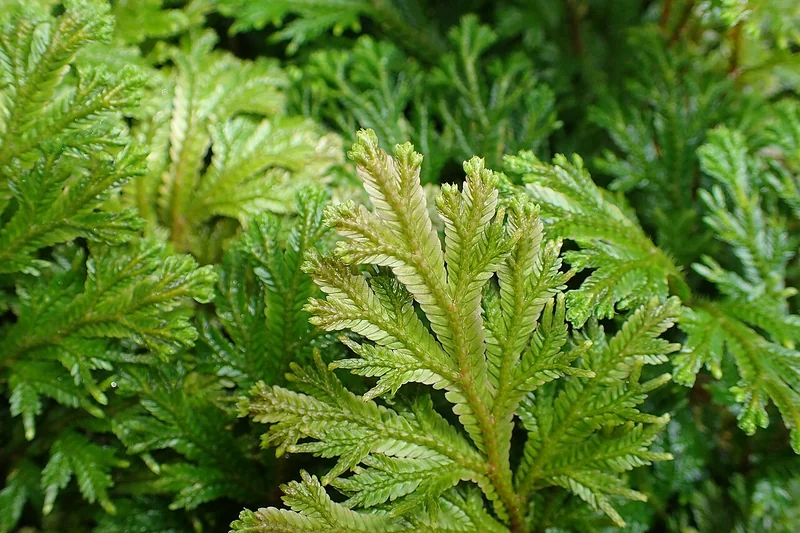
Selaginella uncinata, the Rainbow Moss or Peacock Fern, is a creeping club moss from southern China celebrated for its remarkable iridescent foliage — tiny, overlapping, scale-like leaves that shift between blue, green, violet, and teal depending on the angle of light. Despite the common name, it is not a true moss or fern but a lycophyte, an ancient lineage predating both. It thrives in high-humidity enclosures like terrariums and wardian cases, creating a shimmering carpet of metallic colour.
Care facts at a glance
- Light
- Low light
- Water
- Keep the medium permanently moist but not waterlogged; mist lightly every 1–2 days in open environments.
- Humidity
- 75–95 %
- Temperature
- 15–28 °C
- Soil
- Moist, peaty or coco-based mix; slightly acidic pH 5.5–6.5.
- Origin
- Humid subtropical and tropical forests of southern China and Southeast Asia.
- Mature size
- 3–5 cm tall; creeping and spreading to fill available space.
Overview
Selaginella uncinata (Desv. ex Poir.) Spring belongs to the Selaginellaceae, a family that diverged from the main vascular plant lineage approximately 400 million years ago. The iridescent blue-green colouration is structural — produced by thin-film interference in the cell layers, not by pigments. The same optical phenomenon creates the colours in soap bubbles and butterfly wings. The colour is most vivid in diffuse, indirect light; under direct sun or darkness it appears simply green. It is best suited to terrariums or Wardian cases where humidity is maintained above 75%.
Care Priorities
- Maintain humidity above 75% at all times — a closed or semi-closed terrarium is ideal; in open conditions, a humidifier is necessary.
- Low, diffuse light is perfect; direct sun bleaches the iridescence and can scorch the delicate stems.
- Keep the medium consistently moist; even brief drying causes the stems to shrivel and the iridescence to fade.
- Trim regularly to prevent it from overtaking other plants in a mixed terrarium.
Common Problems
Loss of iridescence or a dull green colour indicates the plant is drying out or receiving too much direct light. Increase humidity and move to a lower-light position. Rapid stem death radiating from one area is usually a sign of stem rot at a node — remove affected sections and increase airflow slightly to prevent further spread. Spider mites produce fine webbing and cause rapid browning; treat with a neem oil spray early before populations establish. Fungus gnats in the consistently moist soil are controlled by applying beneficial nematodes.
Sources & further reading (2)
- botanical-garden — accessed 2026-05-27
- encyclopedia — accessed 2026-05-27
Frequently asked questions
Why is it called a 'fern' when it is not one?
The common names 'rainbow fern' and 'peacock fern' refer to its fern-like appearance — the flat, branching stems with overlapping scale-leaves look superficially like a fern's frond. Selaginella is a lycophyte, a more ancient lineage that diverged from true ferns long before either group diversified.
Is it suitable for a terrarium?
It is one of the best plants for a tropical terrarium. The constant high humidity, stable temperature, and low diffuse light of an enclosed terrarium match its requirements perfectly. It creates a vivid, shimmering blue-green groundcover that catches the eye.
How does the colour work?
The blue-green iridescence is caused by structural colouration — thin-film interference in the paradermal layer of the leaf cells. Light wavelengths that are amplified by the film thickness appear blue or teal; no blue pigment is present. The colour depends on viewing angle and light source, so the same plant may look blue, green, or violet depending on how you look at it.