Platycerium grande
Platycerium grande Care Guide
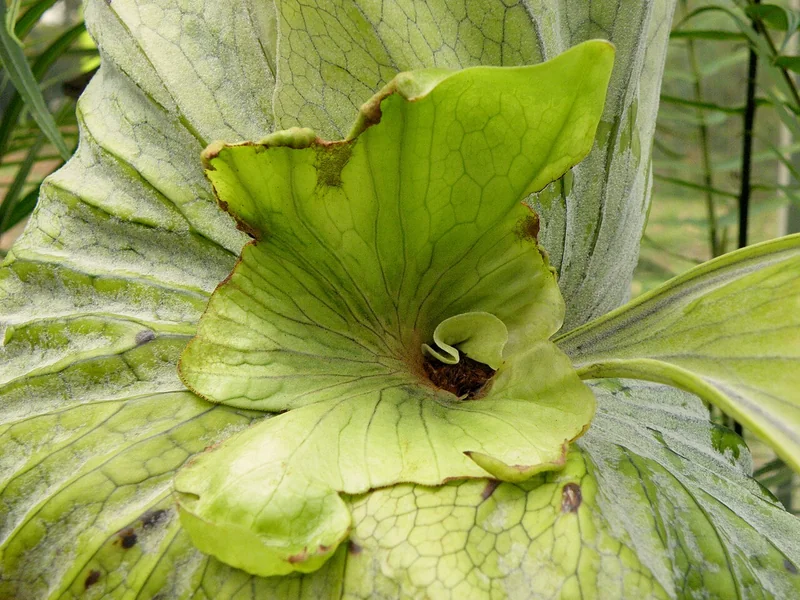 Featured photoplatycerium-grande.jpg
Platycerium grande is one of the largest staghorn ferns, native to the Philippines and nearby islands. Its fertile fronds can reach 2 metres long with deep, dramatic bifurcations that give them the antler-like appearance that inspired the common name. Unlike the more common P. bifurcatum, grande is more tropical in its requirements and needs consistently warm, humid conditions to perform at its best. Mounted on a piece of bark or driftwood, it becomes an extraordinary living wall feature.
Care facts at a glance
- Light
- Bright indirect
- Water
- Soak the mount thoroughly once a week in summer; every 10 to 14 days in cooler months.
- Humidity
- 60–90 %
- Temperature
- 16–30 °C
- Soil
- Grown mounted on cork bark, wood, or wire basket lined with sphagnum moss and compost.
- Origin
- Humid lowland forests of the Philippines, including Mindanao and Luzon.
- Mature size
- Fertile fronds to 2 m long; shield fronds 60 to 80 cm wide.
Overview
Platycerium grande is often confused with P. superbum, which has a similar large size but grows in Australia. P. grande is distinguished by its more deeply bifurcated fertile fronds and Philippine origin. Like all staghorns it produces two distinct frond types: shield (or nest) fronds that clasp the mount and collect organic matter, and fertile fronds that emerge from the shield and bear spores at their tips.
Care Priorities
- Mount on bark or wood rather than potting — staghorn ferns are epiphytes that perform best attached to a vertical surface.
- Humidity above 60 percent is essential; bathrooms or greenhouses are ideal locations.
- Never remove the brown shield fronds — they are alive and functional, slowly turning brown as they mature.
- Fertilise through foliar feeding rather than substrate feeding for mounted specimens.
Common Problems
Black rot appearing on shield fronds is the most serious problem — caused by consistently wet conditions and poor airflow. Cut away affected tissue, improve air circulation, and reduce watering frequency. Scale insects cluster on the underside of fertile fronds; treat with neem oil carefully. Pale or yellowing fertile fronds suggest either nutrient deficiency or insufficient light.
Sources & further reading (2)
- botanical-garden — accessed 2026-05-08
- encyclopedia — accessed 2026-05-08
Frequently asked questions
Do I need to water the shield fronds or just the roots?
Water by soaking the root ball or mount — the shield fronds absorb some moisture but do not need to be saturated. The fertile fronds capture leaf litter and moisture from above in nature.
Can P. grande be grown in a pot?
It can, but it grows less vigorously and impressively than when mounted. A wide, shallow pot with bark-heavy epiphytic mix is the best pot-growing alternative.
My shield fronds are turning brown — is the plant dying?
Brown shield fronds are normal and healthy. They protect the root mass and accumulate organic matter. Only remove them if they show signs of rot (black, wet, smelly tissue).