Hoya parasitica
Hoya parasitica Care Guide
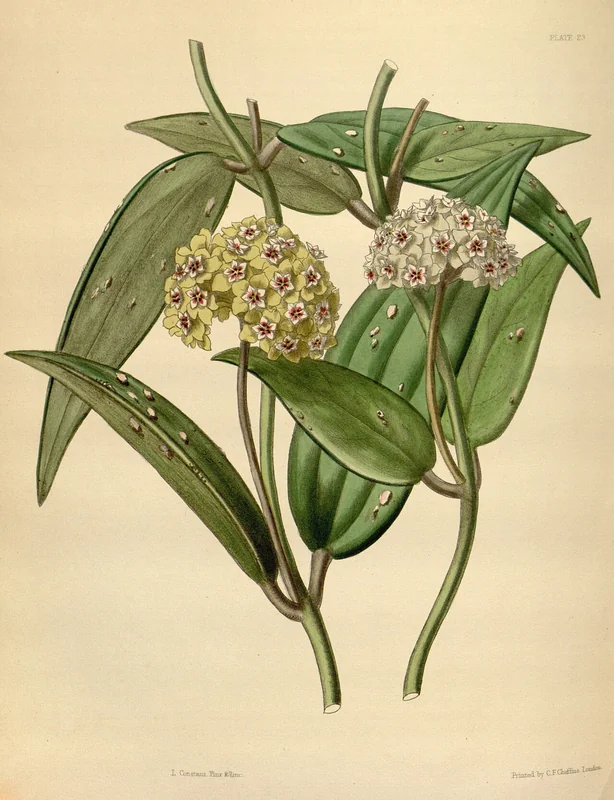 Featured photohoya-parasitica.jpg
Hoya parasitica is a highly variable and widely distributed hoya ranging from India and Sri Lanka across Southeast Asia to the Philippines. It is best known in cultivation in forms with silver-splashed leaves, though plain green-leaved forms also exist. It produces small but numerous flowers in compact umbels, pale cream or greenish-white with a red or pink star-shaped corona centre, with a pleasant light sweet fragrance. Its variability has produced many trade names and cultivar forms, making it one of the more confusing — but rewarding — hoyas for collectors.
Care facts at a glance
- Light
- Bright indirect
- Water
- Water every 10 to 14 days; allow top half of medium to dry between waterings.
- Humidity
- 50–75 %
- Temperature
- 15–32 °C
- Soil
- Well-draining hoya mix: orchid bark, perlite, and a small amount of potting mix.
- Origin
- South and Southeast Asia — India, Sri Lanka, Myanmar, Thailand, Philippines, and adjacent islands.
- Mature size
- Trailing or climbing stems to 3 m; leaf size variable, 5–12 cm long.
Overview
Hoya parasitica (Roxb.) Wall. ex Wight was described in 1834. Its wide geographic range — from India through Southeast Asia — has resulted in substantial natural variation, and a number of distinct leaf forms have entered cultivation under various trade names. The 'splash' form, with silvery-grey flecks across the dark-green leaf surface, is the most popular. Despite its common name ('wall hoya' and 'parasitic wax plant') it is an epiphyte that attaches to trees for support without parasitising them. It is closely related to H. lacunosa and H. diversifolia, and some forms sold under those names may actually be H. parasitica.
Care Priorities
- The silver splashing on popular forms is brightest in medium-bright indirect light; avoid very deep shade, which turns the leaves plain green.
- Leave all peduncles in place — the spurs bloom reliably year after year.
- Repotting is rarely needed; pot-bound plants often bloom more freely.
- Provide adequate humidity (50%+) to maintain the vibrant leaf patterning and prevent spider mite problems in winter.
Common Problems
Silver leaf patterning fading to plain green indicates insufficient light — relocate to a brighter spot, though avoid harsh midday sun. Root rot is the primary killer; use an open medium and never allow excess water to pool. Mealybugs are difficult to spot in the leaf axils of large-leafed forms; inspect with a hand lens monthly. The wide range of trade names and forms means collectors sometimes acquire the same clone twice — compare leaf shape, pattern, and flower colour before purchasing new stock.
Sources & further reading (2)
- botanical-garden — accessed 2026-05-27
- encyclopedia — accessed 2026-05-27
Frequently asked questions
Why do so many trade names exist for this species?
H. parasitica's enormous natural range and high variability meant that many different forms entered the hobby trade under localised or collector-assigned names ('Parasitica Silver Splash', 'Wall Hoya', 'Hoya sp. India', etc.) before the species concept was clarified. Many distinct-looking forms are simply geographic variants of the same species, leading to collector confusion.
Does it flower easily?
Yes — it is one of the more floriferous hoyas in cultivation. Established plants with intact spurs can bloom multiple times per year with good indirect light and a brief winter rest. The flowers are small but produced in large numbers and carry a pleasant sweet fragrance most noticeable in the evening.
How do I preserve the silver splash pattern?
The silver splashing is most vivid in medium-bright indirect light (around 1,000–2,000 lux). In deep shade the pattern fades toward plain green. Adequate humidity (50–65%) also helps maintain the reflective quality of the leaf surface. The pattern is genetic and will not disappear entirely, but it becomes less vivid in poor conditions.