Hoya pachyclada
Hoya pachyclada Care Guide
 Featured photohoya-pachyclada.jpg
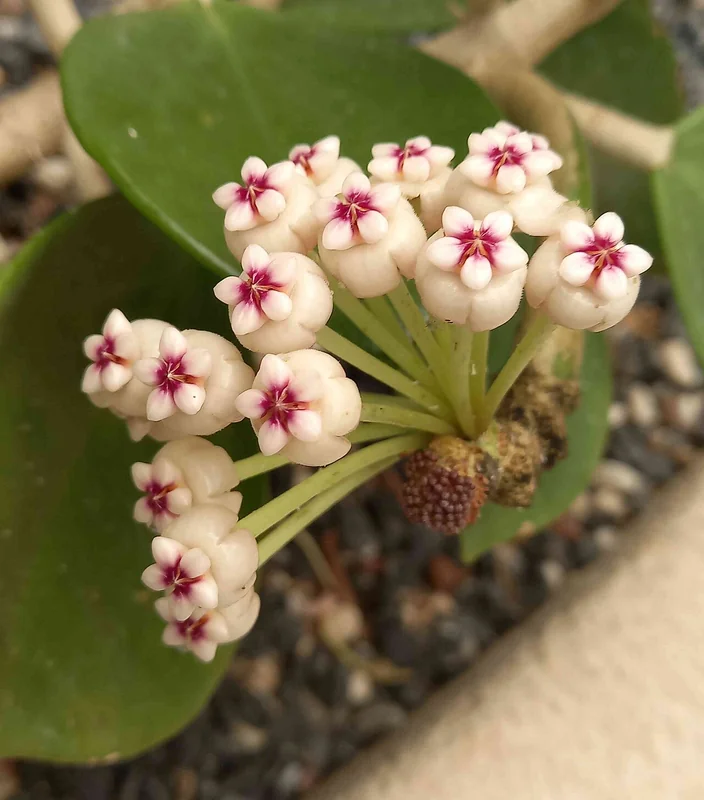
Hoya pachyclada is a compact hoya from Thailand with some of the thickest, most succulent-like leaves in the genus — rounded, smooth, and pale grey-green to blue-green, almost resembling a succulent rather than a hoya. It produces large umbels of beautiful ivory-white flowers with bright yellow-orange centres and a wonderful sweet fragrance. The extreme leaf thickness makes it more drought-tolerant than most hoyas and suitable for collectors with minimal time for frequent watering.
Care facts at a glance
- Light
- Bright indirect
- Water
- Water when the pot feels very light and the top half of medium has dried; every 14 to 21 days. Very drought-tolerant.
- Humidity
- 40–65 %
- Temperature
- 15–35 °C
- Soil
- Very open, gritty hoya mix: 60% orchid bark, 30% perlite, 10% potting mix.
- Origin
- Tropical dry forests and limestone hills of Thailand.
- Mature size
- Compact shrubby habit; stems to 60–90 cm.
Overview
Hoya pachyclada Kerr was described in 1939, named for the thick (pachy-) stems (clada) typical of the species. Native to the seasonally dry limestone forests of Thailand where rainfall is strongly seasonal, it has evolved leaves of extraordinary thickness — up to 8 mm — as a water storage adaptation. The rounded, concave leaf shape channels rain down the midrib toward the base, optimising water collection in its dry habitat. The flower umbels can contain 20–40 individual flowers, each 1.5–2 cm across, with a powerful sweet scent especially in the evening.
Care Priorities
- Water very sparingly: the thick leaves store enough moisture to sustain the plant for 2–3 weeks without water.
- Use a very open, fast-draining mix — this species is more prone to root rot in a standard potting mix than most hoyas.
- Bright light, including some direct morning sun, is important for flowering; the large flower umbels require considerable energy.
- A pronounced dry winter rest (very little water, cooler temperatures) triggers reliable flower bud formation.
Common Problems
Root rot from overwatering is the primary risk; if leaves begin to yellow or go limp despite the apparent moisture in the medium, check the roots — they may have rotted while the thick leaves remain turgid from stored water. Scale insects are common on the thick stems; check regularly and treat with horticultural oil. Failure to flower is usually because the plant did not receive a sufficiently dry winter rest; maintain at 15 °C with water only every 3–4 weeks in winter.
Sources & further reading (2)
- botanical-garden — accessed 2026-05-27
- encyclopedia — accessed 2026-05-27
Frequently asked questions
Are the leaves really that thick?
Yes — H. pachyclada has among the thickest leaves of any commonly cultivated hoya, up to 8 mm in healthy specimens. They feel almost rubbery and are smooth and rounded. This extreme succulence is an adaptation to seasonal drought in its native Thai limestone habitat.
How fragrant are the flowers?
Very fragrant — the large umbels of ivory-white flowers produce a powerful, sweet, slightly vanilla-like scent that is strongest in the evening. A single blooming plant can scent an entire room. This is one of the most intensely fragrant commonly cultivated hoyas.
Can I grow it in a succulent mix?
Yes — the very open, well-draining conditions of a typical succulent mix (with grit rather than bark) are suitable. The key requirement is fast drainage and minimal moisture retention around the roots.