Hoya kentiana
Hoya kentiana Care Guide
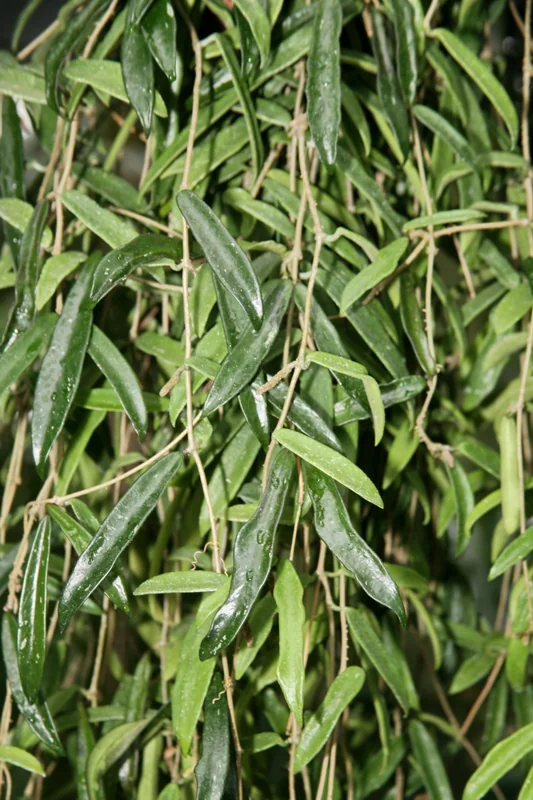 Featured photohoya-kentiana.jpg
Hoya kentiana is a vining Southeast Asian hoya with unusually long, narrow, strap-shaped leaves that trail elegantly from shelves or hanging baskets. The distinctive elongated leaves can reach 15 to 20 cm and are slightly curved along their length, giving the trailing stems an ornamental, draping quality. Clusters of small, star-shaped, pink to pale purple flowers with a pleasant fragrance are produced on mature plants. It is an accommodating hoya for intermediate growers, tolerating average household conditions well.
Care facts at a glance
- Light
- Bright indirect
- Water
- Water when the top 3 to 5 cm of the substrate has dried; roughly every 10 to 14 days in summer.
- Humidity
- 50–75 %
- Temperature
- 15–30 °C
- Soil
- Free-draining hoya mix: bark, perlite, and a small amount of potting mix.
- Origin
- Humid forests of the Philippines and adjacent Southeast Asian islands.
- Mature size
- Vining to 2 to 4 m; leaves 12 to 20 cm long.
Overview
Hoya kentiana was described by C.M.Burton. It is sometimes confused in trade with H. wayetii and H. longifolia, which have similarly narrow leaves. The easiest way to distinguish them is by the flower: kentiana has pink to pale purple petals, while wayetii tends to have dark red-purple flowers. Both are popular trailing hoyas, but kentiana is generally the easier bloomer in typical indoor conditions.
Care Priorities
- Provide a support or hanging position so the trailing stems can grow freely.
- Bright, indirect light promotes vigorous growth and flowering; insufficient light produces leggy stems with wider leaf spacing.
- Do not remove spent flower peduncles; they produce new umbels annually.
- The narrow leaves dry faster than thick-leaved species; adjust watering accordingly in warm weather.
Common Problems
Sparse, widely spaced leaves on new growth indicate low light; move to a brighter position. Yellow leaves with mushy roots mean overwatering; allow thorough drying before the next watering. Spider mites can affect the narrow leaves, causing stippling and eventual leaf drop; increase humidity and treat with neem oil.
Sources & further reading (2)
- botanical-garden — accessed 2026-05-08
- encyclopedia — accessed 2026-05-08
Frequently asked questions
Is H. kentiana the same as H. wayetii?
They are similar species with narrow leaves, sometimes confused in trade. H. kentiana has pink to pale purple flowers, while H. wayetii typically has darker red-purple to maroon flowers.
Can I grow it as a trailing or a climbing plant?
Both — it trails naturally and cascades beautifully from a hanging basket, or it can be trained up a trellis or moss pole for an upright vining display.
How do I encourage flowering?
Bright light, high-phosphorus fertilizer, and slight drought stress between waterings in late summer typically trigger bud formation. Avoid moving the plant once buds have formed.