Hoya campanulata
Hoya campanulata Care Guide
 Featured photohoya-campanulata.jpg
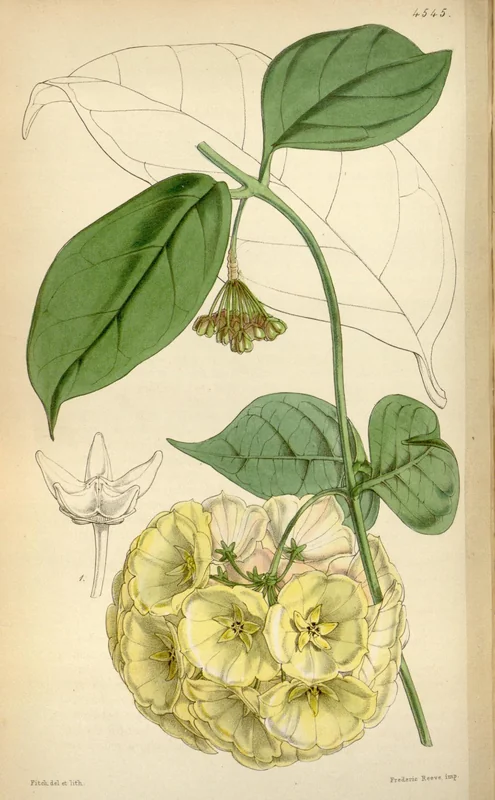
Hoya campanulata is a climbing and trailing hoya from South and Southeast Asia, producing narrow, lance-shaped, dark-green to grey-green leaves with a slightly succulent texture and attractive pendant clusters of bell-shaped flowers — creamy to pale yellow with a contrasting burgundy-purple corona. The unusual bell shape (rather than the flat star typical of most hoyas) gives the species its name and makes it a distinctive addition to a hoya collection.
Care facts at a glance
- Light
- Bright indirect
- Water
- Water when the top half of the medium has dried; every 10 to 14 days in summer. Significantly reduce in winter.
- Humidity
- 50–75 %
- Temperature
- 15–30 °C
- Soil
- Hoya mix: orchid bark, perlite, and a small amount of potting mix. Fast drainage is critical.
- Origin
- Tropical forests of South and Southeast Asia, including India, Myanmar, and Malaysia.
- Mature size
- Trailing or climbing stems to 2 m.
Overview
Hoya campanulata Blume was described in 1826 and is named for the campanulate (bell-shaped) flower form — the corolla lobes reflex only partially rather than lying flat, creating the characteristic bell shape. This flower form is shared by relatively few hoyas and makes the flowers easy to distinguish from typical flat-star hoyas. The narrow, lance-like leaves are also characteristic and more graceful than the broad, oval leaves of many popular Hoya species.
Care Priorities
- Bright, indirect light with some morning sun is ideal for reliable flowering.
- Do not remove old peduncles — flowering repeats from the same spur each season.
- Allow the medium to dry thoroughly between waterings; the succulent leaf texture indicates superior drought tolerance compared to thin-leafed hoyas.
- A cool winter rest (15–18 °C) with reduced watering is beneficial for flower bud initiation.
Common Problems
Yellowing leaves that drop rapidly indicate root rot — inspect the roots immediately and repot in fresh, dry, open medium. Leaves becoming wrinkled and soft simultaneously indicate severe drought; water thoroughly and the leaves should firm up within 24 hours. Aphids on new growth shoots are common in spring; remove with a strong water jet or insecticidal soap. Failure to bloom may need a longer, cooler rest period — maintain at 15 °C with very little water through winter.
Sources & further reading (2)
- botanical-garden — accessed 2026-05-27
- encyclopedia — accessed 2026-05-27
Frequently asked questions
Why are the flowers bell-shaped?
In most hoyas the five corolla lobes reflex fully backward to lie flat, creating the characteristic star shape. In H. campanulata the lobes only partially reflex, remaining upright and slightly curved, creating the bell form. This is a genetic, fixed characteristic of the species.
Does it need a support to climb?
It will climb given a support (moss pole, trellis) or trail elegantly from a hanging basket without one. The trailing form works well in elevated positions where the narrow leaves and pendant flower clusters can be appreciated from below.
How long does it take to bloom?
From a cutting, expect 2–3 years before the first flowering. Mature plants with established spurs (peduncles) bloom reliably each spring. Ensuring a cool winter rest and bright light year-round shortens the wait.