Haworthia truncata
Haworthia truncata Care Guide
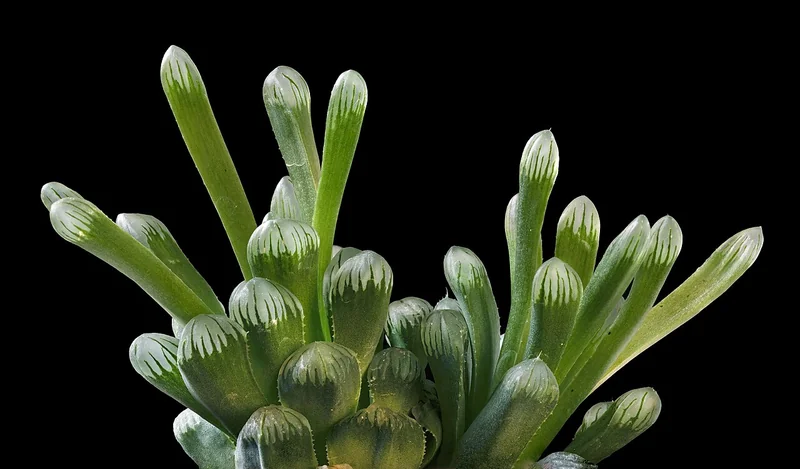 Featured photohaworthia-truncata.jpg
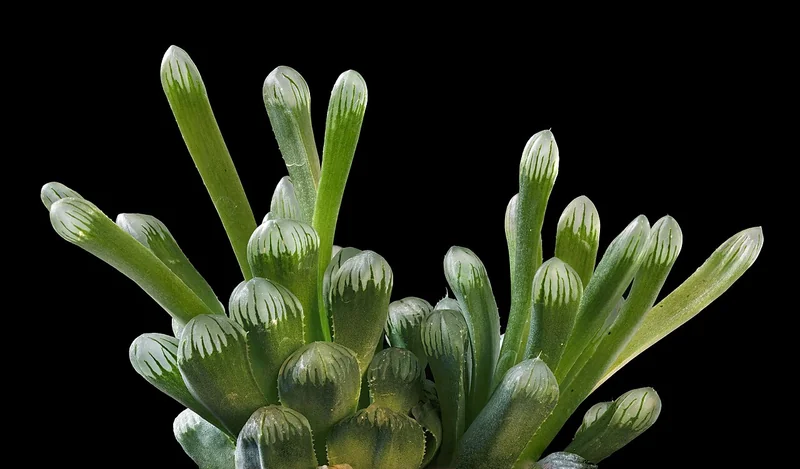
Haworthia truncata is one of the most unusual succulents in cultivation, producing leaves in two rows (distichous) with completely flat, windowed tops that appear to have been cleanly sliced. The plant grows semi-buried in sandy soils in its native Little Karoo of South Africa, exposing only the glassy leaf windows to the sky. This adaptation gives it an unmistakably geometric, almost architectural appearance that makes it a prized collector piece.
Care facts at a glance
- Light
- Bright indirect
- Water
- Water sparingly when soil is fully dry — once every 3 to 4 weeks in summer, once per month or less in winter.
- Humidity
- 30–55 %
- Temperature
- 5–35 °C
- Soil
- Very gritty succulent mix: 60 percent coarse sand or perlite, 40 percent succulent compost.
- Origin
- Sandy soils of the Little Karoo, Western Cape, South Africa.
- Mature size
- 4 to 8 cm tall; slowly spreads through offsets to 10 to 15 cm across.
Overview
Haworthia truncata was described by Schönland in 1905. Its most distinctive feature — the flat-topped, window leaf arrangement in two rows — is a specialised adaptation unique within the Haworthia genus. It is considered a collector's plant and is sometimes grafted onto faster-growing rootstocks in Japan to accelerate growth. Some notable variegated and cultivated forms ('variegata', 'lime green') command very high prices at auction.
Care Priorities
- Very bright, diffused light best mimics its native shallow burial; direct afternoon sun is harmful.
- Minimal watering is the single most critical requirement — the plant stores water in its thick leaf tissue.
- Use the grittiest possible substrate; coarse perlite is preferable to fine sand.
- Pot in terracotta and ensure the drainage hole is unobstructed.
Common Problems
Shrivelled or accordion-like leaves (not from heat stress) indicate underwatering — water thoroughly and the leaves should plump within days. Soft, translucent leaves at the base with an unpleasant smell are root rot; remove from pot, trim all soft tissue, dry for 5 to 7 days before repotting in fresh, dry gritty mix. New growth that looks distorted can indicate a soil pathogen or mealybug damage — inspect roots carefully at the next repot.
Sources & further reading (2)
- botanical-garden — accessed 2026-05-08
- encyclopedia — accessed 2026-05-08
Frequently asked questions
Why does my H. truncata look like it is buried?
In nature the plant grows with only the flat leaf tips exposed above soil. Indoors it is grown above ground for display, but the same semi-buried aesthetic is sometimes replicated by collectors using very shallow, wide containers.
How slow is the growth?
Extremely slow — it may produce only one or two new leaves per year under typical indoor conditions. Some rare cultivars are grafted to accelerate growth.
Can I propagate by leaf-cutting?
Leaf cuttings are possible but very unreliable and slow to root. Offsets, when produced, are the most practical propagation method.