Gasteria carinata
Gasteria carinata Care Guide
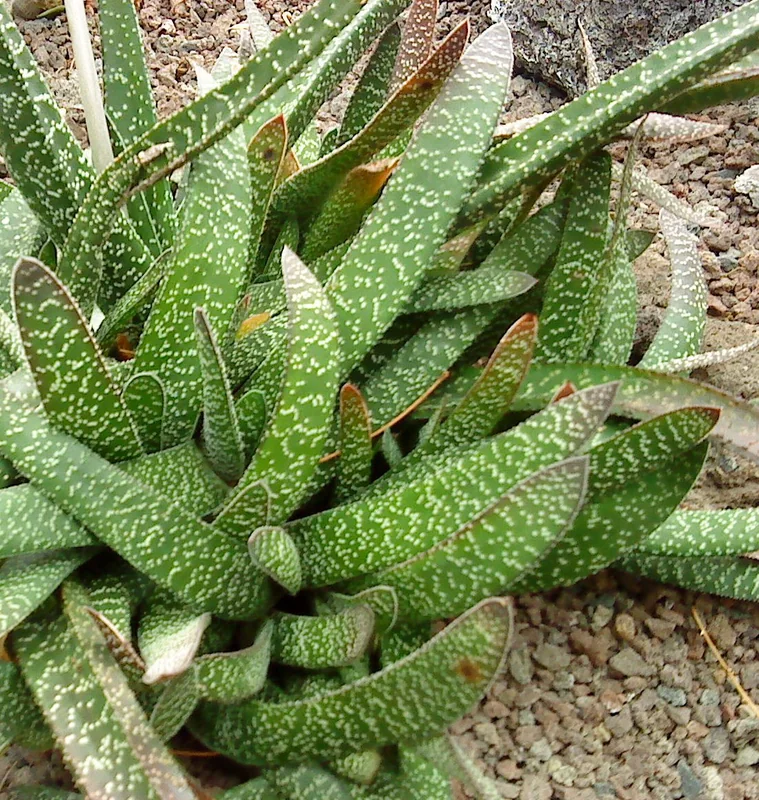 Featured photogasteria-carinata.jpg
Gasteria carinata is a variable South African succulent in the aloe family, characterised by thick, tongue-shaped leaves with a strong central keel and a warty or white-spotted surface. It forms rosettes that slowly become fan-shaped or spiralled with age. Gasteria is one of the most shade-tolerant succulents, making it an excellent choice for positions that would be too dim for most other succulents. The pink-red, stomach-shaped flowers (giving the genus its name) appear in late winter and spring.
Care facts at a glance
- Light
- Medium light
- Water
- Water when the soil has dried completely — every 2 to 3 weeks in summer, monthly in winter.
- Humidity
- 30–60 %
- Temperature
- 7–35 °C
- Soil
- Gritty, well-draining succulent mix; can tolerate slightly more organic matter than most succulents.
- Origin
- Rocky slopes and shade habitats of the Western Cape and Namaqualand, South Africa.
- Mature size
- 15 to 25 cm tall; spreading rosette 20 to 30 cm wide.
Overview
Gasteria carinata was described by Duval and is a highly variable species with several recognised varieties and many natural hybrids across its South African range. In the wild it often grows under rocks or in dappled shade, accounting for its tolerance of lower light than most succulents. The warty white bumps on the leaf surface are called tuberculae and are a key identification feature. Gasteria readily hybridises with Haworthia and Aloe, and numerous intergeneric hybrids circulate in cultivation.
Care Priorities
- Indirect or bright indirect light — this is one of the few succulents that will survive (and even thrive) in indirect light away from a window.
- Allow soil to dry fully between waterings; root rot develops readily in consistently moist conditions.
- Use a gritty but slightly more organic mix than for desert cacti.
- Cool winter rest with reduced watering encourages spring flowering.
Common Problems
Pale, washed-out leaf colour and slow growth in indirect light positions are acceptable trade-offs for its shade tolerance. Soft, smelly rot at the leaf base is bacterial soft rot from overwatering; remove the plant, cut away affected tissue, and dry for a week before replanting. Root mealybugs can go undetected for months; check roots at every repot.
Sources & further reading (2)
- botanical-garden — accessed 2026-05-08
- encyclopedia — accessed 2026-05-08
Frequently asked questions
Can G. carinata survive in a dark corner?
It tolerates low light better than most succulents, but 'dark corner' is too little. It needs at least bright, ambient indoor light from a nearby window to maintain health.
What makes Gasteria different from Haworthia?
Gasteria leaves are typically thicker and more tongue-shaped, arranged in distichous (two-ranked) fans when young. Flowers are distinctly gastric or stomach-shaped, while haworthia flowers are more tubular and symmetrical.
How do I propagate from leaves?
Remove a healthy leaf cleanly, allow the cut end to callous for 2 to 3 days, then place on barely moist succulent mix. Roots and small rosettes can develop over several months.