Euphorbia tirucalli
Euphorbia tirucalli Care Guide
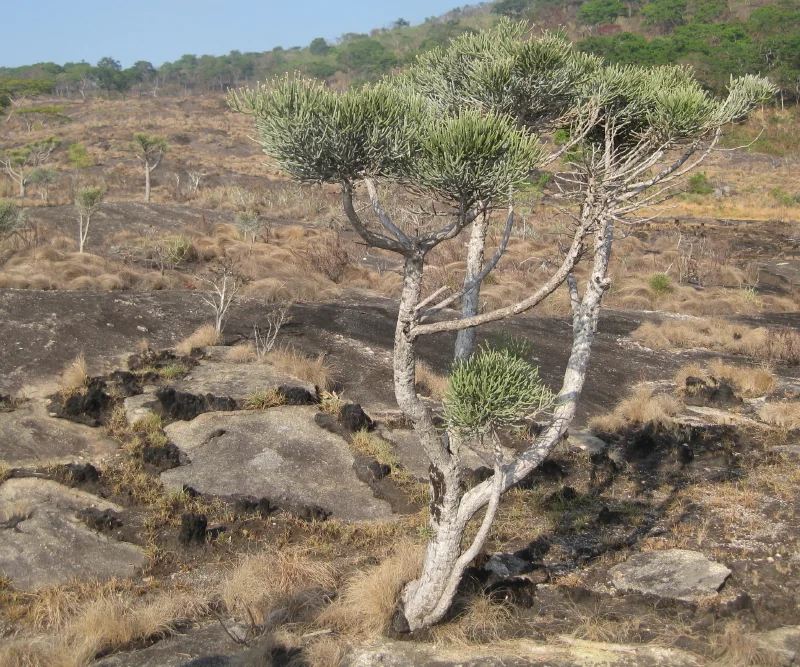 Featured photoeuphorbia-tirucalli.jpg
Euphorbia tirucalli, the Pencil Cactus or Firesticks, is a tropical African succulent with a spectacular branching mass of pencil-thin, cylindrical, bright-green stems that lack leaves except as tiny, ephemeral growths on new shoots. The popular cultivar 'Sticks on Fire' (syn. 'Rosea') produces stems that glow in vivid shades of orange, red, and yellow at the tips, intensifying in bright light. It is a striking architectural specimen for bright, warm indoor spaces.
Care facts at a glance
- Light
- Bright indirect
- Water
- Water every 2–3 weeks in summer when the top half of soil has dried. Monthly or not at all in winter.
- Humidity
- 10–50 %
- Temperature
- 10–40 °C
- Soil
- Very gritty, fast-draining cactus or succulent mix.
- Origin
- Semi-arid regions of tropical and subtropical Africa; widely naturalised pantropically.
- Mature size
- 1–2 m as a houseplant; can reach 7 m outdoors.
Overview
Euphorbia tirucalli L. was described by Linnaeus in 1753 and has been widely cultivated and naturalised throughout the tropics. The pencil-thin stems are leafless for most of the year — photosynthesis occurs through the green outer cortex of the stems themselves. The 'Sticks on Fire' / 'Rosea' cultivar is a horticultural selection that consistently produces vivid orange-red-yellow colouration at stem tips, most intense in high-light conditions. All parts of the plant contain a highly caustic white latex — contact with eyes can cause temporary blindness, and skin contact causes irritation.
Care Priorities
- Bright light with direct sun for at least 4 hours maximises the orange-red colouration in the 'Sticks on Fire' cultivar.
- Safety first: always wear gloves and protect eyes when pruning, repotting, or handling any part of the plant.
- Keep in a stable location — avoid frequently moving the plant, which causes stem drop.
- In winter, reduce watering to once a month or less; the plant is semi-dormant and excess moisture causes rot.
Common Problems
Sudden, dramatic stem drop (entire sections dropping off the plant) is usually a response to temperature change, overwatering, or significant light change — the plant self-prunes under stress. Move back to its original spot and the remaining stems will remain healthy. Loss of orange colouration in the 'Sticks on Fire' cultivar is caused by low light; the colour is a stress response that intensifies under bright sun and drought. Root rot is fast-moving; improve drainage and reduce watering immediately at the first sign of a soft stem base.
Sources & further reading (2)
- botanical-garden — accessed 2026-05-27
- encyclopedia — accessed 2026-05-27
Frequently asked questions
How dangerous is the latex sap?
Very — it is among the more caustic Euphorbia latexes. If sap contacts the eyes, rinse immediately and thoroughly with clean water for 15 minutes, then seek medical advice. Skin contact causes dermatitis in many people; always wear gloves when handling the plant. Keep away from children and animals.
Why are stems dropping?
Stem drop is a self-thinning response to stress — overwatering, cold shock, sudden relocation, or root disturbance. Reduce watering, maintain stable warmth (above 15 °C), and avoid moving the plant. Remaining stems will continue growing normally.
Is the 'Sticks on Fire' cultivar the same species?
Yes. 'Sticks on Fire' and 'Rosea' are cultivar names for colour selections of E. tirucalli with enhanced tip colouration. Care requirements are identical to the standard species.