Cymbidium sinense
Cymbidium sinense Care Guide
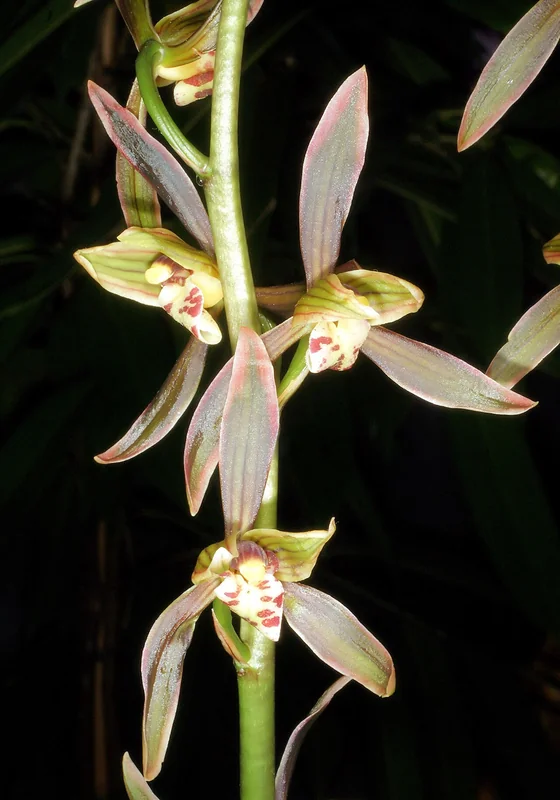 Featured photocymbidium-sinense.jpg
Cymbidium sinense is one of the five classic Chinese orchids revered in East Asian culture for over 3,000 years. It produces tall upright spikes of 10–20 fragrant flowers in deep wine-red, maroon, or near-black with a white-spotted lip, appearing in winter to early spring. Unlike modern hybrid cymbidiums it is a cool-intermediate grower with narrow, graceful, dark-green leaves and a refined, modest flower size. Its cultural significance in China, Japan, and Korea is enormous — it is a symbol of virtue, simplicity, and refined taste in literati painting and poetry.
Care facts at a glance
- Light
- Bright indirect
- Water
- Water every 7 days in the growing season; reduce to every 10 to 14 days in autumn and winter.
- Humidity
- 50–75 %
- Temperature
- 8–26 °C
- Soil
- Coarse orchid bark mix with perlite and some fine composted bark. Well-draining but slightly moisture-retentive.
- Origin
- Subtropical and montane forests of southern China, Taiwan, Vietnam, Myanmar, northeastern India, and Japan.
- Mature size
- Upright pseudobulbs with strap-like leaves to 60–80 cm long. Flower spikes erect, 50–70 cm tall.
Overview
Cymbidium sinense (Jacks.) Willd. was described in 1805 but has been in Chinese cultivation for millennia — Confucius himself compared the fragrance of orchids (likely this species) to virtue. It belongs to the traditional 'Oriental' or 'botanical' cymbidium group, quite different in character from the large-flowered modern hybrid cymbidiums of European horticulture. C. sinense is a cool-intermediate species from subtropical Chinese forests, producing multiple flower spikes on mature plants with 10–20 flowers per spike in winter — a bloom time valued in East Asian flower arranging traditions. The fragrance is subtle, sweet, and classic.
Care Priorities
- A cool autumn and winter (8–15 °C nights from September to December) is essential for initiating the winter flower spikes.
- Very bright indirect light in summer — some growers move established plants outdoors in a sheltered position to maximise summer light and temperature variation.
- Feed alternating high-nitrogen (spring/summer) and high-phosphorus (late summer/autumn) to build pseudobulbs and then initiate flowering.
- Repot every 2–3 years in spring; the pseudobulbs and roots quickly fill a container.
- Division should leave at least 3 pseudobulbs per division; single pseudobulbs rarely produce flowers the first year after separation.
Common Problems
Failure to produce flower spikes despite healthy growth almost always means insufficient light in summer and/or no cool autumn rest; move to a brighter spot and ensure night temperatures drop below 15 °C in autumn. Fusarium wilt causes yellowing and sudden collapse of individual pseudobulbs; remove affected tissue immediately with a sterile knife and treat the wound with fungicide — the disease can spread through a pot rapidly. Scale insects on pseudobulbs and under leaf sheaths are the most common pest; treat with horticultural oil. Aphids on emerging flower spikes damage the buds; spray off with water or treat with insecticidal soap.
Sources & further reading (2)
- botanical-garden — accessed 2026-05-27
- encyclopedia — accessed 2026-05-27
Frequently asked questions
Why is it so important in East Asian culture?
C. sinense is one of the 'Four Gentlemen' of Chinese art — alongside the plum blossom, chrysanthemum, and bamboo — representing refined character, modesty, and moral integrity. Confucius's writings reference orchid fragrance as a metaphor for virtuous company. The flower appears in Chinese painting for over 1,000 years and remains a popular motif in calligraphy and ceramic decoration.
Is it the same as hybrid cymbidiums?
No — modern hybrid cymbidiums are largely derived from different species and bred for large, colourful flowers on arching spikes. C. sinense is the original 'oriental cymbidium' valued for its narrow, graceful leaves, subtle wine-red flowers, and fragrance. The care is similar but C. sinense grows cooler and is less tolerant of central heating than many modern hybrids.
What does the flower smell like?
The fragrance is delicate, sweet, and green-floral — often described as the classic 'orchid scent' of East Asian poetry, subtle and refined rather than heavy. It is strongest in the morning and in cool conditions. The fragrance intensifies as more flowers on the spike open simultaneously.