Bulbophyllum lobbii
Bulbophyllum lobbii Care Guide
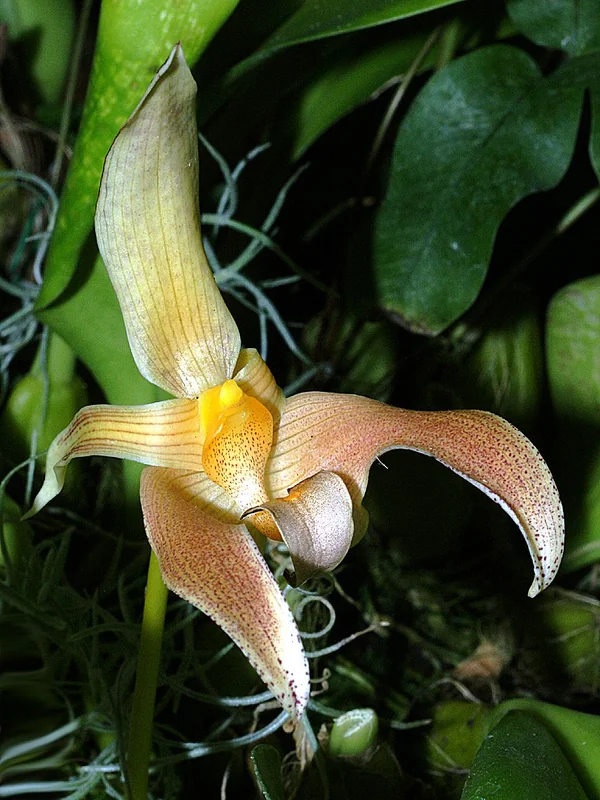 Featured photobulbophyllum-lobbii.jpg
Bulbophyllum lobbii is a robust epiphytic orchid from Southeast Asia producing unusually large, solitary flowers on individual stems from pseudobulb bases — creamy-yellow striped with fine purple-brown lines and a distinctive lip that rocks and oscillates with the slightest air movement. The oscillating lip is an insect-mimicry pollination mechanism. The flowers emit a rich, spicy-sweet fragrance. It is one of the largest-flowered and most rewarding Bulbophyllum species for cultivation, accessible to hobbyists with good light and warm conditions.
Care facts at a glance
- Light
- Bright indirect
- Water
- Water every 5 to 7 days during the growing season; allow a slight drying of the surface between waterings.
- Humidity
- 60–85 %
- Temperature
- 16–32 °C
- Soil
- Cork bark or tree fern mount with sphagnum at the roots, or coarse orchid bark in a slatted basket.
- Origin
- Lowland and submontane rainforests of Thailand, Malaysia, Borneo, Java, and the Philippines.
- Mature size
- Creeping rhizome with pseudobulbs spaced 4–6 cm apart; leaves to 20 cm. Flower stems 10–15 cm with one large flower.
Overview
Bulbophyllum lobbii Lindl. was described in 1847 and named for Thomas Lobb, the Veitch Nurseries collector who gathered specimens in Southeast Asia. It is one of the most spectacular species in the vast genus Bulbophyllum (over 2,000 species — the largest orchid genus). The oscillating lip is a sophisticated insect-deception mechanism: the rocking motion mimics a live insect, attracting specific fly pollinators. Despite its elaborate floral mechanics, B. lobbii is one of the more forgiving Bulbophyllum species; it is robust, fast-growing, and tolerates a wider range of conditions than many of its relatives.
Care Priorities
- Mount on cork bark to allow the creeping rhizome to spread naturally; in a pot the rhizome quickly runs out of space and production of new pseudobulbs slows.
- High humidity is important; the large flower collapses and drops early in very dry indoor air.
- Warm temperatures year-round — a brief cool period (to 16 °C) is tolerated but not beneficial.
- The creeping growth habit means the plant's centre becomes congested over time; divide every 3–4 years in spring, keeping 4–6 pseudobulbs per section.
- Bright indirect light (not direct sun) promotes flowering; deep shade results in vegetative growth without blooms.
Common Problems
Flower dropping before fully opening is usually caused by very low humidity or root dehydration at flowering time — increase humidity and ensure the mount or medium is consistently moist. Scale insects clustering on pseudobulbs and along the rhizome are the most common pest; treat with horticultural oil. Pseudobulbs shrivelling despite regular watering indicates root damage (rot or desiccation); repot or remount in fresh medium. The oscillating lip mechanism can be damaged by handling — do not touch the lip directly when the flower is open.
Sources & further reading (2)
- botanical-garden — accessed 2026-05-27
- encyclopedia — accessed 2026-05-27
Frequently asked questions
Why does the lip rock?
The lip (labellum) is attached to the flower by a flexible, hinged joint that allows it to rock in air currents. This motion mimics an insect moving on the flower and attracts female insects of certain fly species, which approach to investigate a potential mate and pick up or deposit pollen. The mechanism is genetically fixed and operates without any active control from the plant.
How large are the flowers?
Flowers are 5–7 cm across — large for the genus and unusually large for the Bulbophyllum group. The creamy-yellow ground colour with fine purple-brown striping is attractive, and the oscillating lip adds kinetic interest. Each flower spike carries one large flower and lasts 1–3 weeks.
Is it difficult to grow?
B. lobbii is among the most forgiving Bulbophyllum species. It tolerates standard indoor temperatures, is not extremely demanding about humidity, and mounts are easy to maintain with regular misting. Compared to many orchid genera it is straightforward once mounted correctly.