Ludisia discolor
Ludisia discolor Care Guide
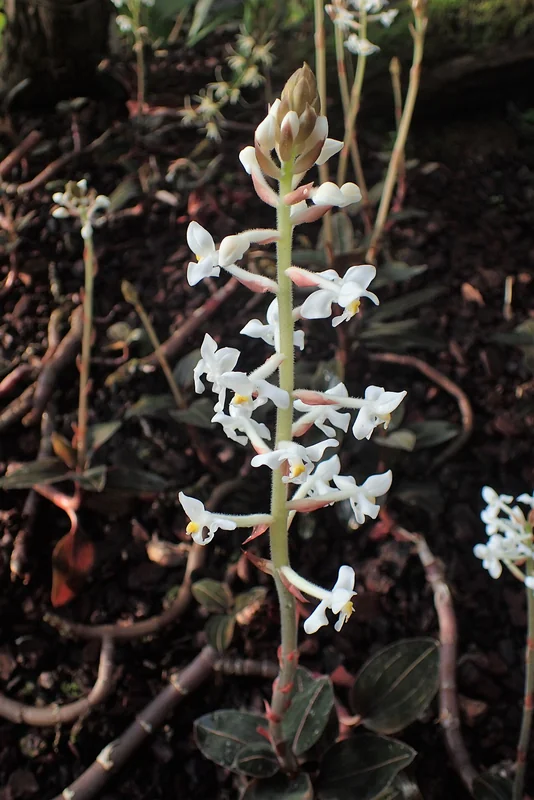 Featured photoludisia-discolor.jpg
Ludisia discolor is the most widely cultivated jewel orchid — a terrestrial Southeast Asian orchid prized exclusively for its extraordinary foliage: velvety, deep wine-red to near-black leaves with brilliant gold or copper-coloured midrib and lateral vein network that creates a jewel-like iridescent effect under light. Small white flowers on upright spikes appear in winter. Unlike most orchids, it is grown as a foliage plant and thrives in the warm, humid, lower-light conditions suitable for other tropical houseplants, making it unusually accessible for orchid growers.
Care facts at a glance
- Light
- Low light
- Water
- Keep consistently moist; water every 7 days when the top 1–2 cm dries.
- Humidity
- 60–85 %
- Temperature
- 18–30 °C
- Soil
- Moisture-retentive, airy terrestrial orchid mix: fine orchid bark, sphagnum moss, and perlite. Or standard peat-free potting compost with 20% perlite.
- Origin
- Humid lowland and montane forests of South and Southeast Asia — India, Myanmar, Thailand, Malaysia, Indonesia, and the Philippines.
- Mature size
- Creeping habit; stems 15–30 cm tall with leaves 5–8 cm long.
Overview
Ludisia discolor (Ker Gawl.) A.Rich. was described in 1825. It is the only species widely recognised in the genus Ludisia (though some taxonomists include it in the large genus Haemaria). Jewel orchids are a polyphyletic group of terrestrial orchids in the tribe Cranichideae valued for iridescent foliage rather than flowers — others include Macodes petola, Anoectochilus sikkimensis, and Dossinia marmorata. L. discolor's gold veining is produced by iridoplasts — chloroplasts modified into flat, disk-like structures that reflect gold-wavelength light. The effect is most vivid when light hits the leaf at a low angle.
Care Priorities
- Treat the watering regime more like a tropical foliage plant (consistent moisture) than a typical orchid (drying cycles); this species is unusual in Orchidaceae in its moisture preference.
- Bright indirect light shows the gold veining most vividly; the effect diminishes in very deep shade.
- Stem cuttings root extremely easily in water or moist sphagnum — propagation is straightforward and useful to regenerate leggy plants.
- High humidity is important for the velvety leaf texture; in dry air the leaves lose their sheen and may curl at the margins.
- Do not expose to direct sun; the dark leaves absorb heat rapidly and burn within hours.
Common Problems
Stem rot at the base is the most common problem, caused by waterlogged medium; ensure very free drainage and do not allow water to stand in the saucer. Leggy growth with long internodes indicates insufficient light — move to a brighter position; take cuttings from the stem tips and replant to create a fuller, bushier plant. Mealybugs shelter in leaf axils where the leaf meets the stem; inspect regularly and treat with diluted isopropyl alcohol on a cotton bud. Fungus gnats indicate overly moist medium surface; a layer of grit or fine perlite on the surface discourages egg-laying.
Sources & further reading (2)
- botanical-garden — accessed 2026-05-27
- encyclopedia — accessed 2026-05-27
Frequently asked questions
Do I need special orchid care for it?
No — L. discolor is the most beginner-friendly orchid species precisely because it does not need bark-mounted, air-drying, or high-light orchid care. It grows in warm, humid conditions with regular watering, similar to a tropical fern or calathea. If you can grow a calathea, you can grow a jewel orchid.
What do the flowers look like?
The flowers are small (1 cm), white, and borne in an upright spike 15–25 cm tall in winter. They are attractive up close but modest compared to the extraordinary foliage. Most growers remove flower spikes to redirect energy into leaf production, though this is personal preference.
Is the iridescent effect real or a coating?
Real — the gold veining is produced by iridoplasts (structurally modified chloroplasts) that reflect gold wavelengths via thin-film optical interference, identical in mechanism to the iridescence of butterfly wings. It cannot be rubbed off and is a genuine structural feature of the leaf cells.