Astrophytum myriostigma
Astrophytum myriostigma Care Guide
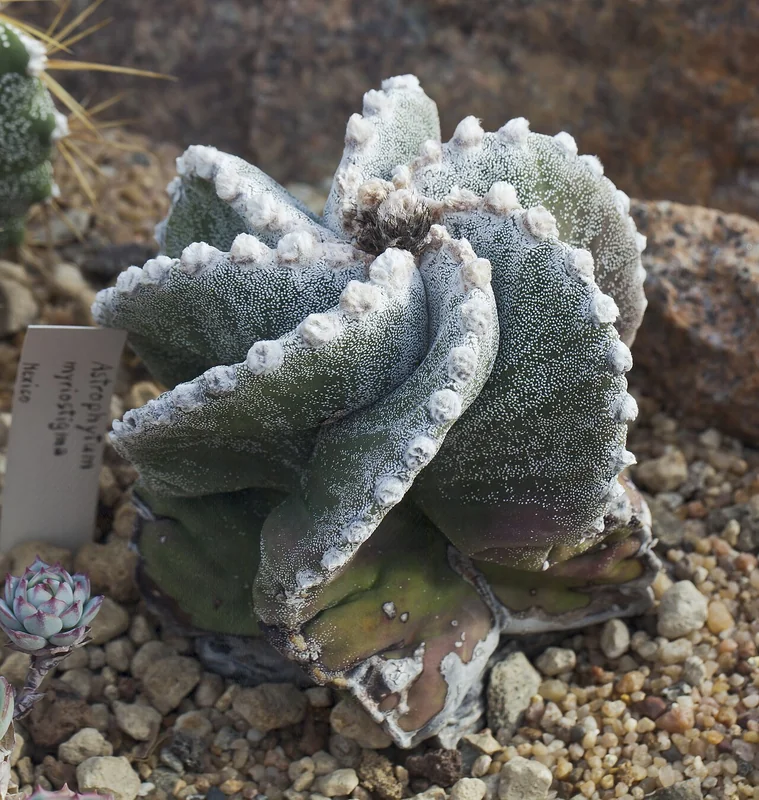 Featured photoastrophytum-myriostigma.jpg
Astrophytum myriostigma, the bishop's cap or bishop's mitre cactus, is a distinctive spineless Mexican cactus with a deeply ribbed, star-shaped cross-section — typically 4 to 8 ribs — covered in tiny white trichome dots that give the grey-green body a characteristic frosted appearance. It produces bright yellow flowers with an orange-red throat at the apex in spring and summer. Its spineless nature, architectural form, slow growth, and ease of care make it one of the most popular cacti for indoor collections and minimal-maintenance windowsill gardens.
Care facts at a glance
- Light
- Bright indirect
- Water
- Water when the substrate is completely dry; every 14 to 21 days in summer, once every 6 to 8 weeks in winter.
- Humidity
- 15–45 %
- Temperature
- 5–35 °C
- Soil
- Mineral-rich cactus mix: one part cactus compost to two parts coarse sand or perlite.
- Origin
- Limestone desert and rocky scrubland of the Chihuahuan Desert, Mexico (Tamaulipas, San Luis Potosí, Nuevo León, Coahuila).
- Mature size
- Globe to 15 to 30 cm diameter; rarely exceeds 20 cm in cultivation.
Overview
Astrophytum myriostigma was described by Lemaire in 1839. The genus name means 'star plant' (Latin: aster = star, phytum = plant), referring to the star-shaped cross-section of the ribbed body. The species name myriostigma means 'ten thousand dots' in Greek, referring to the numerous white trichome flecks that cover the surface. These dots are not spines but are small areoles producing white woolly hair that reflects sunlight and reduces heat absorption in the exposed limestone desert habitat. Several rib-number variants exist, from the classic 5-ribbed form ('bishop's mitre' resemblance) to 3, 4, 6, and 8-ribbed forms, all equally desirable in cultivation.
Care Priorities
- Strong, direct or bright indirect light is needed for compact, well-formed growth; the rib structure becomes less defined and the body paler under insufficient light.
- Being spineless means no physical defence against handling; the white dot surface is easily rubbed away by contact and takes time to regenerate.
- A strict dry winter rest with minimal watering is essential; Astrophytum is more cold-sensitive than many cacti at the root level and should be kept dry if temperatures drop below 5 °C.
- Grow from seed if possible — propagation is seed-only as this species does not naturally produce offsets.
Common Problems
Corking at the base — a brown, bark-like texture appearing from the bottom upward — is normal ageing and not disease; it does not affect plant health. Root mealybugs are difficult to detect and can cause mysterious decline; unpot and inspect the roots annually. Fungal stem rot at the base from overwatering progresses rapidly and is often fatal by the time it is noticed; always prioritise well-draining substrate and very infrequent winter watering. Rubbing or touching the white dot pattern causes permanent damage to the decorative surface; handle as little as possible.
Sources & further reading (2)
- botanical-garden — accessed 2026-05-08
- encyclopedia — accessed 2026-05-08
Frequently asked questions
Why are the white dots disappearing from the surface?
The white trichome dots are fragile and can be rubbed off by handling or by water spray. They do regenerate over time but this is slow. Always handle the plant from the base and avoid getting water on the body.
Can it be propagated vegetatively?
No — it does not offset naturally and cannot be propagated by cuttings as it lacks a viable meristem outside the apex. Seed is the only propagation method, and seedlings take many years to reach a presentable size.
How old does it need to be to flower?
Typically 5 to 10 years from seed before the first flowers appear. A plant already flowering at purchase has been growing for many years; treat it accordingly.