Amorphophallus konjac
Amorphophallus konjac Care Guide
 Featured photoamorphophallus-konjac.jpg
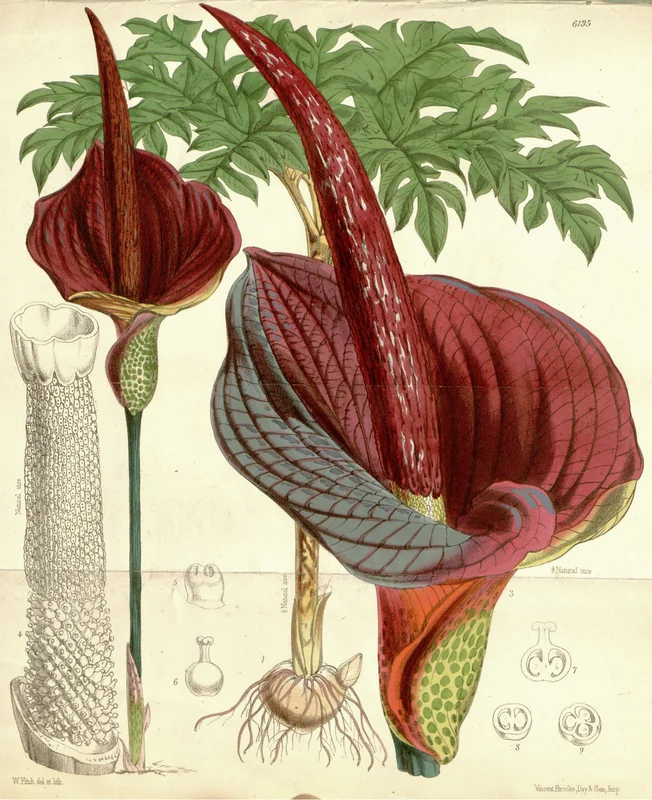
Amorphophallus konjac is a remarkable corm-forming aroid from East Asia that emerges each spring as a single, deeply dissected compound leaf that can reach 1.2 m across, held on a single spotted stalk resembling a snake's skin. In late winter, before the leaf appears, mature corms occasionally produce a striking, deep-purple inflorescence. The above-ground portion dies back completely in autumn, making it a fascinating seasonal indoor specimen.
Care facts at a glance
- Light
- Bright indirect
- Water
- Water generously during the growing season (spring–summer), allowing the top 3–4 cm to dry between waterings. Stop watering entirely in autumn when leaves yellow.
- Humidity
- 50–80 %
- Temperature
- 10–32 °C
- Soil
- Rich, loose, well-draining potting mix amended with coarse perlite or grit; good drainage is essential.
- Origin
- Warm temperate and subtropical forests of China, Japan, Korea, and Southeast Asia.
- Mature size
- Single leaf stalk 60–120 cm tall; leaf canopy 80–150 cm across.
Overview
Amorphophallus konjac has been cultivated in East Asia for over 2,000 years, primarily for its large starch-rich corm. As an ornamental, it is grown for the spectacular seasonal drama of a single compound leaf that unfurls from nothing in a matter of days. Mature corms weighing over 4 kg can produce inflorescences up to 1 m tall. The flowers emit a brief but pungent rotting odour to attract pollinators — typically a one- or two-day event.
Care Priorities
- Plant the corm in a deep, large pot (at least 35 cm wide for mature specimens) to give the extensive root system room.
- Feed consistently during the growing season — each year the corm grows substantially and needs fuel for next year's display.
- Allow a completely dry, cool dormancy (10–15 °C) for the corm after leaves die back in autumn.
- Repot every 1–2 years in fresh compost; the corm will have grown noticeably.
Common Problems
Failure to emerge in spring usually means the corm was kept too cold and wet during winter — inspect it for rot. A soft, hollow-sounding corm that collapses indicates wet storage rot; cut away all affected tissue, dust with fungicide, and dry the wound before replanting. The brief inflorescence odour, while striking, disappears within 1–2 days and is not a cause for concern. Rapid yellowing of leaves in late summer is normal dormancy behaviour, not a pest or disease issue.
Sources & further reading (2)
- botanical-garden — accessed 2026-05-27
- encyclopedia — accessed 2026-05-27
Frequently asked questions
Will it flower indoors?
Only mature, large corms (typically 2+ years old and weighing several kilograms) flower. The inflorescence appears before the leaf in late winter to spring and emits a brief rotting scent for 1–2 days. Smaller corms produce only the leaf.
How do I store the corm over winter?
Once the leaves have yellowed and died back naturally in autumn, lift the corm, let it dry for a week, then store it in paper or a paper bag at 10–15 °C in a dry, dark place. Do not let it freeze or get wet.
Does the konjac corm keep growing each year?
Yes — unlike bulbs that divide each year, the main konjac corm grows larger and heavier annually. Small offset cormels form around the base and can be separated to propagate new plants.