Amorphophallus bulbifer
Amorphophallus bulbifer Care Guide
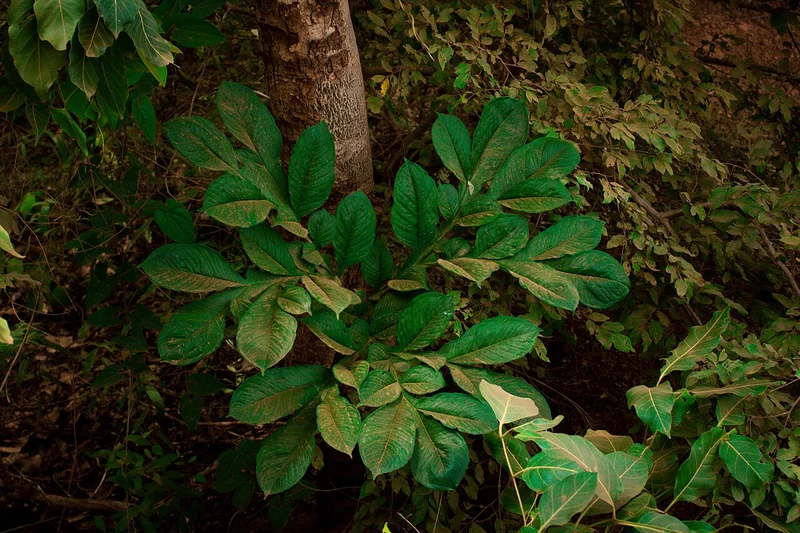 Featured photoamorphophallus-bulbifer.jpg
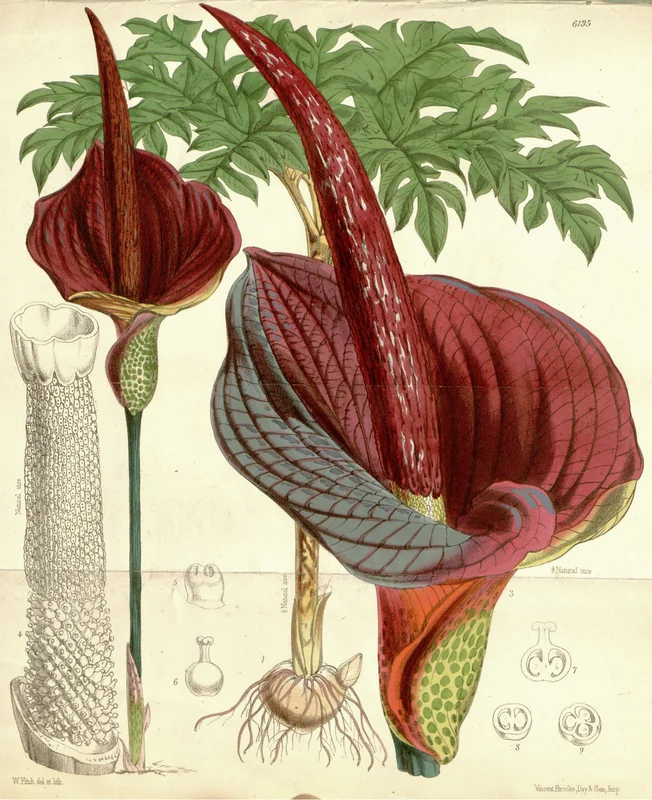
Amorphophallus bulbifer is a corm-forming aroid from the forests and thickets of India and Myanmar, grown for its broad, decorative compound leaf that arises on a single spotted petiole. The species produces small greenish-brown bulbils at the junction of the leaf branches, which drop off and readily root — a unique propagation strategy that sets it apart from other commonly grown Amorphophallus species. Like all in the genus, it goes fully dormant in winter.
Care facts at a glance
- Light
- Bright indirect
- Water
- Water when the top 3–4 cm of medium dries during the growing season. Stop watering once foliage begins to die back in autumn.
- Humidity
- 55–80 %
- Temperature
- 12–32 °C
- Soil
- Loose, well-draining potting mix with perlite and grit; fast drainage prevents corm rot.
- Origin
- Forest margins, thickets, and grasslands of northern India and Myanmar.
- Mature size
- Single leaf stalk 50–90 cm tall; leaf canopy 60–100 cm across.
Overview
Amorphophallus bulbifer was described by Blume in 1827. The species name 'bulbifer' refers directly to the bulbils — small vegetative propagules — that develop at the fork between the three main leaf branches. These drop naturally in autumn and can be collected and potted to grow into flowering-sized corms over several years. The inflorescence, which appears in late winter before the leaf on mature corms, is greenish-white with a muted odour, less intense than A. konjac.
Care Priorities
- Provide a bright, shaded spot — direct midday sun scorches the single leaf; too little light results in a weak, elongated petiole.
- Collect and pot bulbils in autumn when they fall naturally from the leaf junction.
- Allow complete dormancy from autumn through late winter; store the corm cool (12–15 °C) and dry.
- Repot into fresh compost each spring when new growth is starting.
Common Problems
Premature yellowing and collapse of the leaf stalk in midsummer (rather than autumn) can indicate corm rot, usually from overwatering. Unpot to inspect — a healthy corm should be firm and solid throughout. If rot is found, trim and dust with fungicide before replanting in dry medium. Failure to produce bulbils in a given year is often a sign that the plant is under-fertilised; increase feeding frequency slightly during the growing season.
Sources & further reading (2)
- botanical-garden — accessed 2026-05-27
- encyclopedia — accessed 2026-05-27
Frequently asked questions
How do I grow new plants from the bulbils?
Collect fallen bulbils in autumn and plant them just below the surface in small individual pots of well-draining mix. Keep slightly moist at room temperature. They will sprout in spring and reach flowering size in 3–5 years depending on growing conditions.
Does A. bulbifer produce an unpleasant smell?
The inflorescence emits a mild carrion scent for 1–2 days, far less intense than A. konjac. If the corm blooms indoors, simply move it outdoors or to a well-ventilated space for those 2 days.
Can I leave it in the pot year-round?
Yes, but once the foliage dies back in autumn, stop watering entirely and keep the pot in a cool, dry location. Resume watering in spring when new growth appears at the pot surface.