Canis lupus familiaris
Standard Schnauzer
 Featured photostandard-schnauzer.jpg
The Standard Schnauzer is a medium-sized German working dog of great antiquity, the ancestral form from which the Giant Schnauzer and Miniature Schnauzer were developed. The breed is depicted in works by Albrecht Dürer from 1492 and Lucas Cranach the Elder from 1501. Originally a rat catcher, stable dog, and general-purpose farm worker in Bavaria and Württemberg, the breed was formally standardised in the late 19th century. The AKC admitted the Standard Schnauzer in 1904 and places it in the Working Group. Males stand 45–50 cm.
Quick facts
- AKC group
- Working
- Origin country
- Germany
- Origin period
- Medieval, standardised late 19th century
- Coat type
- Wirehaired
- Coat colors
- Pepper and Salt, Pure Black
- Average lifespan
- 13-16 years
- Recognition
- AKC 1904 · FCI 1955 · UKC 1948 · Group 2 — Pinscher and Schnauzer-Molossoid Breeds, Swiss Mountain and Cattle Dogs (Section 1: Pinscher and Schnauzer type)
Origin
The Standard Schnauzer is the ancestral form of the three Schnauzer sizes. Albrecht Dürer's 1492 painting 'Madonna with Many Animals' (Gemäldegalerie, Berlin) contains a dog that is virtually identical to the modern Standard Schnauzer in profile, coat, and head type. Lucas Cranach the Elder's 1501 'Der Hirschjagd' (The Stag Hunt) includes a similar dog. These artistic records indicate that a stable, recognisable Schnauzer type existed in southern Germany by at least 1492. The breed's traditional working roles were rat-catching and stable guarding in Bavaria and Württemberg.
Recognition
The breed was exhibited at German shows from the 1870s as the 'Wirehaired Pinscher'. At the 1879 Hanover show, the name 'Schnauzer' was introduced — derived from the German 'Schnauze' (snout) in reference to the breed's distinctive beard and whiskers. The Pinscher-Schnauzer Klub was founded in Germany in 1895 to manage both breeds. The AKC admitted the Standard Schnauzer in 1904, making it one of the earliest-recognised German breeds in America. The FCI registered the breed in 1955 under standard No. 182.
Standard
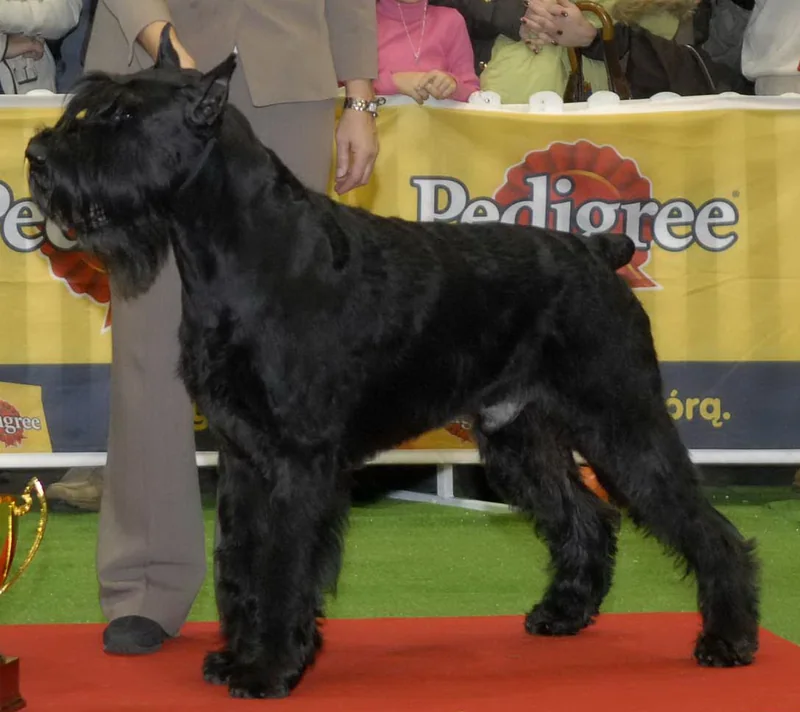
The FCI and AKC standards describe a square-built, robust, sinewy dog with a rectangular head, arched eyebrows, a prominent beard and whiskers, and a hard, wiry coat. Only two colours are recognised: pepper and salt (a grey-and-white banded outer coat giving a salt-and-pepper effect) and pure black with a black undercoat. The coat is close-lying with a dense undercoat; show dogs are hand-stripped. Males stand 45–50 cm; females 44–47 cm. The Standard Schnauzer is the foundation from which the Giant Schnauzer (developed from the Standard and local cattle dogs) and Miniature Schnauzer (developed by crossing the Standard with Affenpinscher) were subsequently created.
Sources & further reading (3)
- kennel-club-registry — accessed 2026-05-27
- encyclopedia — accessed 2026-05-27
- fci-standard — accessed 2026-05-27
Frequently asked questions
What is the difference between the three Schnauzer sizes?
The Standard Schnauzer (45–50 cm) is the ancestral form, documented in German art from 1492. The Giant Schnauzer (60–70 cm) was developed in Bavaria in the 19th century by crossing the Standard with local cattle-driving dogs and possibly the Great Dane, to produce a larger working dog. The Miniature Schnauzer (30–35 cm) was created by crossing the Standard with the Affenpinscher for a compact ratter. The AKC places the Standard and Giant in the Working Group and the Miniature in the Terrier Group.
When was the Standard Schnauzer recognised by the AKC?
The AKC admitted the Standard Schnauzer in 1904, making it one of the earliest German breeds recognised in the United States. The FCI registered the breed under standard No. 182 in 1955, classifying it in Group 2, Section 1 (Pinscher and Schnauzer type) with Germany as patron country.
What does 'Schnauzer' mean?
The name derives from the German 'Schnauze', meaning snout or muzzle, in reference to the breed's prominent beard and whiskers which frame the muzzle. The name was formally introduced at the 1879 Hanover Dog Show, replacing the earlier designation 'Wirehaired Pinscher'. The word 'Schnauzer' is also used colloquially in German to describe a person with a moustache.