Canis lupus familiaris
Boxer
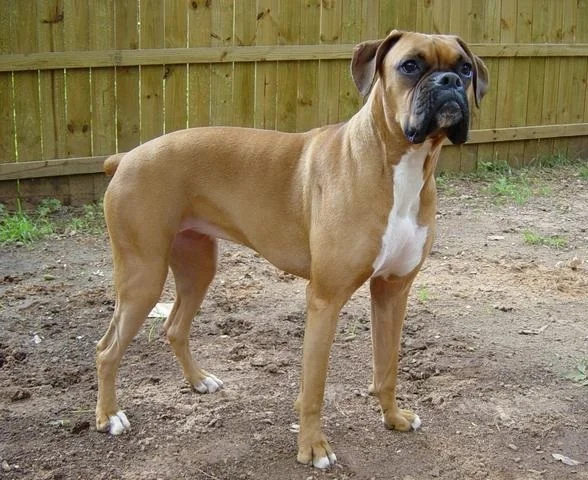 Featured photoboxer.jpg
The Boxer is a German bull-baiter (Bullenbeisser) crossed with English Bulldog in 19th-century Munich. The Boxer was developed in late-19th-century Germany by crossing the now-extinct Bullenbeisser (a German bull-baiting dog descended from medieval Molossus types) with the English Bulldog.
Quick facts
- AKC group
- Working
- Origin country
- Germany
- Origin period
- Late 19th century
- Coat type
- Short
- Coat colors
- Fawn, Brindle, with white markings
- Average lifespan
- 10-12 years
- Recognition
- AKC 1904 · FCI 1955 · UKC 1949 · Group 2 — Pinscher and Schnauzer-Molossoid breeds-Swiss Mountain and Cattle Dogs (Section 2.1: Molossoid breeds, Mastiff type)
Origin
The Boxer descends from the now-extinct Bullenbeisser (German for 'bull-biter'), a medium-sized hunting and bull-baiting dog descended from medieval Molossus stock and used in the German states from the 17th century onward to hold large game (bear, wild boar, bull) by the head until the hunter arrived. After the abolition of bull-baiting and the decline of large-game hunting in 19th-century Germany, the Bullenbeisser was crossed with the English Bulldog brought to Munich in the 1860s. Three Munich breeders — Friedrich Roberth, Elard König, and Rudolf Höpner — fixed the modern type in the 1890s; the Deutsche Boxer-Klub was founded in 1895 and the first standard published in 1902.
Recognition
The American Kennel Club admitted the breed in 1904, the United Kennel Club followed in 1949, and the Federation Cynologique Internationale published the international standard (FCI No. 144) in 1955. The FCI assigns the breed to Group 2 — Pinscher and Schnauzer-Molossoid breeds-Swiss Mountain and Cattle Dogs (Section 2.1: Molossoid breeds, Mastiff type).
Standard
The AKC and FCI standards describe a medium-sized, square-built, smooth-coated dog of great strength and short, broad muzzle. The undershot jaw is a defining breed feature, inherited from the Bullenbeisser working role. The short, hard, shiny coat lies smooth and tight on the body. Recognized colours are fawn (ranging from light tan to mahogany) and brindle, with or without white markings — pure white is disqualified. Males stand 57-63 cm at the withers, females 53-60 cm.
Sources & further reading (3)
- kennel-club-registry — accessed 2026-05-04
- encyclopedia — accessed 2026-05-04
- fci-standard — accessed 2026-05-04
Frequently asked questions
What is the Boxer's AKC group?
The American Kennel Club places the Boxer in the Working Group. The Working Group gathers breeds developed for jobs other than herding or hunting — guarding, draft, sled work, and water rescue — including the Boxer, Rottweiler, Saint Bernard, and Newfoundland. The breed's foundation working role was as a German bull-baiter (Bullenbeisser) crossed with English Bulldog in 19th-century Munich.
When was the Boxer officially recognized?
The American Kennel Club admitted the breed in 1904; the United Kennel Club followed in 1949; the Federation Cynologique Internationale published the international standard (FCI No. 144) in 1955.
What is the average lifespan of a Boxer?
Kennel-club longevity surveys place the Boxer's average lifespan in the 10-12 years range. The figure here represents the spread reported by the major parent-club studies and the Kennel Club (UK) purebred-dog health surveys.