Canis lupus familiaris
Giant Schnauzer
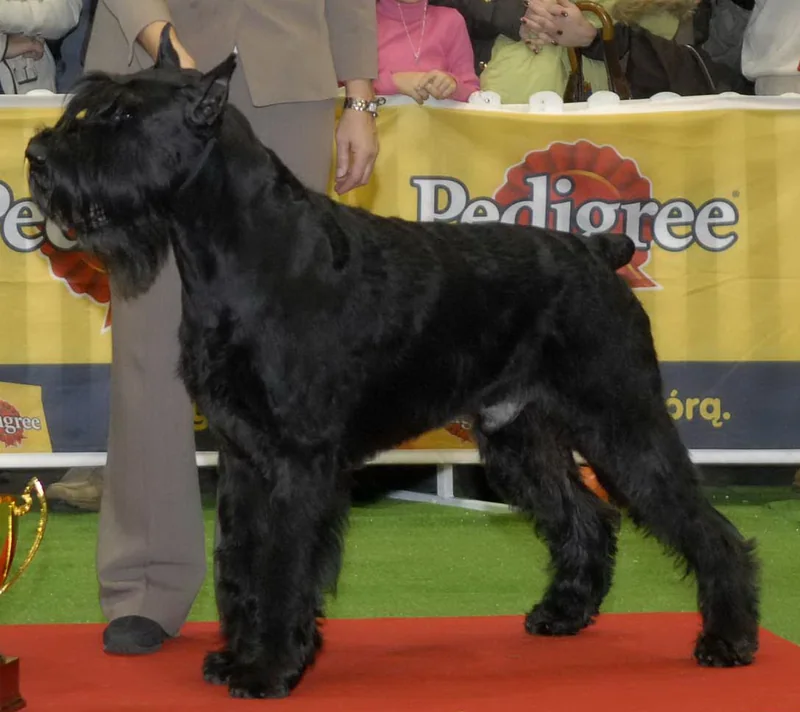 Featured photogiant-schnauzer.jpg
The Giant Schnauzer is the largest of the three Schnauzer breeds and one of Germany's most capable working dogs. Developed in Württemberg and Bavaria as a cattle-driving dog, it transitioned to police and military work, serving in both World Wars. Its distinctive beard, bushy eyebrows, and salt-and-pepper or solid black wire coat are unmistakable hallmarks. The AKC recognised the breed in 1930. Males stand 65–70 cm and weigh 25–48 kg.
Quick facts
- AKC group
- Working
- Origin country
- Germany
- Origin period
- 17th century
- Coat type
- Wirehaired
- Coat colors
- Black, Salt and Pepper
- Average lifespan
- 12-15 years
- Recognition
- AKC 1930 · FCI 1954 · UKC 1948 · Group 2 — Pinscher and Schnauzer-Molossoid Breeds, Swiss Mountain and Cattle Dogs (Section 1.3: Schnauzers)
Origin
The Giant Schnauzer was created in the Württemberg and Bavaria regions of southern Germany, where drovers needed a larger version of the Standard Schnauzer to drive cattle along mountain roads between farms and city markets. The breed was developed by crossing Standard Schnauzers with larger working breeds including the Bouvier des Flandres, rough-coated German cattle dogs, and possibly the Great Dane and Rottweiler. By the mid-19th century a consistent type had emerged, known regionally as the Munich Schnauzer or Munchener. The breed was shown at Munich dog shows from the 1880s onward.
Recognition
The Pinscher-Schnauzer-Klub (PSK), founded in Germany in 1895, registered the Giant Schnauzer in the early 20th century. Munich Police began training the breed as a service dog before World War I, validating its working intelligence and drive. The FCI (FCI No. 181) recognised the Giant Schnauzer in 1954, placing it in Group 2 alongside the Standard and Miniature Schnauzers. The AKC admitted the breed in 1930, classifying it in the Working Group.
Standard
The AKC and FCI standards describe a large, powerful, squarely built working dog, compact and strong with a reliable temperament and superior intelligence. The head is strong and long with a powerful muzzle and a distinctive thick beard and eyebrows. The double coat has a harsh, wiry, close-lying outercoat and a dense undercoat. Recognised colours are solid black and salt-and-pepper (a pepper-and-salt grey from the banded hairs); no white is permissible beyond a small chest spot. Males stand 65–70 cm; females 59–65 cm.
Sources & further reading (3)
- kennel-club-registry — accessed 2026-05-07
- encyclopedia — accessed 2026-05-07
- fci-standard — accessed 2026-05-07
Frequently asked questions
What AKC group does the Giant Schnauzer belong to?
The AKC places the Giant Schnauzer in the Working Group. The breed was developed in Germany for cattle driving and later transitioned to police and military service — roles that place it in the Working Group alongside other large guard and service breeds. The FCI classifies all three schnauzer sizes (Miniature, Standard, Giant) in Group 2 (Pinscher and Schnauzer types).
How does the Giant Schnauzer differ from the Standard and Miniature Schnauzers?
The three schnauzer sizes share the same characteristic beard, bushy eyebrows, and salt-and-pepper or black wire coat, but differ significantly in size and primary function. The Giant Schnauzer (65–70 cm, 25–48 kg) was developed for cattle driving and police/military work. The Standard Schnauzer (45–50 cm, 14–20 kg) was the original farm and rat-catching dog. The Miniature Schnauzer (30–36 cm, 4–8 kg) was developed for ratting from the Standard. Only the Standard is in the AKC Terrier Group; the Miniature is also in the Terrier Group; the Giant is in the Working Group.
When was the Giant Schnauzer recognised by the AKC?
The AKC recognised the Giant Schnauzer in 1930, placing it in the Working Group. The FCI had recognised it in 1954 (FCI No. 181). The breed's formal registration in Germany began under the Pinscher-Schnauzer-Klub, founded in 1895, and Munich police training established its working credentials in the early 20th century.