Canis lupus familiaris
Stabyhoun
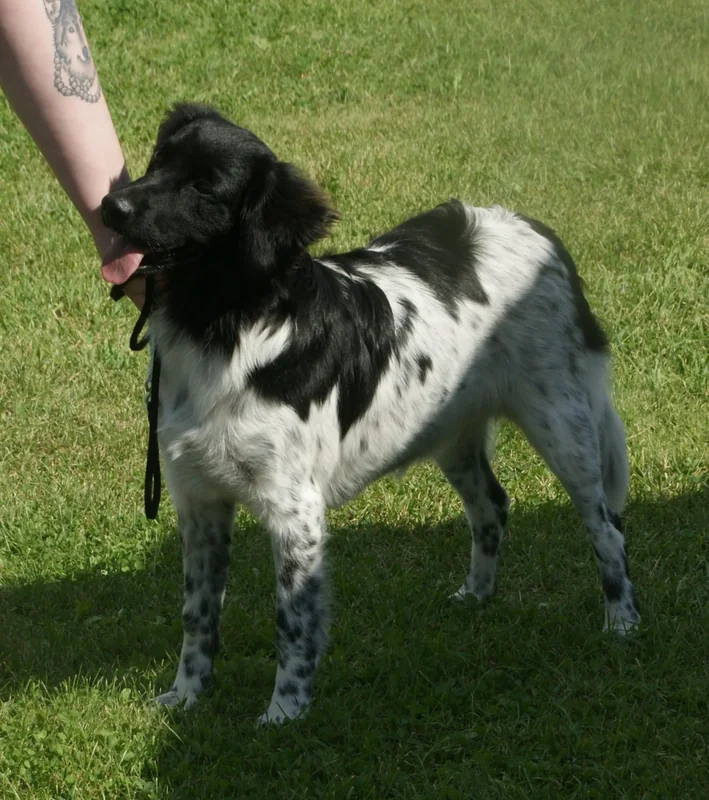 Featured photostabyhoun.jpg
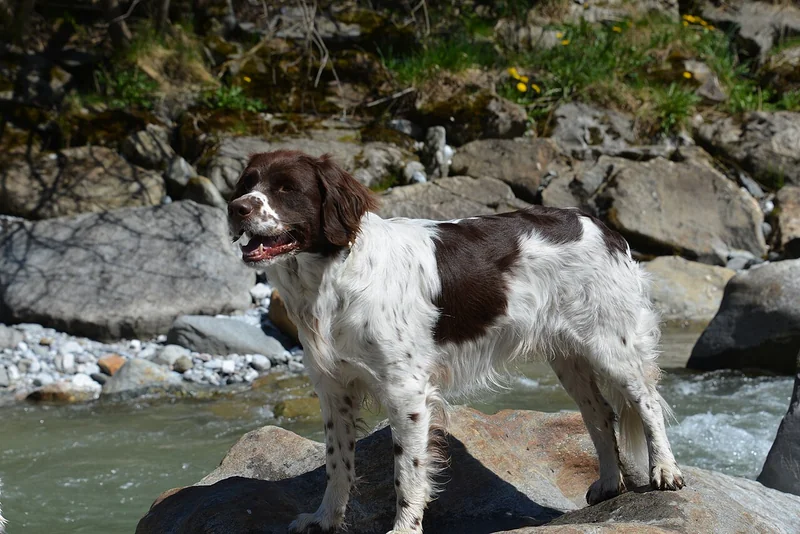
The Stabyhoun is a medium-sized Dutch pointing spaniel native to the Frisian clay district of the northern Netherlands, where it developed from 17th-century Continental setting spaniels as a dual-purpose farm dog and game hunter. The FCI registers it as No. 222; the breed has been AKC Foundation Stock Service listed and is gaining recognition across Europe and North America. With an estimated worldwide population under 7,000 registered dogs, the Stabyhoun is one of the world's rarest breeds. Males stand 53–55 cm.
Quick facts
- AKC group
- Sporting
- Origin country
- Netherlands
- Origin period
- 17th century
- Coat type
- Medium
- Coat colors
- Black and White, Brown and White, Orange and White
- Average lifespan
- 13-15 years
- Recognition
- FCI 1942 · Group 7 — Pointing Dogs (Section 1.2: Continental Pointing Dogs, Spaniel type)
Origin
The Stabyhoun is one of the oldest Frisian breeds and one of the rarest dogs in the world. It developed in the clay district of Friesland in the northern Netherlands, a region isolated by extensive waterways that helped preserve the breed's original character. The dog was an all-purpose farm tool: it hunted small game (principally rabbit and waterfowl), retrieved from water, and guarded the farmyard. Contemporary references describe the breed in the clay districts of Friesland from the early 19th century, though its continental spaniel ancestry traces to the 16th and 17th centuries.
Recognition
The Nederlandse Stabyhoun Vereniging was founded in 1942 and immediately registered the breed with the Raad van Beheer (Dutch Kennel Club), which granted recognition the same year. The FCI recognised the Stabyhoun under standard No. 222, assigning it to Group 7, Section 1.2 (Continental Pointing Dogs, Spaniel type) with the Netherlands as patron country. The breed is also recognised by the Kennel Club (UK), the Swedish Kennelklubben, and several other European clubs. It is listed in the AKC Foundation Stock Service.
Standard
The FCI standard describes a medium-sized, slightly longer-than-tall dog with a broad, slightly domed skull and a long, straight muzzle. The coat is long on the body, with flat or slightly wavy texture, a plume on the tail, and feathering on the ears and backs of the legs. Recognised colours are black and white, brown and white, and orange and white; ticking and roan patterns are permitted. Males stand 53–55 cm; females 50–53 cm. The breed is notable for its moderate, balanced build and long, low-set tail that reaches the hock.
Sources & further reading (3)
- fci-standard — accessed 2026-05-27
- encyclopedia — accessed 2026-05-27
- breed-club — accessed 2026-05-27
Frequently asked questions
How rare is the Stabyhoun?
The Stabyhoun is one of the world's rarest dog breeds, with the worldwide registered population estimated at fewer than 7,000 dogs, the majority located in the Netherlands. The Nederlandse Stabyhoun Vereniging maintains strict controls on breeding to preserve genetic diversity while preventing the population from becoming too large to manage responsibly. The breed has gained small but growing followings in the United Kingdom, United States, Canada, and Scandinavia.
What does 'Stabyhoun' mean?
The name's etymology is debated among Frisian historians. The most popular interpretation derives it from the Dutch phrase 'sta mij bij' (stand by me), reflecting the dog's role as a loyal working companion. An alternative theory links it to 'staby' (stable or farmstead), placing emphasis on the dog's origin as a farm utility dog rather than a specialised hunting dog.
What FCI group is the Stabyhoun in?
The FCI assigns the Stabyhoun to Group 7 — Pointing Dogs, Section 1.2 (Continental Pointing Dogs, Spaniel type), FCI No. 222. The Netherlands is patron country. The Stabyhoun and the Drentsche Patrijshond are the two Dutch breeds classified in Group 7 and share a broad ancestry from Continental setting spaniels.