Canis lupus familiaris
Kooikerhondje
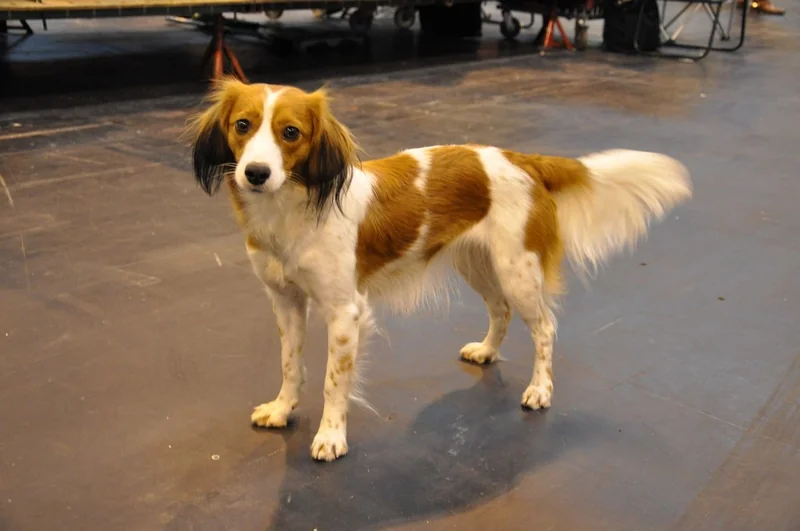 Featured photokooikerhondje.jpg
The Kooikerhondje is a small Dutch spaniel historically used to lure ducks into funnel traps called eendenkooi by frolicking along the water's edge. The breed appears in 17th-century Dutch Golden Age paintings by Jan Steen and Rembrandt, attesting to its long history as a duck-hunting companion. Nearly exterminated during World War II, the breed was revived from a handful of dogs by Baroness van Hardenbroek van Ammerstol in 1939. The Netherlands Kennel Club recognised it in 1966; the AKC admitted it in 2018. Males and females stand 35–40 cm and weigh 9–11 kg.
Quick facts
- AKC group
- Sporting
- Origin country
- Netherlands
- Origin period
- 17th century
- Coat type
- Medium
- Coat colors
- Orange-Red with White, Red with White
- Average lifespan
- 12-15 years
- Recognition
- AKC 2018 · FCI 1990 · UKC 1996 · Group 8 — Retrievers, Flushing Dogs, Water Dogs (Section 2: Flushing Dogs)
Origin
The word 'Kooikerhondje' means 'little dog of the cager' (eendenkooi hunter) in Dutch — a reference to the breed's traditional role in luring ducks along narrow, reed-bordered channels into pipe traps where they were caught live for the feather and food trade. The dog's cheerful, playful behaviour near the water attracted curious ducks; its bushy, black-tipped ear fringes, called 'earrings', may have mimicked the appearance of small waders that ducks associate with safety. The same technique — called tolling — is used by the Nova Scotia Duck Tolling Retriever, a breed likely influenced by Dutch immigrants who brought Kooiker-type dogs to North America.
Recognition
The breed was nearly lost during World War II, when Dutch domestic dog populations declined severely. Baroness van Hardenbroek van Ammerstol located a surviving female, Tommy, in 1939 and systematically rebuilt the breed. The Netherlands Kennel Club (Raad van Beheer) officially recognised the Kooikerhondje in 1966. The FCI granted recognition in 1990 (FCI No. 314). The AKC entered the breed in the Miscellaneous Class in 2016 and granted full Sporting Group recognition in 2018.
Standard
The FCI and AKC standards describe a small, well-proportioned spaniel-type dog, slightly longer than tall, with a friendly and alert expression. The coat is medium length, straight or slightly wavy, with a dense undercoat; the distinctive feature is the long, black-tipped feathering on the ears known as 'earrings'. The coat is orange-red with clear white patches, with no overlapping of the two colours. Males and females both stand 35–40 cm and weigh 9–11 kg.
Sources & further reading (3)
- kennel-club-registry — accessed 2026-05-07
- encyclopedia — accessed 2026-05-07
- fci-standard — accessed 2026-05-07
Frequently asked questions
What AKC group is the Kooikerhondje in?
The AKC places the Kooikerhondje in the Sporting Group. The breed is classified as a flushing/tolling spaniel — it was historically used to lure (toll) ducks into pipe traps and also to flush birds for hunters. The AKC granted full Sporting Group recognition in 2018, making the Kooikerhondje one of the more recently recognised breeds in the group.
What are the distinctive 'earrings' on the Kooikerhondje?
The Kooikerhondje has long, black-tipped ear fringes on the outer edges of the ear that are colloquially called 'earrings'. These are a breed-specific trait mentioned in the FCI standard. One theory holds that these distinctive markings mimicked the black-and-white pattern of certain wading birds that wild ducks associate with safe feeding areas, thus helping the dog lure ducks more effectively into the eendenkooi pipe traps.
How was the Kooikerhondje saved from extinction?
By the 1930s the breed had nearly disappeared, and during World War II the Dutch dog population declined further. Baroness van Hardenbroek van Ammerstol initiated a revival by locating surviving dogs in 1939, finding a female named Tommy that became the cornerstone of the modern breed's recovery. A structured breeding program was established, and the Netherlands Kennel Club recognised the revived breed in 1966.