Canis lupus familiaris
German Shepherd
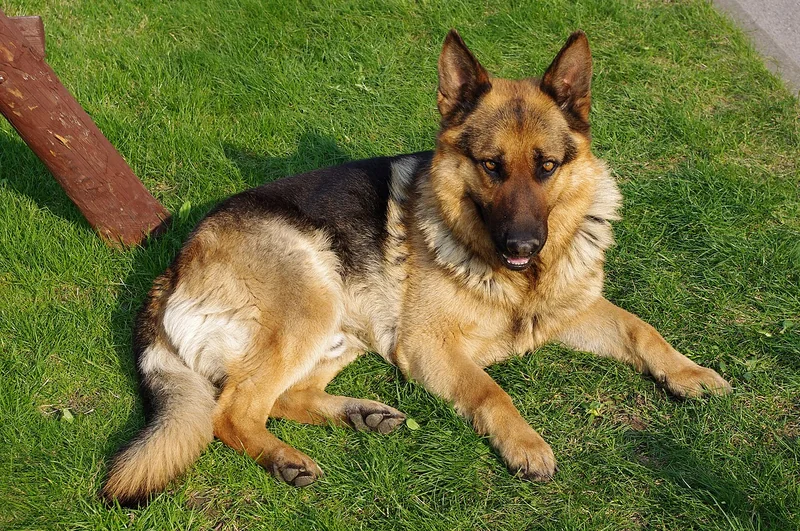 Featured photogerman-shepherd.jpg
The German Shepherd (Deutscher Schäferhund) is a medium-to-large herding breed standardized in Germany at the end of the 19th century. The first registered dog, Horand von Grafrath, was acquired in April 1899 by Captain Max von Stephanitz, who founded the Verein für Deutsche Schäferhunde the same month. The AKC admitted the breed in 1908; the FCI assigns it to Group 1. The standard describes a slightly elongated, muscular dog 55 to 65 cm at the withers with a dense double coat.
Quick facts
- AKC group
- Herding
- Origin country
- Germany
- Origin period
- Late 19th century
- Coat type
- Double
- Coat colors
- Black and Tan, Sable, Solid Black, Black and Red, Black and Cream, Black and Silver
- Average lifespan
- 9-13 years
- Recognition
- AKC 1908 · FCI 1955 · UKC 1918 · Group 1 — Sheepdogs and Cattledogs (Section 1: Sheepdogs)
Origin
Captain Max von Stephanitz registered Horand von Grafrath as the first German Shepherd on 22 April 1899 and founded the Verein für Deutsche Schäferhunde (SV) the same day. Stephanitz's foundational programme drew on the working herding strains of Thuringia, Württemberg, and Bavaria, selecting for biddability, endurance, and physical structure suited to the sustained trotting gait used to manage flocks across uneven terrain. The SV remains the breed's parent club in the country of origin and continues to maintain the international stud-book.
Recognition
The American Kennel Club admitted the German Shepherd in 1908. The Kennel Club (UK) registered the breed in 1919 under the substitute name 'Alsatian Wolf Dog' — a post-First-World-War concession to anti-German sentiment — shortened to 'Alsatian' in 1936 and finally restored to 'German Shepherd Dog' in 1977. The FCI's standard (FCI No. 166) is held by the SV on behalf of the country of origin (Germany).
Standard
The AKC and FCI standards describe a slightly elongated, well-muscled dog with a powerful, far-reaching trot. The double coat exists in two recognized varieties: stock-coated (medium length, dense outer coat with undercoat) and long stock-coated (longer outer coat with feathering, with undercoat). Recognized colours include black-and-tan, sable, solid black, and several pattern variants; pure white is disqualified under the FCI standard but accepted by the UKC's separate White Shepherd standard. Males stand 60-65 cm at the withers, females 55-60 cm.
Sources & further reading (3)
- kennel-club-registry — accessed 2026-04-29
- encyclopedia — accessed 2026-04-29
- fci-standard — accessed 2026-04-29
Frequently asked questions
What is the German Shepherd's AKC group?
The American Kennel Club places the German Shepherd Dog in the Herding Group. The Herding Group, established by the AKC in 1983 (carved out of the older Working Group), gathers breeds historically used to control the movement of livestock — collies, sheepdogs, corgis, and the German Shepherd among them. The Shepherd's foundation purpose was tending sheep flocks across the agricultural landscapes of late-19th-century Germany.
When was the German Shepherd officially recognized?
Captain Max von Stephanitz registered the foundation dog Horand von Grafrath on 22 April 1899, the date the breed itself dates from. The American Kennel Club admitted the breed in 1908, and the FCI standard (FCI No. 166) is maintained on behalf of the country of origin Germany. The Kennel Club (UK) registered the breed in 1919 under the temporary name 'Alsatian', restoring 'German Shepherd Dog' in 1977.
What is the average lifespan of a German Shepherd?
Kennel-club longevity surveys report an average lifespan of approximately 9 to 13 years, with the Kennel Club (UK) 2004 purebred-dog health survey median sitting at 10.95 years. Lifespan figures vary across registries and survey methodologies; the range here represents the spread reported by the major parent-club studies.