Canis lupus familiaris
Bracco Italiano
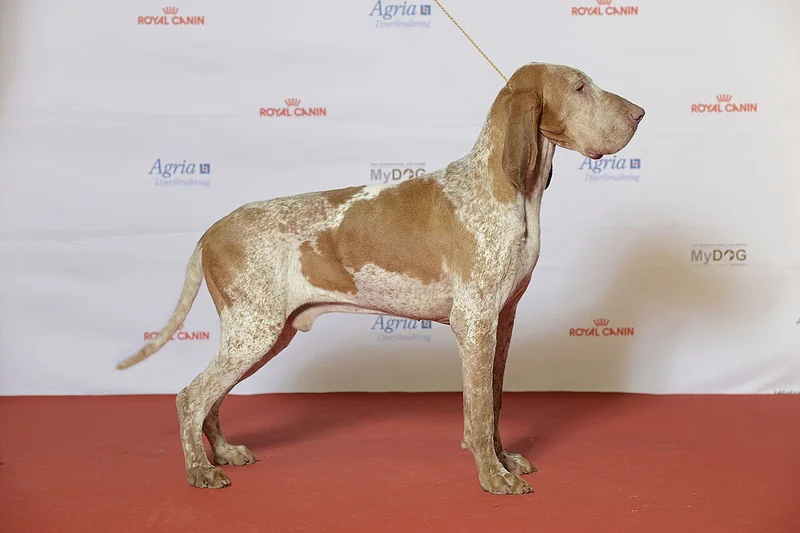 Featured photobracco-italiano.jpg
The Bracco Italiano is a large, powerful Italian pointing dog considered the oldest European gundog breed, with depictions traceable to ancient Roman bas-reliefs and documented in the Medici and Gonzaga courts from the 14th century. The breed existed in two regional varieties — the heavier Piedmontese and the lighter Lombard — that were unified into a single standard by the Società Amatori Bracco Italiano in 1949. The FCI registers it as No. 202; the AKC admitted the breed in 2022. Males stand 58–67 cm.
Quick facts
- AKC group
- Sporting
- Origin country
- Italy
- Origin period
- Ancient, documented from 14th century
- Coat type
- Short
- Coat colors
- White and Orange, White and Chestnut, White and Amber, Roan Orange, Roan Chestnut
- Average lifespan
- 11-13 years
- Recognition
- AKC 2022 · FCI 1956 · UKC 2006 · Group 7 — Pointing Dogs (Section 1.1: Continental Pointing Dogs, Braque type)
Origin
The Bracco Italiano's origins are among the most ancient of any European sporting dog. Roman bas-reliefs and mosaics from the 1st and 2nd centuries AD depict pointing dogs with the characteristic pendulous lips and long ears of the modern Bracco. Italian cynologists generally credit the breed to early crosses between the Segugio Italiano (a scent hound) and Asiatic Mastiff-type dogs that reached the Italian peninsula through trade routes. By the 14th and 15th centuries, the Medici and Gonzaga courts maintained Bracco kennels and dispatched dogs as diplomatic gifts to the courts of France, Germany, and Spain, which influenced the development of several Continental pointing breeds.
Recognition
The Società Amatori Bracco Italiano (SABI), founded in 1949, unified the Piedmontese and Lombard regional varieties under a single standard and began organising field trials and conformation shows. The FCI registered the Bracco Italiano under standard No. 202 in 1956, with Italy as patron country; it is placed in Group 7, Section 1.1 (Continental Pointing Dogs, Braque type). The UKC recognised the breed in 2006. The AKC admitted the Bracco Italiano in 2022, its most recent addition to the Sporting Group at the time of writing.
Standard
The FCI and AKC standards describe a large, muscular, well-balanced dog with a lean, sculpted head, long pendulous ears, and a distinctive 'lemon squeezer' muzzle profile with prominent, pendulous lips. The short, dense, glossy coat comes in white and orange, white and chestnut, and roan patterns. The build is powerful but elegant — the neck is arched, the back strong, and the hindquarters well-angulated for the characteristic slow, methodical trot in the field. Males stand 58–67 cm and weigh 25–40 kg.
Sources & further reading (3)
- kennel-club-registry — accessed 2026-05-27
- encyclopedia — accessed 2026-05-27
- fci-standard — accessed 2026-05-27
Frequently asked questions
Is the Bracco Italiano the oldest pointing breed?
The Bracco Italiano is widely considered the oldest European pointing breed still in existence, with depictions of pointing dogs in ancient Roman mosaics and bas-reliefs believed to represent its ancestors. The breed is documented unambiguously in the 14th century courts of the Medici and Gonzaga families in Italy, earlier than most other Continental pointing breeds. However, establishing exact lineages is difficult across such spans of time, and other breeds also claim ancient origins.
When did the AKC recognise the Bracco Italiano?
The AKC granted the Bracco Italiano full recognition in 2022, placing it in the Sporting Group. The breed had been listed in the AKC Foundation Stock Service (FSS) before full recognition. The FCI had registered the breed since 1956 under standard No. 202, and the UKC admitted the breed in 2006.
What were the two regional varieties of the Bracco Italiano?
Before 1949, two regional varieties existed. The Bracco Piemontese from Piedmont was heavier, with denser bone, and often carried a roan coat. The Bracco Lombardo from Lombardy was lighter and more elegant, typically with an orange-and-white coat. The Società Amatori Bracco Italiano unified the two into a single breed standard in 1949, describing a moderate type that encompasses both historical builds.