Canis lupus familiaris
Bergamasco Sheepdog
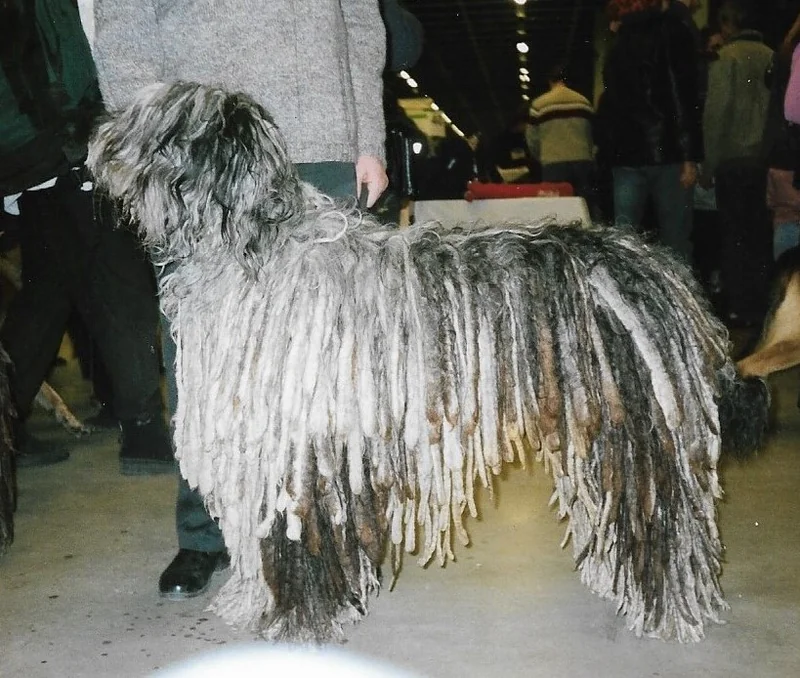 Featured photobergamasco-sheepdog.jpg
The Bergamasco Sheepdog is a large, ancient Italian herding breed from the Bergamo Alps, distinguished by a remarkable coat consisting of three distinct types of hair — the undercoat, the rough outer coat ('goat hair'), and the woolly hair — that interweave naturally to form flat, felt-like mats covering the entire body. The breed was used by Alpine shepherds for centuries to guide and protect sheep flocks. The AKC admitted it in 2015 and places it in the Herding Group. The FCI registers it as No. 194. Males stand 56–62 cm.
Quick facts
- AKC group
- Herding
- Origin country
- Italy
- Origin period
- Ancient, documented from medieval period
- Coat type
- Long
- Coat colors
- Grey (from light to dark), Merle Grey, Black, All shades between light grey and black; isabella and white patches permissible
- Average lifespan
- 13-15 years
- Recognition
- AKC 2015 · FCI 1956 · UKC 1995 · Group 1 — Sheepdogs and Cattledogs (Section 1: Sheepdogs)
Origin
The Bergamasco Sheepdog's ancestors are traced by Italian cynologists to the herding dogs of ancient Middle Eastern peoples, who moved with sheep flocks westward into Europe over millennia. The breed's distinctive flocked coat is believed to have been gradually fixed through selection in the extreme climate of the Bergamo Alps in Lombardy — the mats provide insulation in winter, resist moisture, and protect against predator bites. Medieval and Renaissance-era Italian paintings from the Bergamo area depict large, shaggy herding dogs consistent with the modern breed.
Recognition
The Ente Nazionale della Cinofilia Italiana (ENCI) and subsequently the FCI registered the Bergamasco Sheepdog under standard No. 194 in 1956, classifying it in Group 1, Section 1 (Sheepdogs) with Italy as patron country. The UKC recognised the breed in 1995. The AKC placed the Bergamasco in the Miscellaneous Class in 2011 and granted full Herding Group recognition in 2015.
Standard
The FCI and AKC standards describe a large, robust, powerfully built dog slightly longer than tall. The defining feature is the unique coat: three types of hair interweave to form flat mats ('flocks') that cover the body from the back downward. The undercoat is short, dense, and oily; the 'goat hair' is long, rough, and straight; the woolly hair is dense and soft. The flocks form naturally from about a year of age and are never trimmed or brushed out on show or working dogs. The colours range from grey (all shades) to black; white markings on chest and feet are permissible. Males stand 56–62 cm.
Sources & further reading (3)
- kennel-club-registry — accessed 2026-05-27
- encyclopedia — accessed 2026-05-27
- fci-standard — accessed 2026-05-27
Frequently asked questions
How does the Bergamasco's coat form?
The Bergamasco's distinctive coat consists of three distinct hair types that grow together and naturally interweave from approximately one year of age to form flat, felt-like mats called 'flocks'. The three types are: a short, fine, oily undercoat; a long, rough, straight outer coat (called 'goat hair' because of its texture); and a dense, woolly middle layer. As these three types grow together and intertwine, they mat into flat bands rather than round cords (as in the Puli or Komondor). The mats are never trimmed or brushed out in the breed's natural state.
When did the AKC recognise the Bergamasco Sheepdog?
The AKC admitted the Bergamasco Sheepdog to the Herding Group in 2015, after the breed entered the AKC Miscellaneous Class in 2011. The FCI had recognised the breed since 1956 under standard No. 194, and the UKC since 1995.
Is the Bergamasco's matted coat the same as the Komondor's cords?
No. The Bergamasco and Komondor both develop naturally matted coats, but the structures are different. The Komondor's cords are round, rope-like twists of the double coat that can hang individually to the ground. The Bergamasco's 'flocks' are flat, ribbon-like mats formed by three distinct hair types felting together. The Bergamasco coat appears as overlapping flat bands; the Komondor as round hanging cords.