Felis catus
Kinkalow Longhair
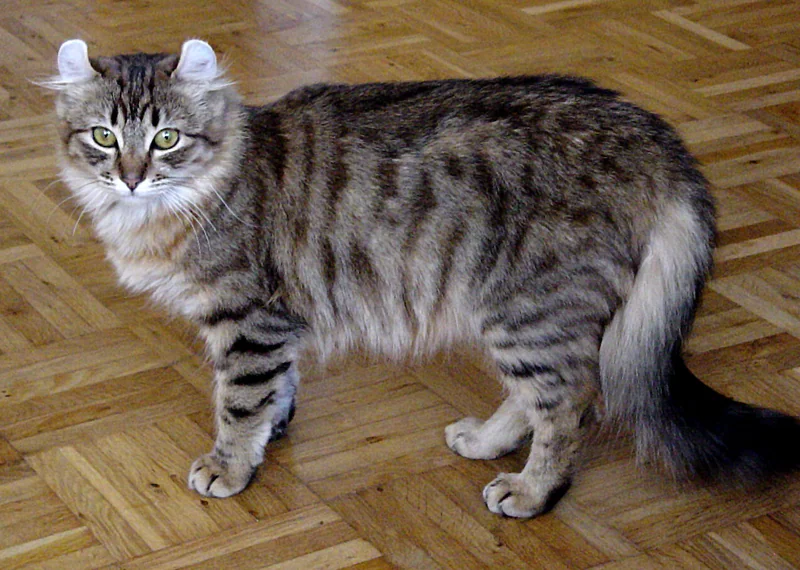
The Kinkalow Longhair is the longhaired coat-length variety of the Kinkalow breed. The Kinkalow was developed in the 1990s by breeder Terri Harris through crossing Munchkin (short-legged) cats with American Curl cats, combining the Mkmt short-limb mutation with the American Curl's autosomal-dominant ear-curl gene. Both the shorthaired and longhaired Kinkalow are registered with TICA in its experimental/Preliminary New Breed programme. The longhair variety has a silky, semi-long coat with a flowing tail plume, contrasting with the Munchkin's low-riding stance.
Quick facts
- Origin country
- United States
- Origin period
- 1990s (Munchkin × American Curl cross, Terri Harris)
- Coat type
- Long
- Coat colors
- All colours and patterns recognized
- Size category
- Small
- Average lifespan
- 12-15 years
- Recognition
- —
Origin
The Kinkalow is a Munchkin-American Curl cross developed by Terri Harris in the 1990s. The breed combines two distinct dominant mutations: the Mkmt gene for short limbs (from Munchkin) and the CuRLY gene for curled ears (from American Curl). Longhaired kittens arise when American Curl (which comes in both coat lengths) contributes the longhair allele.
Standard
The Kinkalow Longhair has the same low-slung, short-legged body profile as the shorthair variety, with ears that curl back in the American Curl style. The longhair coat is silky and semi-long with a plumed tail. The cat is small to medium in size with a moderate cobby body, appearing proportionate despite the reduced limb length.
Munchkin × American Curl Cross
The Kinkalow combines the Munchkin's short-limb Lm gene with the American Curl's ear-curl gene (Cu). The short-legged body and backward-curling ears appear simultaneously when both genes are expressed heterozygously. Because the Lm/Lm homozygous combination is lethal, all Kinkalows are Lm/+; because Cu/Cu homozygosity is associated with rigid ear cartilage, Kinkalows may be Cu/+ or Cu/Cu, with breeders typically targeting heterozygosity for both traits.
Sources & further reading (2)
- encyclopedia — accessed 2026-05-27
- registry-breed-profile — accessed 2026-05-27
Frequently asked questions
What breeds were used to create the Kinkalow?
The Kinkalow was developed from the Munchkin (contributing the Mkmt short-limb gene) and the American Curl (contributing the CuRLY ear-curl gene). Both contributing breeds come in shorthaired and longhaired varieties, so Kinkalow litters can include both coat lengths.
Is the Kinkalow a separate breed from the Munchkin?
TICA tracks the Kinkalow within its experimental programme separately from the standard Munchkin. The Kinkalow specifically combines the Munchkin's short-limb gene with the American Curl's ear-curl gene. Munchkins without curled ears are standard Munchkins; Kinkalows require both traits. The two are thus distinct experimental breeds under TICA's registration system.
Can Kinkalow Longhairs have straight ears?
Yes. Because the American Curl's ear-curl gene (Cu) is dominant but not always expressed, some Kinkalow offspring in a litter carry the Munchkin's short-leg gene without the curl gene, producing short-legged cats with straight ears. These are categorized as standard Munchkins rather than Kinkalows. Only offspring expressing both short legs and curled ears are registered as Kinkalows under the TICA experimental standard.