Felis catus
Asian Smoke
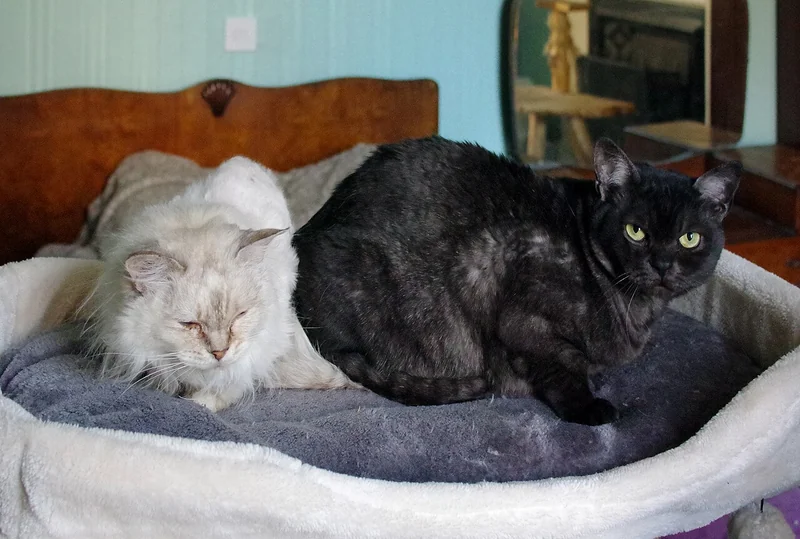
The Asian Smoke is a colour-division of the GCCF's Asian Group — a family of breeds derived from Burmese crosses. The Asian Group includes the Asian Self, Asian Smoke, Asian Tabby, and Tiffanie (longhair). The GCCF recognized the Asian Group collectively in the 1990s. The standard describes a medium-sized, muscular cat with the Burmese conformation and a distinctive smoke coat pattern.
Quick facts
- Origin country
- United Kingdom
- Origin period
- Developed from Burmese crosses in the UK from the 1980s; GCCF recognition 1990s
- Coat type
- Short
- Coat colors
- Black smoke, Blue smoke, Chocolate smoke, Lilac smoke, Red smoke, Cream smoke, Tortoiseshell smoke, All Burmese-derived colours in smoke pattern
- Size category
- Medium
- Average lifespan
- 12–16 years
- Recognition
- GCCF 1995
Origin
The Asian Group descends from Burmese × Chinchilla crosses made in the UK in the early 1980s, beginning with Baroness Miranda von Kirchberg's foundational Burmilla litters in 1981. Selective breeding established the characteristic Burmese conformation in a range of coat patterns, and the GCCF formally recognized the Asian Group in the 1990s. The Asian Smoke division is defined by its smoke pattern: a near-white undercoat with a solid-coloured mantle that creates a shimmering effect when the cat moves.
Standard
The GCCF standard for the Asian Smoke describes a medium-sized, well-muscled cat with the characteristic Burmese type: a rounded head, large golden to yellow eyes, medium ears, and a compact, muscular body. The coat is short, fine, and close-lying. The smoke pattern requires a near-white to white undercoat with solid tipping in any recognized Burmese-derived colour — black, blue, chocolate, lilac, red, cream, or tortoiseshell permutations. The smoke pattern is only visible when the coat parts.
Asian Group Relationship to Burmilla
The Asian Smoke is one of four shorthair coat-pattern divisions within the GCCF's Asian Group — the others being the Burmilla (shaded/tipped), Asian Tabby, and Asian Self. All share the Burmese conformation and the full range of Burmese-derived colours. The longhaired Tiffanie is the fifth member of the Asian Group. Within the Group, the Smoke division is defined by the near-white undercoat beneath a solid-coloured mantle, distinguishing it from the Burmilla's glittery tipped pattern.
Sources & further reading (2)
- encyclopedia — accessed 2026-05-27
- gccf-registry — accessed 2026-05-27
Frequently asked questions
What is the difference between the Asian Smoke and the Burmilla?
The Burmilla is a specific division of the Asian Group with a shaded or tipped (chinchilla-type) pattern, producing a distinctive silver or golden glitter effect. The Asian Smoke has a deeper, more solid smoke pattern with a white undercoat rather than a glittery tipped pattern. Both are members of the GCCF's Asian Group.
Is the Asian Smoke recognized by CFA or TICA?
No. The Asian Smoke is a GCCF (UK) breed division. CFA and TICA do not recognize the Asian Group divisions. The closest comparable breeds in those registries are the Burmese (conformation) and various smoke-pattern domestics.
How is the Asian Smoke's smoke pattern produced genetically?
The smoke pattern requires the Inhibitor gene (I), which suppresses pigment in the lower portion of each hair shaft, producing a near-white or white undercoat. In combination with a solid (non-agouti) coat, the Inhibitor gene produces the smoke effect: the surface of the coat appears solid, but parting the fur reveals white at the base. The Asian Smoke carries both the Inhibitor gene and the non-agouti gene, producing pure smoke rather than the tipped or shaded pattern of the Burmilla.