Felis catus
Asian Group
 Featured photoasian.jpg
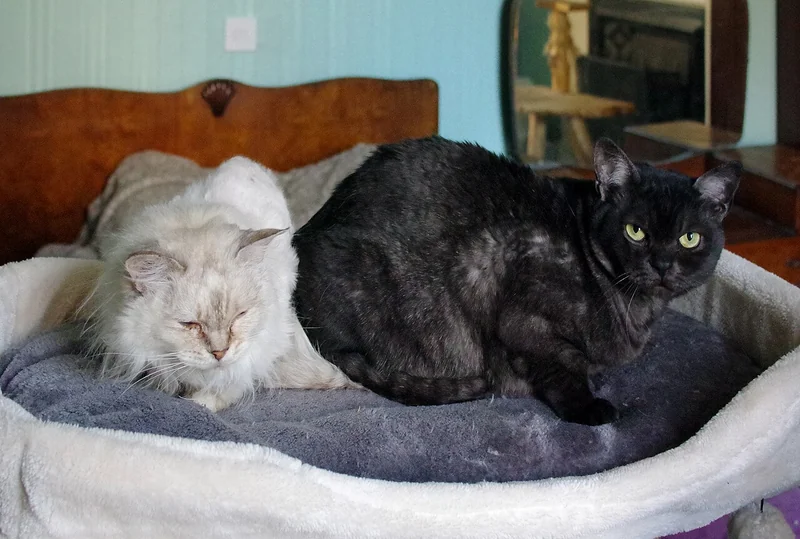
The Asian (or Asian Group) is a Burmese-type shorthair breed developed in the United Kingdom from 1981 by Baroness Miranda von Kirchberg. The Asian shares the Burmese body type but carries non-Burmese coat colours and patterns. The Asian Group encompasses several recognized varieties: Asian Self (solid colours), Asian Smoke (smoke pattern), Asian Tabby (tabby patterns), and the related Burmilla (silver-tipped variant). GCCF recognized the Asian Group in 1989. CFA, TICA, and FIFe do not maintain separate Asian Group registers under that name.
Quick facts
- Origin country
- United Kingdom
- Origin period
- Burmese-derived non-Burmese-coloured shorthair developed by Baroness Miranda von Kirchberg from 1981; GCCF recognition 1989
- Coat type
- Short
- Coat colors
- Asian Self colours: black, blue, chocolate, lilac, red, cream, tortoiseshell, caramel, apricot, Asian Smoke and Tabby variants in all of the above, Burmilla (silver-tipped) handled as a separate variety
- Size category
- Medium
- Average lifespan
- 12-18 years
- Recognition
- GCCF 1989
Origin
The Asian Group originated from a 1981 accidental cross between Baroness Miranda von Kirchberg's lilac Burmese, Faberge, and a chinchilla Persian named Sanquist belonging to her aunt. The resulting kittens — silver-tipped Burmese-type cats — became the foundation of the Burmilla and the broader Asian Group. The breed was developed deliberately from 1981 onward to combine the Burmese body type with non-Burmese coat colours and patterns, producing four shorthair varieties: Asian Self, Asian Smoke, Asian Tabby, and Burmilla.
Recognition
The Governing Council of the Cat Fancy recognized the Asian Group in 1989 as a single breed encompassing all four shorthair varieties. The longhaired counterpart Tiffanie is recognized separately. CFA, TICA, and FIFe do not maintain separate Asian Group registers under that name. CFA and FIFe recognize the Burmilla as a separate breed, while the other Asian Group varieties are not internationally recognized outside GCCF.
Standard
The GCCF standard describes a medium-sized, well-muscled, semi-foreign cat conforming to the European Burmese standard in body type. The head is a moderate wedge with rounded contours, a strong chin, and almond-shaped eyes. The coat is short, fine, and close-lying. The four varieties differ only in colour and pattern: Asian Self carries solid colours; Asian Smoke carries the smoke pattern; Asian Tabby carries tabby patterns (classic, mackerel, spotted, ticked); and the Burmilla carries the silver-tipped pattern. Eye colour is yellow to green.
Sources & further reading (3)
- gccf-registry — accessed 2026-04-30
- encyclopedia — accessed 2026-04-30
- tica-standard — accessed 2026-04-30
Frequently asked questions
What varieties make up the Asian Group?
The Asian Group includes four shorthair varieties: Asian Self (solid colours), Asian Smoke (smoke pattern), Asian Tabby (all tabby patterns), and the Burmilla (silver-tipped pattern). The longhaired counterpart, the Tiffanie, is registered as a separate breed by GCCF. All five share the Burmese body type and origin from the 1981 cross.
When was the Asian Group recognized?
GCCF recognized the Asian Group in 1989. CFA, TICA, and FIFe do not maintain separate Asian Group registers under that name; the Burmilla variety is recognized separately by CFA (2014), FIFe (2002), and TICA.
Is the Asian the same as the European Burmese?
No. The Asian Group shares the Burmese body type and originates from Burmese crosses, but carries non-Burmese coat colours. The European Burmese is restricted to the Burmese coat-colour gene (cb) producing sable, champagne, blue, and platinum. The Asian Group's solid, smoke, tabby, and silver-tipped patterns are all non-Burmese coats produced by the original Persian outcross.