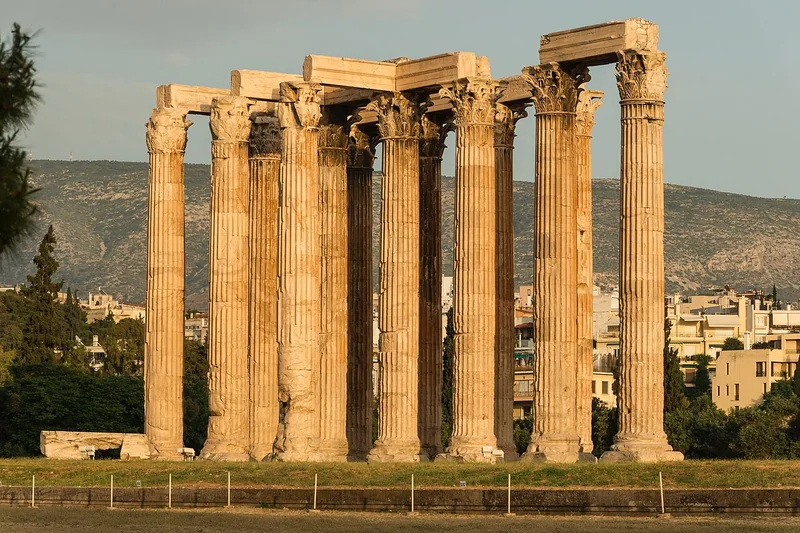
Zeus is the supreme deity of the ancient Greek pantheon, ruler of Mount Olympus and lord of the sky, thunder, and lightning. Born to the Titans Cronus and Rhea, he was hidden in Crete to escape being swallowed by his father. After overthrowing Cronus, Zeus divided dominion over the cosmos with his brothers Poseidon and Hades. He is described in detail by Hesiod in the Theogony and by Homer across the Iliad and Odyssey.
Quick facts
- Pantheon
- Greek
- Figure type
- God
- Period
- Attested from at least the 8th century BCE; Mycenaean precursor Di-we c. 1600–1100 BCE
- Primary sources
- Hesiod Theogony 453–506; Homer Iliad 1.498–530; Apollodorus Bibliotheca 1.1.5–7; Hesiod Theogony 881–885
- Related figures
- hera, poseidon, demeter, athena, apollo, artemis, ares, aphrodite, hephaestus, hermes, dionysus, cronus, prometheus
Origins and rise to power
Zeus was the youngest child of the Titans Cronus and Rhea. Cronus, warned by prophecy that a child would overthrow him, swallowed each newborn. Rhea hid the infant Zeus in Crete and gave Cronus a stone wrapped in swaddling cloths instead. Zeus was raised on Mount Ida, nourished by the goat Amalthea. On reaching maturity he forced Cronus to disgorge his siblings — Hestia, Demeter, Hera, Hades, and Poseidon — and led them in the Titanomachy, a ten-year war against the Titans. Victory won, Zeus and his brothers drew lots: Zeus received the sky, Poseidon the sea, and Hades the underworld.
Attributes and epithets
Zeus wields the thunderbolt, fashioned for him by the Cyclopes as reward for releasing them from Tartarus. His sacred animals are the eagle and the bull; his sacred tree the oak. He bears many epithets in ancient sources: Olympios (of Olympus), Basileus (king), Xenios (protector of guests and strangers), and Agoraios (of the assembly). The great Statue of Zeus at Olympia, one of the Seven Wonders of the Ancient World, depicted him enthroned and was created by Pheidias c. 435 BCE.
Sources & further reading (2)
- primary-source — accessed 2026-05-06
- encyclopedia — accessed 2026-05-06
Frequently asked questions
Who are the parents of Zeus?
Zeus was the son of the Titans Cronus and Rhea. This is recorded in Hesiod's Theogony (lines 453–506), the foundational Greek cosmogony composed around 700 BCE. Cronus swallowed each of his children at birth out of fear of a prophecy, but Rhea saved Zeus by substituting a stone wrapped in cloth.
What does Zeus represent in Greek mythology?
In Greek mythology Zeus represents divine authority over the sky, thunder, and lightning, as well as cosmic order and justice. He is described in Homer's Iliad as the most powerful of the Olympians, whose will shapes the fates of gods and mortals alike. His role as Xenios (protector of guests) reflects the ancient Greek value of hospitality.