God
Yuhwa
The willow-flower river goddess of Korean mythology, mother of the founder of Goguryeo.
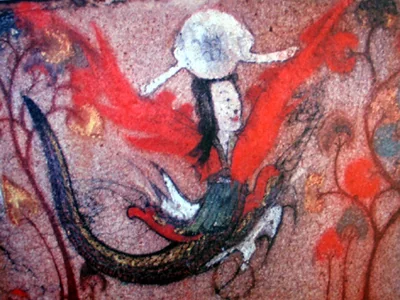
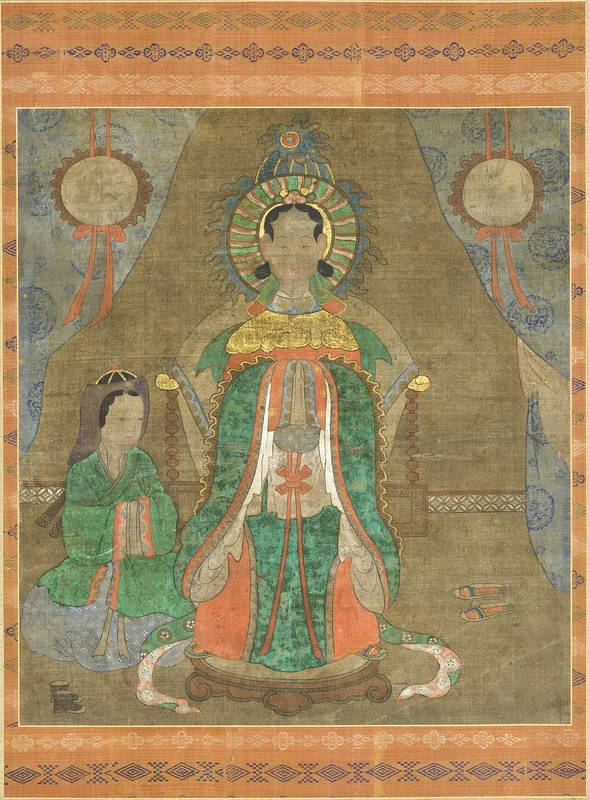
Yuhwa (유화, 柳花, 'Willow Flower') is a river goddess and the mother of Jumong, the legendary founder of Goguryeo, in Korean founding mythology. She was the eldest daughter of Habaek, the river god, and was seduced by the sun deity Haemosu. After Haemosu abandoned her, she was found destitute and taken in by King Geumwa of Buyeo. While imprisoned in his palace, a beam of sunlight followed and illuminated her, causing her pregnancy. She gave birth to a giant egg, from which Jumong was born. Yuhwa nurtured and protected Jumong, warned him of plots against his life, and blessed his departure with grain seeds. After Jumong founded Goguryeo, he sent a messenger to retrieve her, and she was honoured as a founder's mother. The Samguk Sagi (1145 CE) records she was deified and received official sacrifices.
Quick facts
- Pantheon
- Korean
- Figure type
- God
- Period
- Recorded in Samguk Sagi (1145 CE) and Samguk Yusa (1281 CE)
- Primary sources
- Samguk Sagi (1145 CE), Book 13: Goguryeo annals, by Kim Busik; Samguk Yusa (1281 CE), Book 1: 'Goguryeo' section, by Iryeon
- Related figures
- haemosu, jumong, habaek, geumwa
Seduction, abandonment, and the miraculous birth
The Samguk Sagi (1145 CE, Book 13) narrates that Yuhwa and her sisters were playing by the Yalu River when they were brought into a pleasure palace conjured by Haemosu. Haemosu took Yuhwa as his wife but then ascended to heaven alone, abandoning her. Habaek (her father, the river god) was furious at the disgrace and punished Yuhwa by banishing her, with her lips stretched to three chi length, which were later cut short. She was found by King Geumwa's servants near Ubali in Buyeo and taken to the king. When Geumwa heard her story and tried to confine her (or when she was placed in a room), a shaft of sunlight persistently followed and shone on her. She became pregnant; she gave birth to a large egg. Geumwa ordered the egg thrown to dogs, pigs, and birds — all refused to harm it. When it was returned to Yuhwa, the infant Jumong burst out.
Support and deification
The Samguk Sagi (1145 CE) emphasises Yuhwa's active role in Jumong's survival. When the sons of Geumwa — Daeso and others — planned to kill Jumong, Yuhwa warned him to flee. As he departed, she gave him a special barley seed (pressing the seed through his horse's mouth in some versions, wrapped in concealment in others) — a gift of agriculture, connecting her river-goddess nature to fertility and sustenance. After Jumong founded Goguryeo, he sent to Buyeo for his mother; she came and was honoured. The Samguk Sagi records that when Yuhwa died, Geumwa (who had kept her honourably in his court) gave her a state funeral with royal rites, and Jumong sent gifts of return. She was subsequently deified — the Samguk Sagi notes that Goguryeo performed ritual sacrifices to Yuhwa, making her an ancestor-deity of the kingdom.
Sources & further reading (2)
- encyclopedia — accessed 2026-05-06
- primary-source — accessed 2026-05-06
Frequently asked questions
What is the significance of Yuhwa's name 'Willow Flower'?
Yuhwa (柳花, 'Willow Flower') is a name with symbolic resonance in East Asian traditions where the willow is associated with water, flexibility, fertility, and the feminine principle. As the daughter of Habaek (the river god), her willow-flower name connects her to the riparian environment she inhabits. Willows grow along riverbanks, their roots in water — an appropriate emblem for a water deity's daughter. In Korean shamanic (musok) tradition, the willow is also a tree associated with spirits and healing. The flower name (hwa, 花) adds a feminine and seasonal dimension. Some scholars interpret Yuhwa as an embodiment of early Korean agricultural goddess traditions — her gift of barley seed to the departing Jumong connecting the river (water, fertility) to grain cultivation.
How does Yuhwa compare to other founding-mother figures in Korean mythology?
Korean founding mythology has several prominent mother figures who bear or enable the birth of founding heroes. Ungnyeo (the bear-woman of the Dangun myth) is the most direct parallel: both are women of non-human origin who are transformed or marked by their supernatural nature and become the mothers of Korea's legendary founders through divine paternity. Both are passive in the sense that they receive divine impregnation rather than seeking it, but active in nurturing and protecting the resulting hero. Aryeong (mother of the Silla founder Bak Hyeokgeose in the Samguk Yusa) and Heo Hwang-ok (the legendary queen of Gaya from India, whose story has different structure) complete the pattern of exceptional women as mothers of founding figures. Yuhwa is distinctive in that she was later formally deified and received state ritual sacrifice in Goguryeo.