Hero
Baridegi
The Abandoned Princess of Korean myth who journeyed to the underworld and became the first shaman.
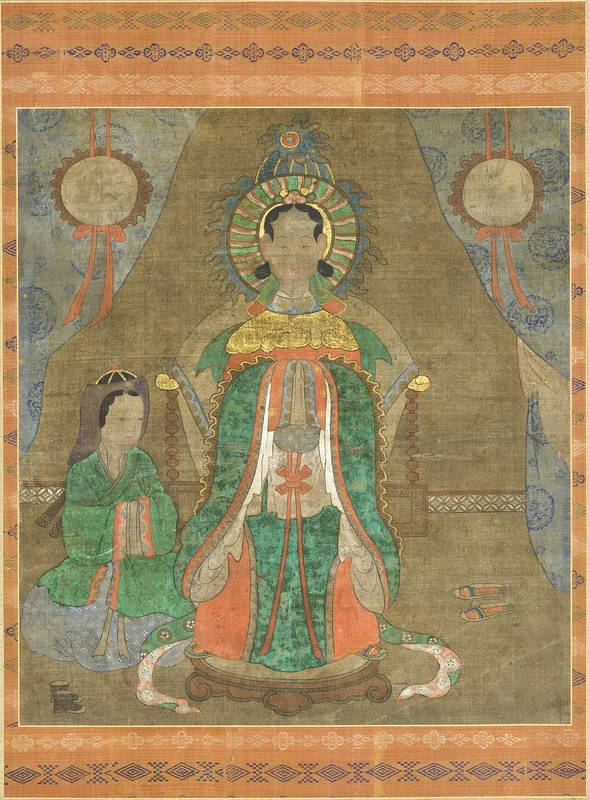
Baridegi (바리데기, 'the abandoned one') is the central figure of the most important narrative in Korean shamanic (musok) tradition — the myth of the first mudang (female shaman). The seventh daughter of a king and queen who desperately wanted a son, she was abandoned at birth for being female. Raised by an old couple in the wilderness, she was later sought out by her dying parents, who needed medicine from the far land of the dead (Seocheon Flower Land, 서천꽃밭). Only Baridegi would undertake the perilous journey. She crossed the underworld, served the guardian deity for years, bore him children, and returned with the medicine of resurrection. She saved her parents' lives and was offered earthly wealth as reward, but chose instead to become the divine guide of souls — the first shaman. The Baridegi narrative (바리공주 or 바리데기) is performed by mudang (female shamans) at funerary rituals (ssitgim-gut) and documented in regional versions across Korea.
Quick facts
- Pantheon
- Korean
- Figure type
- Hero
- Period
- Shamanic oral narrative tradition; written documentation from late Joseon period (18th–19th century CE) and early 20th-century CE ethnographic collection
- Primary sources
- Regional Baridegi narrative traditions documented by Son Jin-tae (1930 CE) and others; Ssitgim-gut (shamanic funeral ritual) narrative tradition — oral
- Related figures
- samsin, cheoyong, mago
Abandonment and journey
In the most common version of the Baridegi narrative, a king and queen pray to Samsin (the birth deity) for a son after six daughters. The seventh child is again a daughter. Furious, the king orders the infant girl placed in a jewelled box (or basket) and abandoned on the mountainside, in the sea, or in the wilderness. The box is found and the child raised by an elderly couple or a divine being. Years later, the king and queen fall gravely ill; a divine message or a shaman's divination reveals that only a medicine from the Seocheon Flower Land (西天花밭, 'Western Heaven Flower Garden') can cure them. All six elder daughters refuse the dangerous journey. A search for the abandoned seventh daughter succeeds; Baridegi alone agrees to go. She undergoes a series of trials in the underworld: she serves the guardian deity (Musin, or the 'divine son of the underworld') for years, bearing him three (or seven) sons in exchange for the medicine. She returns with the flowers of resurrection.
Apotheosis as the first shaman
Baridegi returns from the underworld with the medicine and revives her parents. In most versions, she arrives just as their funeral is beginning — she uses the flowers to restore them. The king offers her wealth, land, and position as reward. Baridegi refuses all earthly gifts and asks instead for the work of guiding dead souls to the afterlife. She becomes the divine first shaman (Baridegi-bosal, 'Baridegi Bodhisattva'), the celestial guide who receives the dead at the boundary between the living world and the underworld and conducts them safely to the land of the dead. Her story is performed by mudang at ssitgim-gut (shamanic funerary rituals) in which the shaman literally re-enacts Baridegi's journey, guiding the soul of the recently deceased through the underworld passage. The myth thus provides the cosmological origin and divine authority for the central function of Korean shamanism.
Sources & further reading (2)
- encyclopedia — accessed 2026-05-06
- primary-source — accessed 2026-05-06
Frequently asked questions
What is the ssitgim-gut and why is Baridegi central to it?
The ssitgim-gut (씻김굿, 'cleansing ritual') is a Korean shamanic funerary ritual performed by a mudang (female shaman) to guide the soul of the recently deceased safely to the afterlife and to free it from any lingering resentments or attachments that might cause it to linger as a harmful spirit. The ritual typically involves the mudang singing and performing the Baridegi narrative — re-enacting the princess's journey to the underworld and her successful guidance of souls — as a way of invoking Baridegi's divine power to conduct the specific soul being mourned. Baridegi's authority as the first shaman and as the deity who knows the path between the worlds makes her the appropriate divine intermediary for this function. The ssitgim-gut is primarily a tradition of the Honam (southern Jeolla) region of Korea, though Baridegi narratives are found across the peninsula in various regional forms.
How does Baridegi compare to Orpheus as an underworld journey myth?
The Baridegi narrative and the Greek Orpheus myth (Apollodorus, Bibliotheca 1.3.2; Ovid, Metamorphoses 10–11) share the structural pattern of the living descending to the underworld to retrieve something essential — for Orpheus, his wife Eurydice; for Baridegi, the medicine to save her parents. Both figures must endure underworld conditions through art and endurance rather than force: Orpheus charms Persephone with music; Baridegi serves the underworld guardian through years of labour. Both retrieve what they sought and return to the upper world. The key difference is outcome: Orpheus fails (he looks back) and returns empty-handed; Baridegi succeeds and revives her parents. Moreover, Baridegi is transformed by the journey into a divine intermediary between worlds — she becomes the first shaman. Orpheus's fate is dismemberment. The Korean myth is thus ultimately more optimistic: the journey to the underworld is not defeat but apotheosis.