Place
Yomi
The shadowy underworld of Japanese mythology, realm of the dead presided over by Izanami.
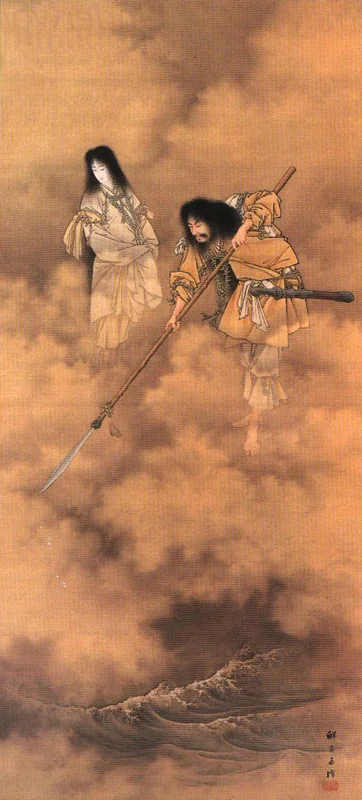
Yomi (黄泉, 'Yellow Springs' — borrowing the Chinese term Huángquán) is the underworld in Japanese mythology, the realm of the dead. It is a dark, polluted realm from which no one returns — entry is possible but exit is forbidden. Izanami, the creator goddess, descended to Yomi when she died giving birth to the fire deity Kagutsuchi. When Izanagi followed to retrieve her, he found her body decaying in the darkness. His horrified flight and the sealing of Yomi with the Great Boulder of Yomotsu Hirasaka established the permanent separation between the living world and the dead. Yomi's association with death, pollution (kegare), and the decay of the body reflects Japanese ritual concepts of death as a source of spiritual impurity requiring purification. Described in the Kojiki (712 CE, trans. Chamberlain 1882) Book I, sections 9–11, and Nihon Shoki (720 CE, trans. Aston 1896).
Quick facts
- Pantheon
- Japanese
- Figure type
- Place
- Period
- Described in the Kojiki (712 CE) and Nihon Shoki (720 CE)
- Primary sources
- Kojiki (712 CE), trans. Chamberlain 1882: Book I, sections 9–11; Nihon Shoki (720 CE), trans. Aston 1896: Vol. I, pp. 20–26
- Related figures
- izanami, izanagi, susanoo, hel
Description of Yomi
The Kojiki (Book I, sections 9–10, trans. Chamberlain 1882) describes Yomi only indirectly through the narrative of Izanagi's visit. It is a place of darkness where the dead dwell; when Izanagi lit a torch (breaking off a comb-tooth to ignite), he saw Izanami's body covered in maggots and inhabited by eight thunder deities — Fire Thunder, Black Thunder, Earth Thunder, and others — emanating from her decaying limbs. The Nihon Shoki (trans. Aston 1896: Vol. I, pp. 20–22) adds that the land of Yomi is entered via a great pass called Yomotsu Hirasaka. The gateway is sealed by the Great Boulder after Izanagi's flight. Yomi is described in contrast to the living world: dark, damp, polluted, and populated by the rotting dead. The shikome (hideous women of Yomi) and the thunder deities pursue Izanagi at Izanami's command.
Separation of living and dead
The myth of Izanagi's flight from Yomi (Kojiki Book I, section 10, trans. Chamberlain 1882) serves as the origin myth for the separation between life and death in Japanese cosmology. As Izanagi fled, he threw obstacles that delayed his pursuers: his black headdress became grapes (which the shikome stopped to eat), his comb became bamboo shoots, and then he threw peaches (three-times-three, the sacred number), which drove back the thunder deities — giving peaches their role as protective, demon-warding fruit in Japanese culture. Finally, at Yomotsu Hirasaka, Izanagi heaved the Great Boulder across the gateway. Izanami shouted her vow to kill a thousand people daily; Izanagi answered with fifteen hundred births. This exchange is the formal origin myth for human mortality and fertility — the permanent rates of death and birth that balance the world.
Sources & further reading (2)
- primary-source — accessed 2026-05-06
- encyclopedia — accessed 2026-05-06
Frequently asked questions
How is Yomi different from Buddhist concepts of hell (jigoku)?
Yomi, as described in the Kojiki (712 CE, trans. Chamberlain 1882) and Nihon Shoki (720 CE, trans. Aston 1896), is not a place of punishment. It is simply where all the dead go — regardless of moral conduct — and its primary qualities are darkness, decay, and pollution (kegare). By contrast, Buddhist jigoku (地獄, derived from the Sanskrit naraka) is a realm of active punishment for bad karma, with specific torture chambers and judges of the dead. Buddhism arrived in Japan in the 6th century CE and brought with it detailed visions of hell as punishment. In the centuries following Buddhism's arrival, Yomi and jigoku were sometimes conflated in Japanese religious thought, particularly as the concept of a judge of the dead (Enma-ō, derived from the Hindu/Buddhist Yama) was incorporated into Japanese underworld mythology. In the original Shinto texts, however, Yomi is a neutral realm of the dead, not a punitive one.
What is the significance of the Great Boulder at Yomotsu Hirasaka?
The Great Boulder of Yomotsu Hirasaka (Yomotsu Hirasaka no Chigaeshi no Ōkami, 'Great Deity of the Returning Slope of Yomi') that Izanagi placed at the mouth of Yomi to seal the gateway (Kojiki Book I, section 10, trans. Chamberlain 1882) is the mythological explanation for why the dead cannot return to the living world. The boulder is itself deified — it becomes one of the kami, the guardian of the boundary between life and death. The Nihon Shoki (trans. Aston 1896: Vol. I, p. 25) names the pass as Yomotsu Hirasaka and identifies it with a specific location in Izumo Province (present-day Shimane Prefecture), where the Ifuya-zaka slope near the Kami-no-Kuni area is traditionally associated with the boundary of Yomi. The boulder makes the separation physical and permanent — death cannot be undone.