God
Ebisu
The Shinto god of fishing and fortune, the only one of the Seven Lucky Gods born in Japan.
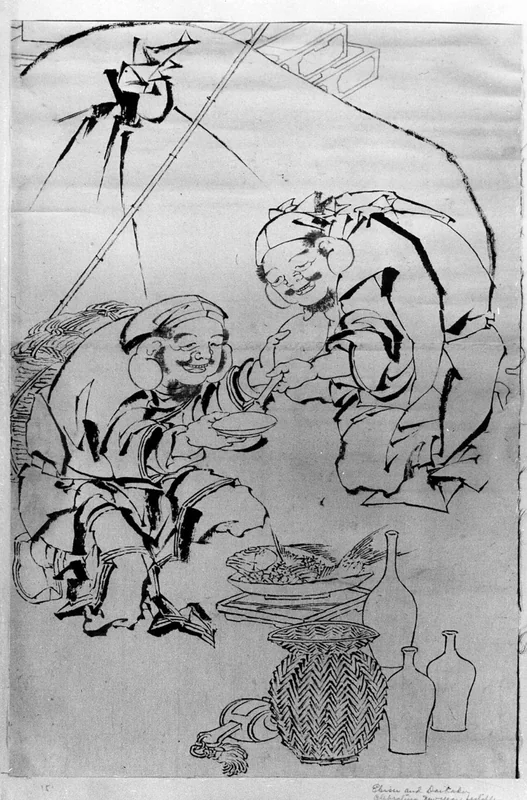
Ebisu (恵比須 or 蛭子, 'Blessed One' or 'Leech Child') is the deity of fishing, commerce, and good fortune in Japanese mythology, one of the Seven Lucky Gods (Shichifukujin). He is identified in some traditions as the child of Izanagi and Izanami — specifically the deformed 'leech-child' (Hiruko) who was born without bones and set adrift in a boat because the ritual circling of the pillar was done incorrectly (Izanami spoke before Izanagi). This child survived, washed ashore in Hokkaido or Ezo, and was raised by the Ainu people, becoming the god of fishing. In another tradition, Ebisu is a son of Ōkuninushi. He is the only one of the Seven Lucky Gods considered purely Japanese in origin (the others derive from Chinese and Indian sources). Described in the Kojiki (712 CE, trans. Chamberlain 1882) Book I, section 5, and regional Fudoki traditions.
Quick facts
- Pantheon
- Japanese
- Figure type
- God
- Period
- Hiruko tradition in Kojiki (712 CE); Ebisu cult developed through the Heian period (794–1185 CE)
- Primary sources
- Kojiki (712 CE), trans. Chamberlain 1882: Book I, section 5 (Hiruko); Nihon Shoki (720 CE), trans. Aston 1896: Vol. I, p. 15 (Hiruko)
- Related figures
- izanagi, izanami, okuninushi, daikoku
Hiruko: the leech child
The Kojiki (Book I, section 5, trans. Chamberlain 1882) recounts that the first time Izanagi and Izanami performed the ritual of circling the pillar, Izanami (the woman) spoke first — a violation of proper order. The child produced was Hiruko ('Leech Child'), who was born malformed and without bones. They placed the child in a boat of rushes and set it adrift on the sea. The Nihon Shoki (trans. Aston 1896: Vol. I, p. 15) gives essentially the same account. Later Japanese tradition identified this rejected, drifting child with Ebisu — who, despite his inauspicious origin, survived, washed ashore, and became a deity of fishing and good fortune. The identification is not made explicit in the canonical texts but appears in regional traditions (Fudoki) and medieval shrine chronicles.
Ebisu as fishing and commerce deity
In the Ebisu cult as it developed through the Heian and Kamakura periods, the deity is typically depicted as a cheerful, corpulent man in court robes carrying a fishing rod in one hand and a sea bream (tai) tucked under the other arm — the tai being a symbol of celebration and prosperity in Japanese culture (the word tai is a near-homophone of medetai, 'auspicious'). He is the patron deity of fishermen, merchants, and workers. His main shrines include Nishinomiya Jinja (Hyogo Prefecture) and the network of Ebisu shrines throughout Japan. The annual Tōka Ebisu festival at Imamiya Ebisu Shrine in Osaka (10th of January) is one of the largest Shinto festivals in western Japan. Unlike many kami who are invisible in business transactions, Ebisu is considered a hands-on deity who does not abandon his worshippers.
Sources & further reading (2)
- primary-source — accessed 2026-05-06
- encyclopedia — accessed 2026-05-06
Frequently asked questions
What are the Seven Lucky Gods (Shichifukujin) of Japan?
The Seven Lucky Gods (七福神, Shichifukujin) are a group of deities in Japanese folk religion who bring good fortune. They are: Ebisu (fishing, commerce — Japanese origin), Daikokuten (wealth, farmers — derived from the Indian deity Mahākāla and the Shinto Ōkuninushi), Bishamonten (warriors, authority — derived from the Indian Vaiśravaṇa), Benzaiten (knowledge, music, beauty — derived from the Indian Sarasvatī), Hotei (happiness, plenty — a Chinese Buddhist figure), Jurōjin (longevity, wisdom — Chinese Taoist origin), and Fukurokuju (fortune, happiness, longevity — Chinese Taoist origin). Of the seven, Ebisu is the only deity of purely Japanese (Shinto) origin. The group as a set emerged in the Muromachi period (1336–1573 CE) and became enormously popular in Edo-period (1600–1868 CE) popular culture.
Why does Ebisu carry a sea bream (tai)?
The sea bream (tai, Pagrus major) is one of the most prized fish in Japanese culinary and cultural tradition. Its name tai is a near-homophone for the suffix of medetai ('auspicious, celebratory'), and the fish has been associated with festivity, weddings, and good fortune in Japanese culture for centuries. Ebisu as a fishing deity carries the sea bream under his arm as both a symbol of his domain (fishing) and an icon of the prosperity and good fortune he brings to his worshippers. The Kojiki (trans. Chamberlain 1882) does not mention the sea bream directly in connection with Ebisu, but the association appears firmly established in the iconography of Ebisu shrines by the medieval period. The image of Ebisu with his fishing rod and sea bream is one of the most recognisable in Japanese popular religious art.