God
Ame-no-Uzume
The goddess of dawn and revelry who lured Amaterasu from the heavenly cave with her ecstatic dance.
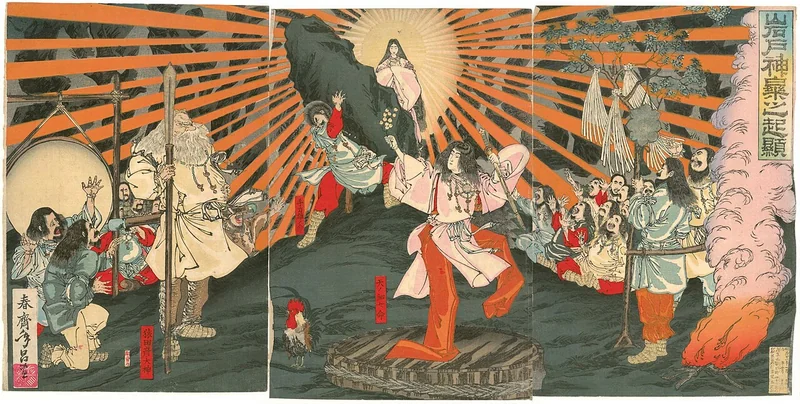
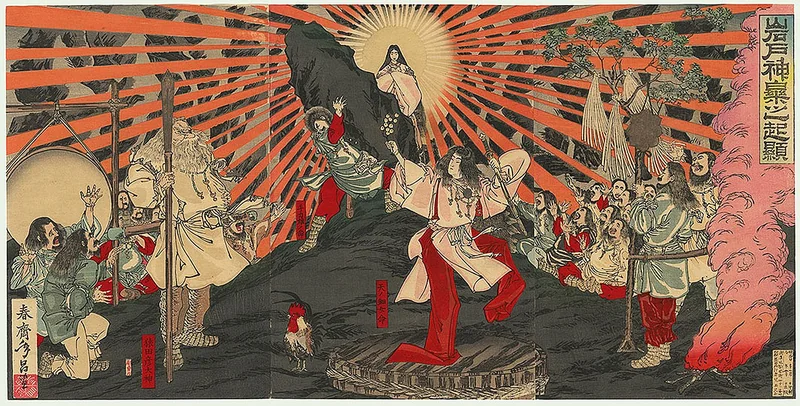
Ame-no-Uzume-no-Mikoto (天宇受売命, 'Heavenly Alarming Female Deity' or 'Heavenly Graceful Female Deity') is the goddess of dawn, revelry, and the arts in Japanese mythology. Her most famous myth is the kagura dance she performed outside the heavenly rock cave (Ama-no-Iwato) where Amaterasu had hidden, plunging the world into darkness. Ame-no-Uzume's ecstatic, comic, and semi-erotic dance provoked hysterical laughter among the eight million kami assembled outside, and it was this inexplicable merriment that lured Amaterasu to open the cave door. She also courageously confronted the menacing deity Sarutahiko when he blocked the passage between heaven and earth. She is considered the ancestor of the sarume, a guild of female performers who conducted rituals at the imperial court. Described in the Kojiki (712 CE, trans. Chamberlain 1882) Book I, sections 16–17.
Quick facts
- Pantheon
- Japanese
- Figure type
- God
- Period
- Recorded in the Kojiki (712 CE) and Nihon Shoki (720 CE)
- Primary sources
- Kojiki (712 CE), trans. Chamberlain 1882: Book I, sections 16–17; Nihon Shoki (720 CE), trans. Aston 1896: Vol. I, pp. 44–50
- Related figures
- amaterasu, susanoo, sarutahiko, takamagahara
The dance before the cave
The Kojiki (Book I, sections 16–17, trans. Chamberlain 1882) describes the crisis of Amaterasu's withdrawal into the rock cave in vivid terms. The eight million deities assembled before the cave and tried various measures. Ame-no-Uzume then climbed onto an upturned tub, partially bared her body, and performed a wild dance — the Kojiki describes her as 'Divine Intoxication' and the dance as comic, loud, and sexually suggestive. The gathered deities burst into uncontrollable laughter. The Nihon Shoki (trans. Aston 1896: Vol. I, pp. 44–47) specifies that she 'skillfully mimicked' things; she may have been performing a ritual mime of divine possession. It was the incongruity of eight million gods laughing at a time of cosmic darkness that prompted Amaterasu to peek out — and the strong arm of Ame-no-Tajikarao pulled the door fully open. Ame-no-Uzume's dance is considered the mythological origin of kagura, the sacred dance still performed at Shinto shrines.
Confrontation with Sarutahiko
When the heavenly deity Ninigi (Amaterasu's grandson) descended to rule the earthly realm, a powerful and menacing deity with a blazing nose and back lit up both sea and land — Sarutahiko-no-Ōkami — was blocking the crossing between heaven and earth (Kojiki Book II, section 33, trans. Chamberlain 1882). All the heavenly deities were afraid to approach him. Ame-no-Uzume alone stepped forward, bared her breasts, and pushed the skirt of her garment down around her hips, then calmly asked Sarutahiko who he was and what he wanted. He announced he had come to guide Ninigi's descent. Ame-no-Uzume thus resolved the situation alone through boldness rather than force. She later married Sarutahiko. This episode reinforces her identity as a deity of courage, performance, and the power to mediate between dangerous forces.
Sources & further reading (2)
- primary-source — accessed 2026-05-06
- encyclopedia — accessed 2026-05-06
Frequently asked questions
What is kagura and how does it relate to Ame-no-Uzume?
Kagura (神楽, 'music and entertainment for the kami') is a genre of sacred Shinto dance and music performed at shrines. The Kojiki's account of Ame-no-Uzume's dance before the heavenly rock cave (Book I, sections 16–17, trans. Chamberlain 1882) is considered the mythological origin of kagura. The performance by Ame-no-Uzume — involving ecstatic movement, partial undress, divine possession, and a ritual comedy that made the gods laugh and restored light to the world — models the basic structure of kagura as a performance that communicates with and influences the kami. Different regional kagura traditions (Mi-kagura at the imperial court, Satokagura in villages) share Ame-no-Uzume's myth as a founding narrative.
Who are the sarume and how are they connected to Ame-no-Uzume?
The sarume (猿女) are a guild of female ritual performers who served at the Japanese imperial court and are mentioned in the Nihon Shoki (trans. Aston 1896: Vol. I, pp. 49–50). The word sarume contains 'saru' ('monkey' or 'away'), and their guild was founded by the descendants of Ame-no-Uzume. The Kojiki (Book II, section 37, trans. Chamberlain 1882) records that Ame-no-Uzume, after marrying Sarutahiko, took the name Saruta, and that the women in her service became the sarume guild, who performed ritual dances and prayers on behalf of the imperial court. They represent an early institutionalisation of Ame-no-Uzume's mythic role as the deity of performance, mediation, and communication with the divine.