God
Amaterasu
The great goddess of the sun in Japanese mythology, ruler of the heavens.
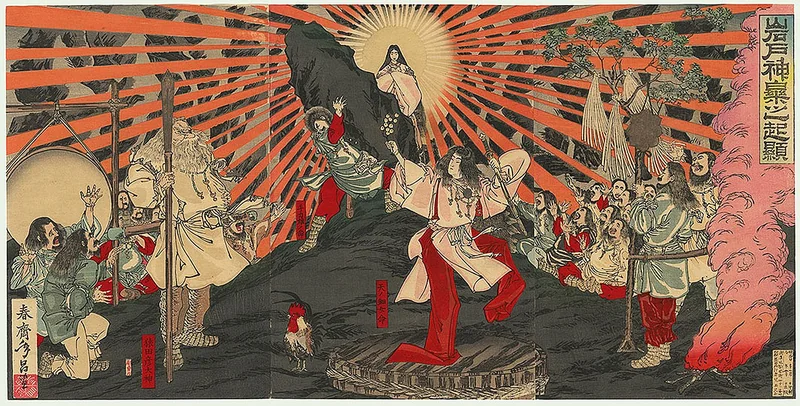
Amaterasu-Ōmikami (天照大御神, 'Great Divinity Illuminating Heaven') is the goddess of the sun and ruler of Takamagahara (the Plain of High Heaven) in Japanese mythology. She was born from the left eye of Izanagi when he purified himself after his return from Yomi, the underworld. Amaterasu is the supreme deity of the Shinto tradition and the divine ancestor of the Japanese imperial family. Her most famous myth is the retreat into the Ama-no-Iwato (Heavenly Rock Cave), plunging the world into darkness, and the subsequent festival to lure her out. She sent her grandson Ninigi to rule Japan. Her sacred symbols are the mirror Yata no Kagami and the sword Kusanagi. Described in the Kojiki (712 CE) and Nihon Shoki (720 CE).
Quick facts
- Pantheon
- Japanese
- Figure type
- God
- Period
- Recorded in the Kojiki (712 CE) and Nihon Shoki (720 CE); tradition considerably older
- Primary sources
- Kojiki (712 CE), trans. Chamberlain 1882: Book I, sections 4–17; Nihon Shoki (720 CE), trans. Aston 1896: Vol. I, pp. 15–40
- Related figures
- susanoo, tsukuyomi, izanagi, izanami, takamagahara
Birth and dominion
The Kojiki (Book I, section 4–5, trans. Chamberlain 1882) describes Amaterasu's birth as part of the purification ritual of Izanagi after he returned from the land of the dead. Izanagi washed his left eye, and Amaterasu was born; from his right eye came Tsukuyomi (the moon god); from his nose came Susanoo (the storm god). Izanagi assigned Amaterasu to rule the Plain of High Heaven (Takamagahara), Tsukuyomi the realms of the night, and Susanoo the seas. Amaterasu became the supreme deity of the Shinto pantheon, and her lineage — through her grandson Ninigi — is the mythological foundation of the Japanese imperial family's claimed divine descent.
Cave withdrawal and return
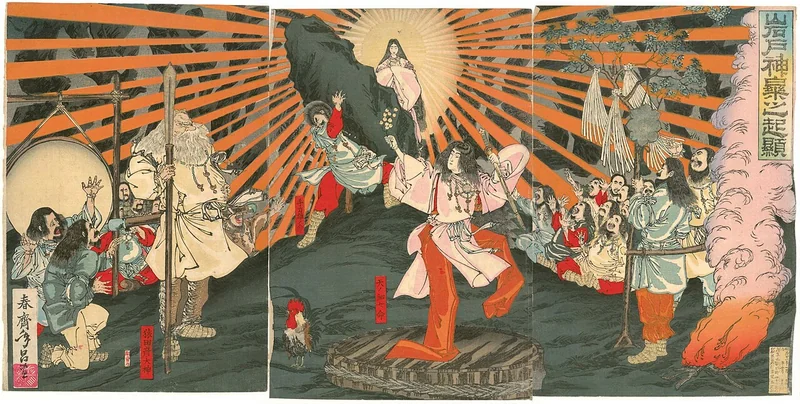
The Kojiki (Book I, sections 16–17, trans. Chamberlain 1882) and Nihon Shoki (trans. Aston 1896: Vol. I, pp. 40–48) describe Susanoo's rampage in Takamagahara: he wailed, destroyed rice paddies, and behaved so violently that Amaterasu hid in the Ama-no-Iwato ('Heavenly Rock Cave'). The world fell into darkness and evil spirits flourished. The eight million kami assembled outside the cave. The goddess Ame-no-Uzume performed a wild, comic dance that caused great uproarious laughter among the assembled gods. Curious about the source of the noise, Amaterasu opened the cave door a crack; the god Ame-no-Tajikarao pulled it fully open. Light was restored to the world. The myth explains both solar eclipses (metaphorically) and the role of ritual festivity in renewing divine presence.
Sources & further reading (2)
- primary-source — accessed 2026-05-06
- encyclopedia — accessed 2026-05-06
Frequently asked questions
What are Amaterasu's sacred symbols?
Amaterasu is associated with three sacred objects that form Japan's imperial regalia (the Sanshu no Jingi). The mirror Yata no Kagami ('Eight-Hand Mirror') was made by the gods to lure Amaterasu from the rock cave and was given to her grandson Ninigi when he descended to rule Japan (Kojiki Book II, section 33, trans. Chamberlain). The sword Kusanagi-no-Tsurugi ('Grass-Cutting Sword') was found by Susanoo inside the Yamata no Orochi serpent and given to Amaterasu. The jewel Yasakani no Magatama ('Curved Jewel of Sasakani') was strung as a necklace. These three objects — mirror, sword, jewel — are traditionally held by the Japanese imperial household as symbols of divine legitimacy.
Why is Amaterasu important to Shinto?
Amaterasu occupies the highest position in the classical Shinto pantheon as the ruler of Takamagahara (the heavenly realm) and the divine ancestor of the Japanese imperial line. The Kojiki (712 CE) and Nihon Shoki (720 CE), both compiled under imperial sponsorship, present Amaterasu's descendant Ninigi as the ancestor of the first emperor Jimmu, making her the founding deity of Japan's political and religious order. The Grand Shrine of Ise (Ise Jingū) in Mie Prefecture is dedicated to Amaterasu and is considered the most sacred site in Shinto. The inner shrine (Naikū) houses the Yata no Kagami, the sacred mirror, as Amaterasu's shintai (divine body).