God
Fūjin
The Japanese god of wind, depicted carrying the winds in a great bag over his shoulders.
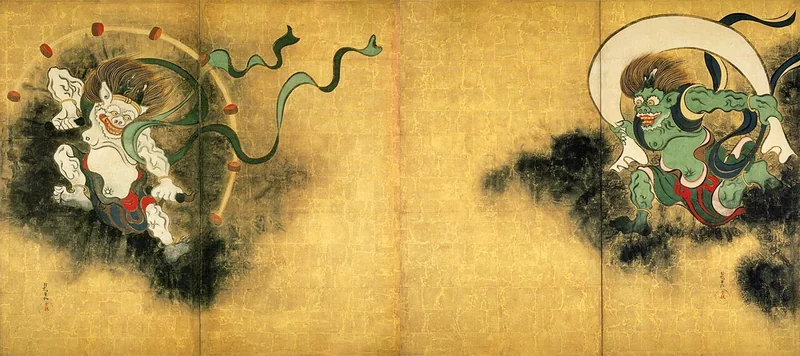
Fūjin (風神, 'Wind God') is the deity of wind in Japanese mythology, one of the oldest kami in the Shinto tradition. He is depicted as a fearsome, wild-haired demon-like figure dressed in a leopard skin, carrying a large bag (wind bag) over his shoulders from which he releases the winds. Fūjin typically appears paired with Raijin (the thunder and lightning deity), and the two are often depicted together in temples and artwork. The pair were originally malevolent forces subdued and enlisted by the Buddha (in syncretic Buddhism-Shinto tradition) to protect the faithful. Their famous paired statues appear in the Sanjūsangen-dō temple in Kyoto (1254 CE reconstruction) and the Fūjin-Raijin-zu screens attributed to Tawaraya Sōtatsu (c. 1600 CE). Mentioned as an atmospheric deity in the Kojiki (712 CE) and Nihon Shoki (720 CE).
Quick facts
- Pantheon
- Japanese
- Figure type
- God
- Period
- Attested as a Shinto deity in the Kojiki (712 CE); paired Fujin-Raijin iconography developed in medieval period
- Primary sources
- Kojiki (712 CE), trans. Chamberlain 1882: Shinatsuhiko (wind deity) references; Nihon Shoki (720 CE), trans. Aston 1896: Vol. I, p. 22 (wind deity Shina-tsu-hiko)
- Related figures
- raijin, susanoo, izanagi, izanami
Origin and iconography
In the Kojiki (Book I, section 6, trans. Chamberlain 1882) and Nihon Shoki (trans. Aston 1896: Vol. I, p. 22), the wind deity is named Shina-tsu-hiko ('Lord of Exhalation') and was born from the breath of Izanagi and Izanami to disperse the mists that covered the land. This early wind deity was associated with the beneficial clearing power of the wind. By the Nara period (710–794 CE), under the influence of continental Buddhist iconography imported from China and India (which included wind-deity figures based on the Hindu Vayu), the wind deity took on the fierce demon-like appearance familiar today: dark green skin, wild hair, a leopard-skin loincloth, and the enormous bag of winds held over the head. The 'bag of winds' image has roots in both Hindu Vayu iconography and Greek mythological depictions of Aeolus, transmitted across the Silk Road.
Fujin and Raijin as guardian deities
In Shinto-Buddhist syncretic tradition, Fūjin and Raijin are frequently paired as temple guardians (niō or deva-kings) who protect sacred spaces and the Buddhist teachings from malevolent forces. The famous wooden statues at Sanjūsangen-dō (Kyoto) date from 1254 CE and depict Fūjin in green and Raijin in red (or vice versa in some traditions), flanking the thousand Kannon statues within the hall. The even more celebrated folding screen painting attributed to Tawaraya Sōtatsu (c. 1600 CE, Kennin-ji temple, Kyoto) — later copied by Ogata Kōrin — depicts the two deities in a dynamic, playful composition that became one of the most recognisable images in Japanese art. The pair represents the terrifying but ultimately controllable forces of nature.
Sources & further reading (2)
- primary-source — accessed 2026-05-06
- encyclopedia — accessed 2026-05-06
Frequently asked questions
What is Fūjin's wind bag and how does it work?
Fūjin's most distinctive iconographic attribute is the large cloth bag (kaze-bukuro, 'wind bag') that he carries over his shoulders or holds above his head. The bag contains the winds of the four directions and all the winds of the world. When he opens the bag, winds are released. This image appears fully developed in the Nara period (710–794 CE) Buddhist-Shinto iconography and may derive from the Indian deity Vayu (wind god) via Chinese Buddhist art. The motif of a wind-keeper carrying the winds in a bag is also found in Greek mythology (Aeolus keeping the winds in a bag, given to Odysseus in Homer's Odyssey) and in various Central Asian traditions, suggesting a shared conceptual archetype across Eurasia transmitted through the Silk Road.
Are Fūjin and Raijin native Japanese deities or imports?
The underlying Japanese kami of wind (Shina-tsu-hiko) and thunder/lightning (Takemikazuchi, Raijin) are attested in the Kojiki (712 CE, trans. Chamberlain 1882) and Nihon Shoki (720 CE, trans. Aston 1896), making them genuinely indigenous Shinto deities. However, the specific paired iconography of Fūjin and Raijin as we know it — the fierce demon appearance, the wind bag, the drum circle — developed under the influence of continental Buddhist art traditions from China, which in turn drew on Indian Hindu iconography of Vayu and Indra/Parjanya. The paired guardian roles also follow the Buddhist dvārapāla (gate guardian) tradition. Japan's Fūjin-Raijin thus represent a synthesis of native kami concepts with imported Buddhist iconographic conventions.