Monster
Yamata no Orochi
The monstrous eight-headed serpent of Japanese mythology, slain by Susanoo with poisoned sake.
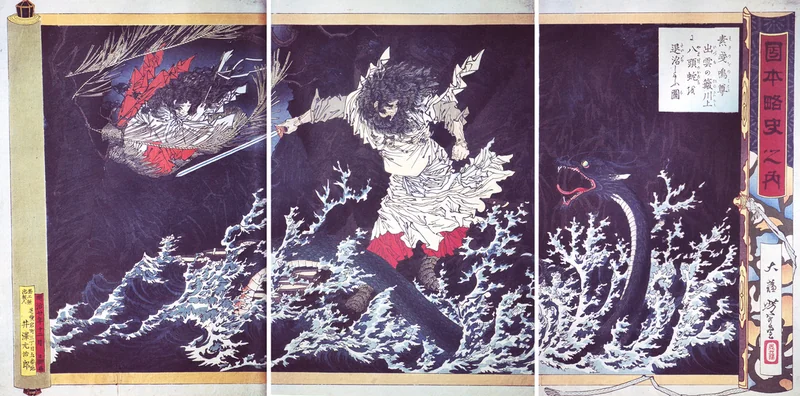
Yamata no Orochi (八岐大蛇, 'Eight-Forked Serpent') is the great eight-headed, eight-tailed serpent of Japanese mythology. Its body was so immense that it stretched across eight valleys and eight mountains; moss and trees grew on its back; its belly was constantly blood-red. Every year it demanded one daughter of the elder couple Ashinazuchi and Tenazuchi, and had already consumed seven daughters when Susanoo arrived. Susanoo tricked the serpent into drinking poisoned sake from eight vats, then slew it as it slept. In the middle tail he found the sword Kusanagi-no-Tsurugi ('Grass-Cutting Sword'), which became one of Japan's three imperial regalia. Described in the Kojiki (712 CE, trans. Chamberlain 1882) Book I, sections 18–19, and Nihon Shoki (720 CE, trans. Aston 1896).
Quick facts
- Pantheon
- Japanese
- Figure type
- Monster
- Period
- Recorded in the Kojiki (712 CE) and Nihon Shoki (720 CE)
- Primary sources
- Kojiki (712 CE), trans. Chamberlain 1882: Book I, sections 18–19; Nihon Shoki (720 CE), trans. Aston 1896: Vol. I, pp. 52–58
- Related figures
- susanoo, amaterasu, kushinadahime
Encounter and defeat
The Kojiki (Book I, sections 18–19, trans. Chamberlain 1882) gives the most detailed account. Susanoo, cast out of heaven, arrived in Izumo Province at the headwaters of the Hi River and found an elderly couple, Ashinazuchi ('Foot-Stroking Elder') and Tenazuchi ('Hand-Stroking Elder'), weeping. Their eight daughters had been eaten by the serpent; only Kushinadahime remained. Susanoo transformed Kushinadahime into a comb, placed her safely in his hair, then had the couple brew sake eight times over (a potent fermentation) and fill eight vats. He also built a fence with eight gates, placing a vat under each gate. When the serpent arrived, each of its eight heads drank from one vat and fell asleep. Susanoo then drew his sword Totsuka-no-Tsurugi and cut the serpent to pieces. When he reached the middle tail, his sword chipped against something inside — he found an extraordinary sword within the tail, which he presented to Amaterasu. This sword became Kusanagi-no-Tsurugi.
Symbol and interpretation
The Yamata no Orochi myth has been interpreted by Japanese scholars in several ways. One traditional reading identifies the Orochi with the Hi River itself — a dangerous, flooding serpentine river — and the annual human sacrifices with the agricultural community's struggle with annual floods. Susanoo as a storm deity controlling the flood waters fits this reading. The sake trap mirrors an agricultural ritual of offering to the river deity. The Kusanagi sword found inside the serpent connects the myth to the origin of Japan's imperial regalia and to the Izumo region's political history. The Nihon Shoki (trans. Aston 1896: Vol. I, pp. 54–56) gives a somewhat different account in which the snake is described in more explicitly naturalistic terms.
Sources & further reading (2)
- primary-source — accessed 2026-05-06
- encyclopedia — accessed 2026-05-06
Frequently asked questions
What is the significance of Kusanagi being found inside Yamata no Orochi?
The Kojiki (Book I, section 19, trans. Chamberlain 1882) records that Susanoo found the extraordinary sword Kusanagi-no-Tsurugi inside the middle tail of Yamata no Orochi, suggesting the serpent had swallowed it or the sword was supernaturally embedded there. Susanoo, recognising its divine quality, gave it to Amaterasu. The sword later entered the possession of the hero Yamato Takeru, who used it to cut surrounding grass when enemies set fire to a field he was trapped in (Kojiki Book II, trans. Chamberlain 1882). Kusanagi is one of Japan's three imperial regalia (Sanshu no Jingi), traditionally enshrined at Atsuta Shrine in Nagoya — connecting the slaying of a primordial monster directly to the physical objects legitimising Japan's imperial authority.
How large was Yamata no Orochi?
The Kojiki (Book I, section 18, trans. Chamberlain 1882) describes Yamata no Orochi in precise cosmic terms: it had eight heads and eight tails; its eyes were red like the winter-cherry; it had a belly that was perpetually blood-red and inflamed; its body stretched across eight valleys and eight peaks; and pine trees and moss grew on its back. The Nihon Shoki (trans. Aston 1896: Vol. I, p. 53) adds that it measured about thirty fathoms in length with a red belly. These descriptions mark it as a creature of cosmic scale rather than a natural animal — a landscape-filling monster whose dimensions reflect the scale of the rivers and mountains it represents. The eight heads and eight tails (yatsu-mata, 'eight forks') give the serpent its name.