Hero
Urashima Tarō
The fisherman who visited the Dragon Palace under the sea and returned to find centuries had passed.
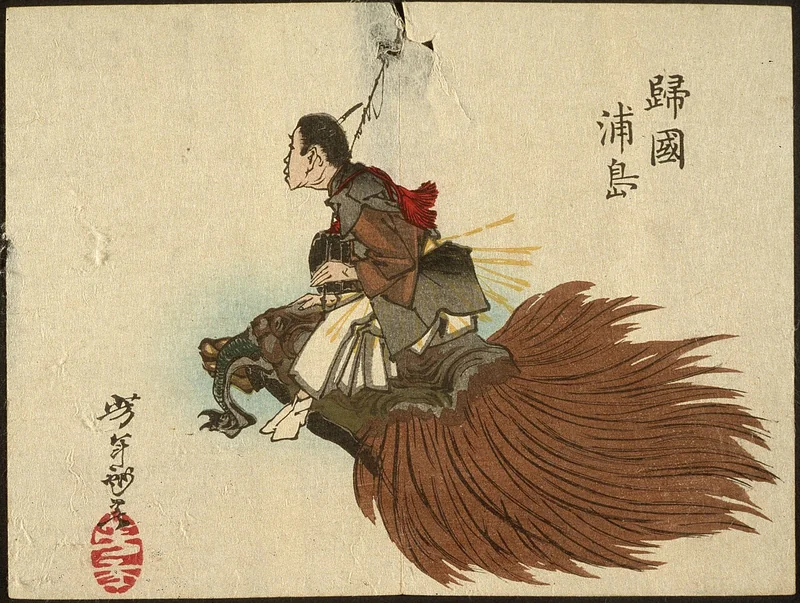
Urashima Tarō (浦島太郎) is the hero of one of Japan's most celebrated folk tales, concerning a fisherman who rescued a sea turtle, was taken to Ryūgū-jō (the Dragon Palace under the sea) as a reward, and spent what seemed like three days there — returning home to find that three hundred years had passed on earth. The story features Otohime (the princess of the sea) who gave him a lacquered box (tamatebako) with the instruction never to open it. When Urashima did eventually open the box, smoke emerged and he instantly aged and died (or turned to dust). The oldest written version appears in the Man'yōshū poetry anthology (c. 759 CE, poems 1740–1741) and the Tango no Kuni Fudoki (c. 8th century CE). A prose version appears in the Nihon Shoki (720 CE, trans. Aston 1896).
Quick facts
- Pantheon
- Japanese
- Figure type
- Hero
- Period
- Oldest version in Man'yōshū (c. 759 CE) and Nihon Shoki (720 CE); oral tradition older
- Primary sources
- Man'yōshū (c. 759 CE), poems 1740–1741; Nihon Shoki (720 CE), trans. Aston 1896: supplement; Tango no Kuni Fudoki (c. 8th century CE)
- Related figures
- ryujin, otohime, amaterasu
The visit to Ryūgū-jō
The Man'yōshū version (poems 1740–1741, c. 759 CE) is the earliest written form. The poet Takahashi no Mushimaro narrates the story in verse: a fisherman from Mizunoe named Urashima went out fishing and caught a giant turtle; he released it back to the sea. It transformed into a beautiful woman (Otohime) who invited him to the land of the immortals (tokoyo no kuni — the eternal land). He followed her under the sea, entered a great palace, and was feasted and celebrated. Three years passed in apparent happiness. He grew homesick and asked to return. Otohime gave him a lacquered box (tamatebako) and warned him not to open it if he ever wished to return. He found his village; his family and friends were all dead and the village transformed. He opened the box; white smoke emerged and he became an old man and died. The Tango no Kuni Fudoki version gives his name as Urashimako and includes more domestic detail.
The tamatebako and time
The lacquered box (tamatebako, 'jewel-hand-box') is the tale's central enigma. What does it contain? In the Man'yōshū version, white smoke or vapour (shirakumo, white cloud) emerges when opened, and Urashima immediately ages. The Tango no Kuni Fudoki gives a more elaborate account: the vapour contains his 'allotted years' — the three hundred years of mortality that had been suspended while he was in the eternal realm. Opening the box releases them all at once. The box thus functions as a vessel of time — specifically, of the time that cannot be recovered or reversed once passed. The motif of a contained, forbidden time that leaks out catastrophically when opened appears in world folklore (Pandora's box in Greek mythology is a structural parallel), reflecting a widespread conceptual archetype.
Sources & further reading (2)
- primary-source — accessed 2026-05-06
- encyclopedia — accessed 2026-05-06
Frequently asked questions
What is tokoyo no kuni (the Eternal Land) in Japanese mythology?
Tokoyo no kuni (常世の国, 'Land of Eternity' or 'Eternal Land') is a concept in Japanese mythology of a land beyond the sea where time does not pass, disease and death are unknown, and the living may dwell among the immortals. It appears in both the Kojiki (712 CE, trans. Chamberlain 1882) and the Nihon Shoki (720 CE, trans. Aston 1896) as a place reached by sailing westward across the sea. Scholars have connected it to continental Chinese concepts of Penglai (the immortal islands) and to the broader East Asian tradition of paradisal islands in the western ocean. In the Urashima Tarō tale, tokoyo no kuni is identified with Ryūgū-jō (the Dragon Palace), fusing the eternal-land concept with the sea-dragon palace mythology. The Tango no Kuni Fudoki version uses tokoyo no kuni explicitly.
Is the Urashima Tarō story similar to any Western myths?
The Urashima Tarō tale shares the structural pattern of 'time passing differently in the otherworld' with several Western traditions. The most direct parallel is the Celtic fairy-mound motif: in Irish and Welsh folklore, a mortal who visits the otherworld (Tír na nÓg or Annwn) for what seems like days or years finds centuries have passed on return. The Christian tradition of the Seven Sleepers of Ephesus, Rip Van Winkle (Washington Irving, 1819), and various 'enchanted time' folk-tales across Europe share the core structure. The specific mechanism in Urashima Tarō — a forbidden box that, when opened, releases suspended time and causes instant aging — is structurally analogous to Pandora's jar (pithos) in Greek mythology (Hesiod, Works and Days 94–105, c. 700 BCE), where a sealed vessel is opened against instructions, releasing its contents into the world with irreversible consequences.