Hero
Ungnyeo
The bear-woman of Korean mythology, transformed through endurance, mother of the first Korean king.
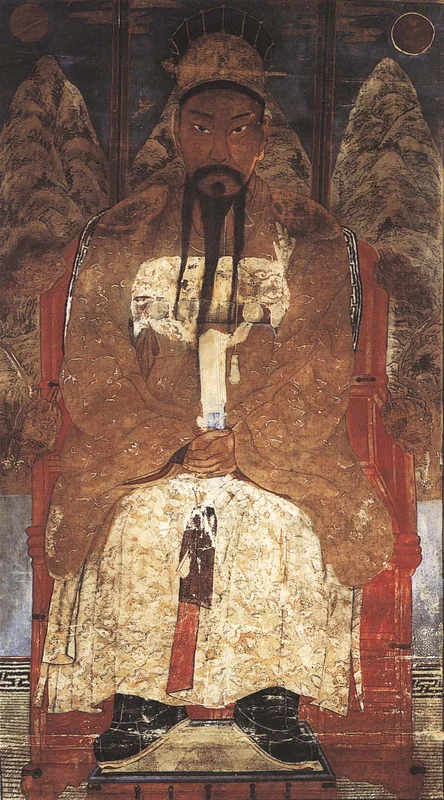
Ungnyeo (웅녀, 熊女, 'Bear Woman') is a central figure of Korean founding mythology — the mother of Dangun, Korea's legendary first king. In the Samguk Yusa (1281 CE), a bear and a tiger living near Hwanwoong's sacred city prayed to become human. Hwanwoong gave them a bundle of mugwort and twenty cloves of garlic, commanding them to stay in a cave for one hundred days without sunlight. The tiger failed after twenty-one days and left; the bear endured the full period and was transformed into a woman. This woman — Ungnyeo — prayed under the sandalwood tree for a child. Hwanwoong took human form and married her; their son was Dangun Wanggeom, the founder of Gojoseon. Ungnyeo thus represents the indigenous people who achieved full membership in Hwanwoong's civilised order through endurance, self-discipline, and faith.
Quick facts
- Pantheon
- Korean
- Figure type
- Hero
- Period
- Recorded in the Samguk Yusa (1281 CE); traditional date in Dangun myth: approximately 2333 BCE
- Primary sources
- Samguk Yusa (1281 CE), Book 1: 'Gojoseon' section, by Iryeon
- Related figures
- hwanwoong, hwanin, dangun
The trial of the cave
The Samguk Yusa (1281 CE, Book 1) narrates that a bear and a tiger living in the same cave near Hwanwoong's city of Sinsi earnestly prayed to Hwanwoong to be granted human form. He gave them a bundle of mugwort (쑥, ssuk) and twenty cloves of garlic, with instructions to eat only these and to avoid sunlight for one hundred days. The tiger left the cave after twenty-one days, unable to endure. The bear remained for twenty-one days (some versions say thirty-seven, others one hundred) and was transformed into a woman (ung-nyeo, 'bear-woman'). The trial's specific ingredients — mugwort and garlic — are both plants with shamanic and medicinal significance in Korean culture; garlic in particular has protective properties against malevolent spirits. The avoidance of sunlight mirrors shamanic initiation periods of isolation and darkness.
Mother of Dangun
After her transformation, Ungnyeo had no husband and prayed under the sandalwood tree for a child (Samguk Yusa 1281 CE). Hwanwoong temporarily assumed human form (hwawa) and took her as his wife; she became pregnant and bore Dangun Wanggeom. Ungnyeo's role as the mother of Korea's founding figure through the combination of divine father (Hwanwoong) and transformed earthly mother (Ungnyeo) parallels other hero-birth myths where an exceptional human or semi-divine woman is impregnated by a heavenly deity. The bear as totemic ancestor — Ungnyeo as the transformed bear — makes the Korean people, through Dangun, descended from both heaven (Hwanwoong/Hwanin) and the earth's primal creature (the bear). This dual ancestry reflects the mediation of the earthly and heavenly that characterises Korean founding mythology.
Sources & further reading (2)
- encyclopedia — accessed 2026-05-06
- primary-source — accessed 2026-05-06
Frequently asked questions
Why does the bear succeed and the tiger fail in the Dangun myth?
The Samguk Yusa (1281 CE) does not explicitly state why the bear succeeds and the tiger fails, beyond saying the tiger 'was not able to observe the taboo' and left the cave before the trial was complete. Korean scholars have proposed various interpretations. One reading sees the bear and tiger as representing different tribal groups in ancient Korea: the bear-totem tribe that successfully assimilated into the Hwanwoong-led civilised order, and the tiger-totem tribe that could not be integrated. Another reading emphasises character: the bear's patience and endurance versus the tiger's impatience and self-will — the trial selects for the civic virtues of perseverance and submission to higher authority. The bear is a significant totemic animal across Siberian and northeastern Asian cultures, making the bear-woman as mother of the first Korean king a statement about indigenous cultural identity.
Is Ungnyeo worshipped in any Korean religious tradition?
Ungnyeo is not typically the object of independent ritual veneration in surviving Korean religious practice, but she is honoured implicitly as the mother of Dangun in the broader Dangun cult. In the Cheondogyo religious movement (a Korean syncretic religion founded in the 19th century CE), Dangun is venerated as a divine founder, and by extension his mother Ungnyeo receives recognition. In Korean shamanic (musok) tradition, bear-spirit worship has been documented in some regional practices, particularly in the northern regions near Mount Baekdu — areas with closer cultural ties to Siberian shamanic traditions. The annual Gaecheonjeol (National Foundation Day, October 3rd in South Korea) honouring Dangun implicitly honours the founding genealogy that includes Ungnyeo.